
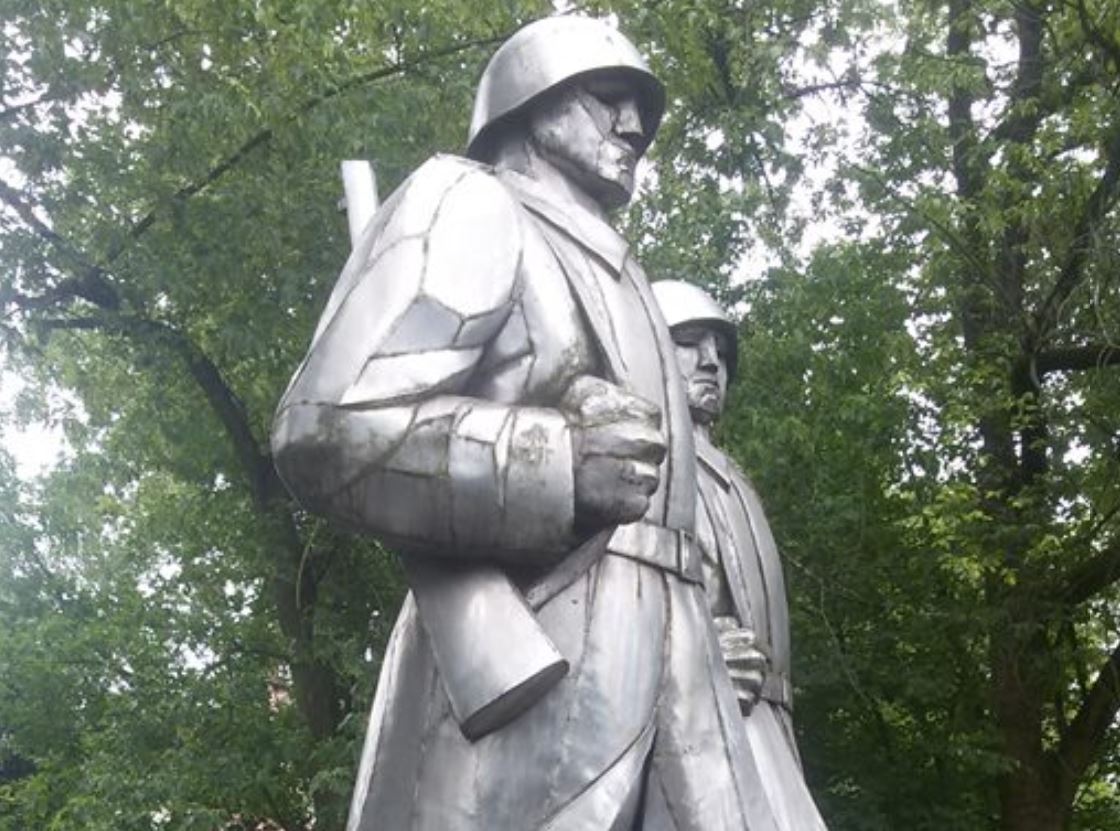
The so-called "liberation" of Poland, the Baltic states and Czechoslovakia from the German occupation in the years of 1944-1945 by the Red Army in the rhetoric of the present authorities of the Russian Federation is one of the fundamental assumptions of the myth of the "Great Patriotic War". In the light of the Russian version of these events, at the price of the blood of millions of Soviet soldiers, it was possible to liberate many European nations, including the Polish nation, from the yoke of fascism. So what was this "liberation" like in the light of the available state of knowledge?
With relation to the entry of the Red Army into the pre-war eastern provinces, since January 1944, the Home Army started fighting with the retreating Germans as part of the "Storm" Operation. The aim of the Poles' action was a military attack on the Germans, a demonstration of the power of the Polish underground resistance movement and its appearance to the invading Soviets as hosts of those lands. The fighting covered vast areas of Volhynia, Vilnius and Nowogrodek regions, and part of Eastern Galicia, and ended with the capture of Vilnius and Lviv by the Home Army units and the Soviet troops. The established military cooperation with the Red Army quickly gave way to the appearance of the NKVD Forces and other security formations of the USSR, whose task was to work out and liquidate the underground resistance movement. The fate of the Home Army units was doomed - they were surrounded and disarmed, and most of the commanders and soldiers were arrested or forced to join General Berling's army. From the first days after the occupation of the Borderlands, it became clear that they would be forcibly re-incorporated into the Soviet Union.
After the tragedy of the Polish Underground State in the Eastern Territories of the Second Polish Republic, a fact that left no doubt as to the further Soviet intentions was the attitude of the Red Army command during the Warsaw Uprising. These events took place in front of the Soviet armies, which stopped in the section of Warsaw on the line of the Vistula River. At the same time, the installation of a puppet communist quasi-government, pompously named the Polish Committee of National Liberation, was established by order of Joseph Stalin. Parallel to these activities, the process of destroying the surviving elites of the Second Polish Republic was progressing. NKVD, NKGB and SMERSZ, together with the UB (Polish secret police under Communism), carried out mass arrests, the victims of which were (along with Nazi collaborators and war criminals) heroes of the underground struggle from the period of the German occupation, as well as prominent social and political activists. The largest of the "cleansing" operations was carried out in the Augustów area, and its result was the capture and murder of about six hundred people. At the same time, there was a ruthless fight with the armed underground units and the youth underground movement. Counting on the outbreak of another war, this time between the Soviets and Western powers, thousands of people, mostly young, decided to continue their armed and conspiratorial resistance, recognizing that after the outbreak of the conflict it would be possible to rebuild a free, democratic state that would respect human rights and human dignity. Individual units kept fighting until the end of the 1940s, and single partisans continued the fight for still a dozen or so years. Apart from the "home" security apparatus, the NKVD troops were once again used to fight the underground resistance movement.
The Red Army "liberated" the territories of central Poland from German occupation, which saved tens of thousands, and perhaps millions of Polish citizens, who would have been killed by the Germans during the implementation of the General "East" Plan. However, this was only one side of the coin. The point is that despite the victory of the Allies over the Third Reich, the Soviet "liberation" was in fact a new form of Poland's submission, and an extension of the sphere of influence of the communist empire far to the West. A wave of crimes and rapes committed by the Red Army soldiers swept across Poland. A detailed estimation of the scale of these crimes is virtually impossible. In view of the weakness of the Polish communists and aversion or even hostility towards them of a significant part of the society, it was the Red Army that guaranteed the introduction of a communist system in Poland with a full terror apparatus modelled on the Soviet one.
For Poles, the Red Army was not a liberating army, bringing freedom and ensuring - as it happened, for example, in the case of the actions of the Allied armies on the Western front - the reconstruction of democratic, independent states, guaranteeing their citizens freedom and human dignity. Unfortunately, despite having suffered a huge and unquestionable blood tribute during the battles with the Wehrmacht in Poland, it was a tool of enslavement of Poland and Central and Eastern Europe, ruthlessly used by the top leadership of the Soviet Union. The sacrifice of hundreds of thousands of soldiers killed on the battlefields became another material for the totalitarian power to use in its expansion into the continent.
Communist Poland was in the zone of Soviet influence with all the negative consequences resulting from this fact. All foundations for the normal organization of social, political and economic life were destroyed. The elections were a staged farce, private trade was abolished, and culture, science and art were fully brought under Communist party control and reduced to a caricature. By the end of the 1940s, the process of destroying the manifestations of the smallest independence of society from the authorities had ended. The Polish Army was also fully indoctrinated. Poland, "People's" in name only, ruled by communists from Moscow, was constantly "watched over" by the services of the Soviet power, first in the form of numerous "advisers" and military commanders, often transferred directly from the Red Army. Military units locked in garrisons watched over the interests of the Soviet Union by the Vistula River and guaranteed the obedience of the Polish executors of Moscow's will. During social and liberation uprisings in 1956 in Poznań and during the "Solidarity carnival" in 1980, Poland was threatened with further military interventions by the Soviet Army.
The last units of the Soviet Army left the territory of Poland only on September 17, 1993, i.e. 54 years after the aggression in 1939. After decades of rule of the violently imposed communist system, Poland was a poor country, with a destroyed economy, with a society tired of numerous pathologies of "socialism with a human face". The effects of this tragic period in the history of Poland are still felt today. Despite this, state bodies, such as the Council for the Protection of Struggle and Martyrdom Sites, and local government structures (voivodeship offices) systematically took care of the burial sites of Soviet soldiers who died in battles with the German occupying forces.
The issue of the 'liberation' of Central and Eastern Europe is currently one of the tools most often used by the Russian propaganda in the conduct of the Russian Federation's historical policy for domestic and foreign use. The Russian propaganda is trying to impose - with varying results - the "export" myth of the "Great Patriotic War" also on other European nations whose territories were occupied by the Red Army in the final stage of World War II and who were subjected to communist rule - in various forms and at different times.
From this perspective, the attempts by the Russian Federation to influence the governments of European countries appear as a defence of the dictatorship of the Soviet vision of history, inscribed in the public space of these countries during the communist rule. The remaining memorials devoted to the Red Army - monuments of "gratitude" - are therefore associated with the consolidation, in the space of democratic European countries, of the glorification of the criminal totalitarian system that led to the death of tens of millions of people and, on the threshold of World War II, closely cooperated with Nazi Germany and was responsible for the outbreak of the greatest so far and the most tragic in consequences armed conflict in the history of mankind. Permission to keep monuments of "gratitude" - transmitters of the communist and totalitarian version of history, therefore, will constitute the consent of the sovereign Polish authorities to leave the false version of the past, created solely for the purpose of perpetuating the "soft power" of the Soviet empire, and now - the Russian Federation, which continues this kind of approach to history. For this reason, the monuments of gratitude should be removed from the territory of the Republic of Poland once and for all. At the same time, it does not contradict keeping and taking due care of cemeteries, sections and individual graves of Red Army soldiers who died during hostilities.
Damian Karol Markowski, Ph.D.
Selected bibliography:
Ackermann Felix, Palimpsest Grodno. Nationalisierung, Nivellierung und Sowjetisierung einer mitteleuropäischen Stadt 1919-1989, Wiesbaden 2010
Adriányi Gabriel, Geschichte der Kirche Osteuropas im 20. Jahrhundert,
Paderborn-München-Wien-Zürich 1992
Amar Tarik Cyril, The Paradox of Ukrainian L’viv. A Borderland City between Stalinists, Nazis and Nationalists, New York 2015
Applebaum Anne, Iron Curtain. The Crushing of Eastern Europe 1944-1956, London 2012
Armia Czerwona/Radziecka w Polsce w latach 1944-1993: studia i szkice, ed. Krzysztof Filip and Mirosław Golon, Borne Sulinowo 2014
Brooks Jeffrey, Thank you, comrade Stalin! Soviet Public Culture from Revolution to Cold War, Princeton 2000
Ciesielski Stanisław, Hryciuk Grzegorz, Srebrakowski Aleksander, Masowe deportacje ludności w Związku Radzieckim, Toruń 2004
Czarnecka Dominika, Pomniki wdzięczności Armii Czerwonej w Polsce Ludowej i III Rzeczypospolitej, Warsaw 2015
Filip Krzysztof, PomnikiWdzięczności na Pomorzu i symbol komunistyczny czerwonej pięcioramiennej gwiazdy, [in:] „Teki Gdańskie” 2016, V. 15
Grzelak Czesław, Kresy w czerwieni. Agresja Związku Sowieckiego na Polskę w 1939 roku, Warsaw 1998
Hryciuk Grzegorz, Polityka radziecka wobec ludności polskiej na Wołyniu i w Galicji Wschodniej w latach 1944-1946, "Acta Universitatis Wratislaviensis. Historia" 2002, No. 155
Kersten Krystyna, Narodziny systemu władzy: Polska 1943-1948, Warsaw 2018
Kołakowski Piotr, NKWD-NKGB a podziemie polskie. Kresy Wschodnie 1944-1945,
„Zeszyty Historyczne” 2001, No. 136
Koniec wojny na Śląsku: rok 1945: studia i materiały, ed. Ksawery Jasiak, Krzysztof Kawalec, Piotr Stanek, Warsaw-Wrocław-Opole 2018
Kurtyka Janusz, Na szlaku AK (NIE, DSZ, WiN), "Zeszyty Historyczne" 1990, No. 94
Maciejowska Alicja, Przerwane życiorysy – Obława Augustowska – lipiec 1945 r., Białystok 2010
Materski Wojciech, Teheran, Jałta, San Francisco, Poczdam, Warsaw 1987
Motyka Grzegorz, Wnuk Rafał, Stryjek Tomasz, Baran Adam F., Wojna po wojnie. Antysowieckie podziemie w Europie Środkowo-Wschodniej w latach 1944-1953, Gdańsk-Warsaw 2012
Motyka Grzegorz, Na białych Polaków obława. Wojska NKWD w walce z polskim podziemiem 1944-1953, Cracow 2014
Motyka Grzegorz, Obywatel „Igła” – krawiec ze Skaryszewa. Analiza mikrohistoryczna kontrrewolucji wyklętych, Warsaw 2018
Paczkowski Andrzej, Polacy pod własną i obcą przemocą, [in:] S. Courtois et al.
Czarna księga komunizmu. Zbrodnie, terror, prześladowania, Warsaw 1999
Pelowski Grzegorz, Relacje między Armią Czerwoną a administracją Polską na terenach wiejskich Pomorza Środkowego w latach 1945-1947, [in:] "Polska Ludowa 1944-1989. Wybrane problemy historii politycznej i społecznej", Słupsk 2016
Pietrow Nikita W., Kto rukowodił organami gosbiezopasnosti 1941-1954. Sprawocznik, Moscow 2010
Pietrow Nikita, Pierwyj priedsiedatiel’ KGB Iwan Sierow, Moscow 2005
Polian Pawieł, Nie po swojej wolie… Istorija i gieografija prinuditiel’nych migracij w SSSR, Moscow 2001
Represje sowieckie wobec narodów Europy 1944-1956, ed. Dariusz Rogut, Arkadiusz Adamczyk, Zelów 2005
Risch William, A Soviet West: Nationhood, Regionalism and Empire in the annexed Wetern Borderlands, "Nationalities Papers. The Journal of Nationalism and Ethnicity" 2015, No. 43, V. 1
Snyder Timothy, Rekonstrukcja narodów. Polska, Ukraina, Litwa, Białoruś 1569-1999,
Sejny 2009
Snyder Timothy, Skrwawione ziemie. Europa między Hitlerem a Stalinem, Warsaw 2010
Surowiec Michał, Wdzięczność – przyjaźń – braterstwo. Propagandowy wydźwięk Pomnika Wdzięczności pierwszej połowy lat pięćdziesiątych XX wieku, [in:] "Legnicki Almanach. Rocznik Historyczny" 2019
Wielikaja Otiecziestwiennaja wojna Sowietskogo Sojuza 1941-1945. Kratkaja istorija, Moscow 1984
Wnuk Rafał, "Za pierwszego Sowieta". Polska konspiracja na Kresach Wschodnich
II Rzeczypospolitej (wrzesień 1939-czerwiec 1941), Warsaw 2007
Zaremba Marcin, Wielka trwoga: Polska 1944-1947. Ludowa reakcja na kryzys, Cracow 2012
Ziemie odzyskane pod wojskową administracją radziecką po II wojnie światowej. Materiały z konferencji, ed. Stanisław Łach, Słupsk 2000