
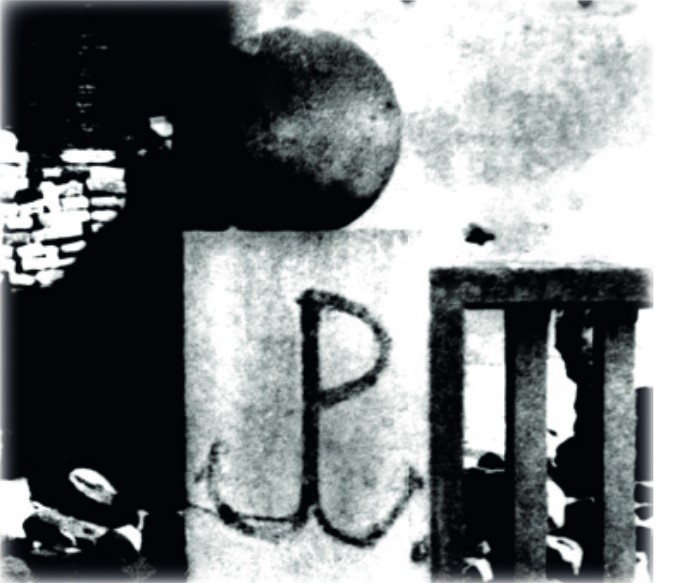
For a month now the symbol of an anchor is being painted on the walls of Warsaw. The drawing of an anchor is made in such a way that its upper part consists of the letter <<P>>, while its lower part – the letter <<W>> [Polska Walcząca – Fighting Poland; trans. annotation]. […] the symbol of an anchor took over the capital and possibly the entire country. Let it spread into the world!
wrote the “Informative Bulletin” of the Home Army on April 16th 1942. The one who painted the symbol next to the bakery was scout Aleksy Dawidowski, and, like every anchor after this one, it was painted according to rules of conspiracy.
Conspiracy competition
The monogram of the letters “P” and “W” was not circumstantial. To come up with an original, conspiracy symbol for Fighting Poland the Office for Information and Propaganda of the Warsaw District of the Home Army gathered a jury for a contest in January 1942. It consisted of Czesław Michalski codename “Jankowski” (the president of the jury); Aleksander Kamiński codename “Hubert” (editor-in-chief of the “Informative Bulletin” of the Home Army); Maria Straszewska codename “Emma” (member of the editorial office of the bulletin) and Anna Smoleńska codename “Hania” (the secretary of the jury).
Twenty seven works were sent to the commission, out of which two were selected. Apart from the anchor, the symbol which was also considered were two crossed swords – a symbol of the battle of Grunwald. In the end, the jury chose the anchor, which was announced to the conspiracy circles on April 16th 1942, in the aforementioned bulletin.