
Both arguments had nothing to do with the truth.
Poles, devastated with the fall of the uprising, had no doubts about the Soviets intentions. “The shadow of the crime – which is leaving Warsaw on its own, without bringing it the help it deserved – history will one day shine the light on and condemn” – wrote the underground “Polish Daily” already on October 3rd 1944.
Ghost town
History shone some light already. We know, that the Soviets not only held off offensive actions, but they also acted against the Uprising – both in a police and military manner. They made it much harder for the British to help the fighting Poles. Just as the Germans – they hunted and killed on their side of the front line those Home Army units which tried to break through to the struggling capital.
Using the Germans to destroy one of the most important centres of Polish independence, Stalin turned down the possibility of creating favourable conditions for his army to march to Berlin
wrote a Russian historian Nikolai Ivanov, calling Stalin’s actions a straight up “crime on the Warsaw Uprising”.
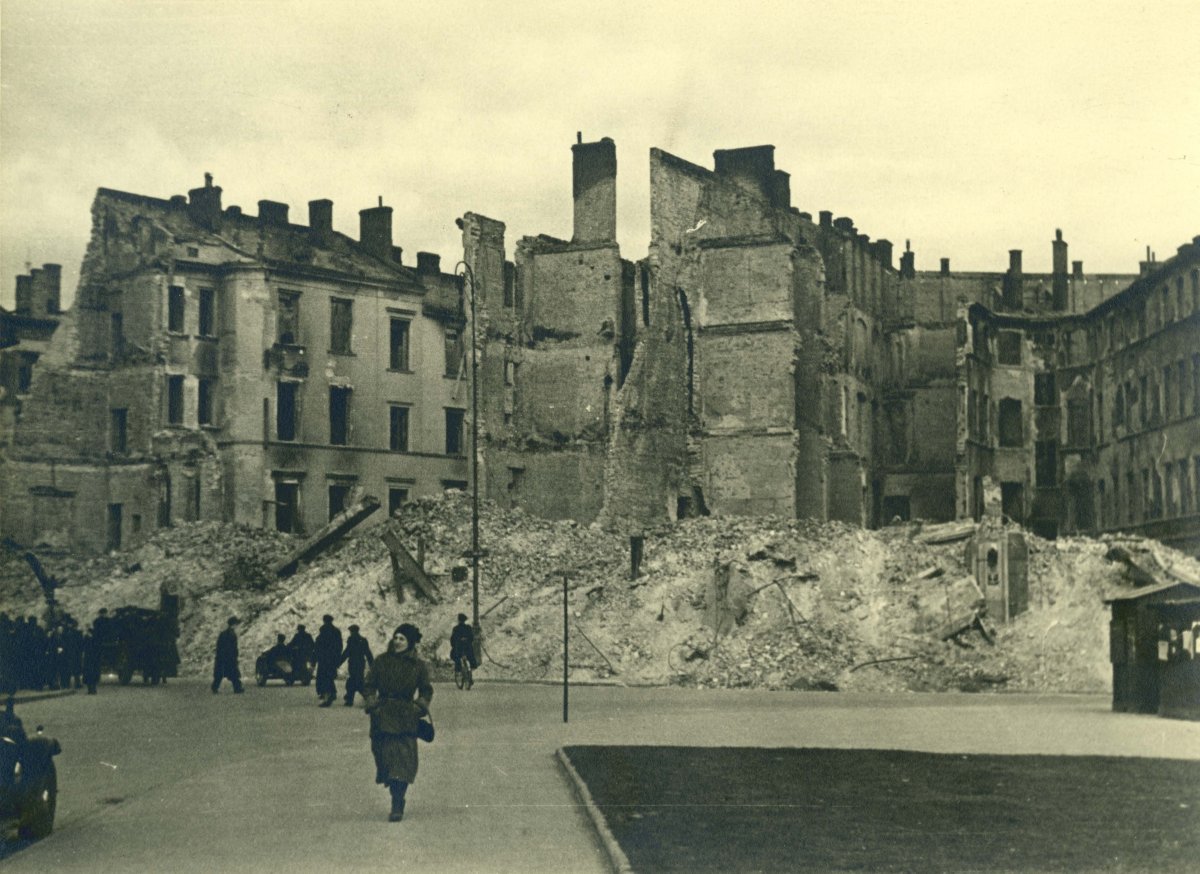
In the autumn of 1944, the Germans made use of the stalemate at the frontline. After having committed horrific war crimes on civilians during the Uprising, they went on to fulfil the orders of the systematic destruction of the Polish capital. They burned street after street, house after house. A German soldier Joe J. Heydecker recalled this from the time he was in Warsaw in November of 1944.
But this silent city of ruins, Warsaw, I still see before my eyes with all the details. The city, which I walk across with my friend […] is ghastly. […] It’s actually hard to imagine, that we’re in a real, million people city, which is actually entirely in ruins and that it’s not just a surreal film scenery. […] Graves are everywhere. On the sides of the streets, where pavements once were, there are mounds; mounds after mounds. There are hundreds of them, hundreds. […] Most of the graves are unnamed. There’s only earth, cracked stone plate and rubble.
Only after a few months, on January 12th 1945 the Soviets began the military offensive in Poland. They made use of the crushing advantage they had already had over the Germans in the summer of 1944. On January 17th they also took what was left of Warsaw.
The Communist propaganda knew no boundaries to its cynicism. Efficiency was all that counted. Marching in the burned out, desolate city was nonetheless called “the liberation of the capital of Poland”. The day was immediately celebrated as a grand holiday. Then, for more than 40 years, on January 17th there were annual ceremonies, school academies and other events for the occasion. Wreaths were laid in front of the hypocritical “monuments of gratitude” for the Red Army, also in Warsaw itself.