
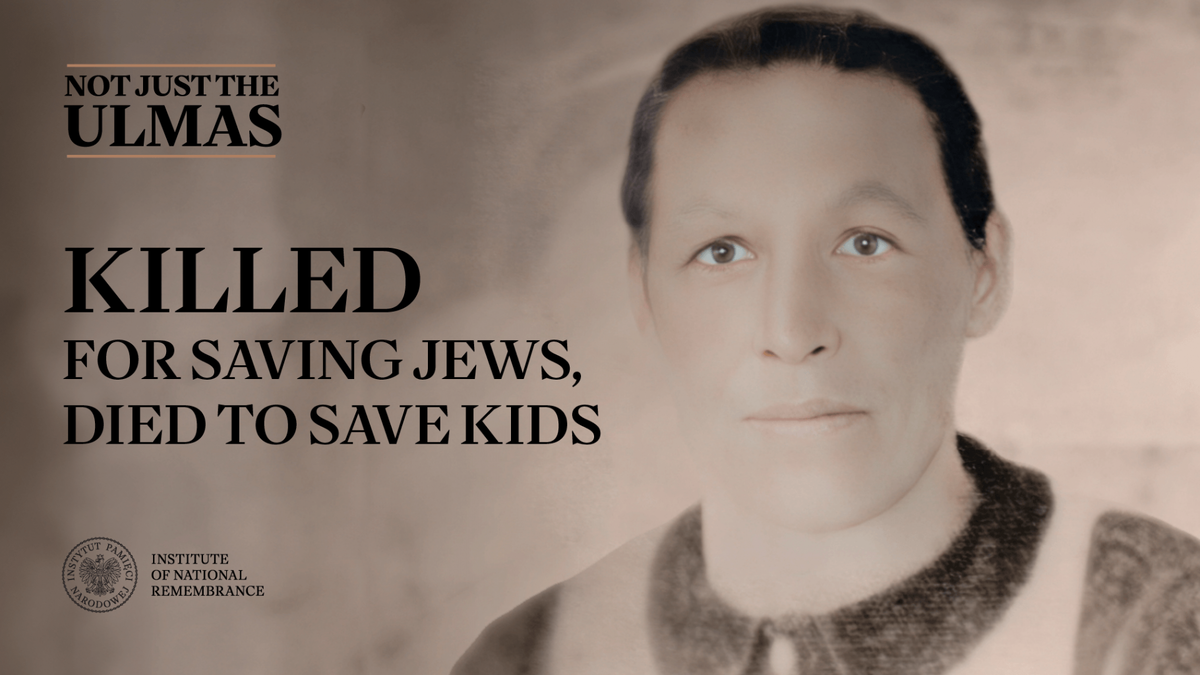
“Killed for saving Jews, Died to save Kids” – the 20th Episode of the IPN Film Series Entitled Not Just the Ulmas Now Available on IPNtv
The 20th and last episode from the Not just the Ulmas series is now available on the IPNtv channel. The film “Killed for saving Jews, Died to save Kids” presents the story of Katarzyna Filipek, a widow who, while raising seven children, accepted the responsibility of sheltering six Jews, for which she paid the ultimate price. The family of the shopkeeper Sternlicht had initially been hiding at the farm of Stefan Barglik, the head of the village of Tokarnia, near Rabka Zdrój. Barglik was a particularly tragic figure. First, he sheltered those wanted by the Germans and looked for hiding places for them.Then, blackmailed by the Germans with the lives of his own family and the Filipek family, and maybe even the entire village, he handed them over to the occupiers, and then himself was also murdered.
For the narrative presented in the film, Dr. Maciej Korkuć of the IPN Branch in Cracow made use of, among other materials, a publication on Katarzyna Filipek and Maria and Stefan Barglik by Martyna Grądzka-Rejak entitled: Repression for helping Jews in the occupied Polish lands during World War II, vol. I, M. Grądzka-Rejak, A. Namysło, eds., Warsaw 2019, p.138, as well as an article by Anna Zechenter "Jedenaste: przyjmij bliźnie pod swoim dach" [Eleventh: accept your neighbor under your roof] published in IPN Biuletyn, No. 3 (98) March 2009, p. 83.
Katarzyna Filipek sacrificed her life for others on two occasions. The first time was when, as a widow and a mother of seven children, she took in six Jewish people under her roof – the local shopkeeper Szmul Szternlicht, together with his two daughters and their two children, namely Salomea Geshir with her son, and Rozalia Hilfstein with her son Adolf; with them was also Rozalia's husband, Juda. Previously, they had been hiding with the Bargliks, the family of the village head of Tokarnia.
When the Germans learned of Jews hiding in the village, they forced the village head to search for them under penalty of death. Hoping that the Jews would flee, the village head had previously announced in the church that a manhunt was being prepared. At the same time, he assured Catherine Filipek that he would start the search in another part of the village. Unfortunately, most likely as a result of the Germans' threat to his own family and the Filipek family, and perhaps even the entire village, he turned the Szternlichs over to the Germans. They were murdered soon afterwards. After two weeks, on 4 February1944, the Gestapo also came for the Bargliks. Katarzyna Filipek turned herself in to the Gestapo, hoping that they would then not come to her house and harm her seven children. The Germans murdered her along with Maria Barglik and Helena Mrugala on 6 March. Stefan Barglik was also killed. The children from both families survived, but nine months later, on 4 December 1944, the farm of the orphaned Filipeks was burned down by the Germans as part of a punitive pacification of the nearby village of Zawadki, for helping partisans.
In 1988, Katarzyna Filipek was awarded the title “Righteous Among the Nations” by Yad Vashem. Thousands of Poles, however, have still not been honored for their sacrifice. This includes widows with underage children under their care. Artur Morach wrote to Prof. Jan Żaryn about one such widow, a mother of eight children, in the context of the Jedwabne crime: Szmul Wasersztajn, a Jew saved from this pogrom [in Jedwabne on 10 July 1941] and main witness to the Gross' account, survived, among other reasons, due to the fact that he found shelter shortly after the pogrom in the barn of my grandmother, who lived 5 km. from Jedwabne in the village of Przestrzele. Since Szmul Wasersztain went to the same school as my late uncle Leon Dziedzic and was his friend from childhood, he hid in my grandmother's barn after escaping from Jedwabne, where my uncle Leon found him. He evidently hoped that Leon and his family would not betray him. My grandmother was already alone at the time, as my grandfather had died of pneumonia shortly before the war, leaving her and their eight children, including my mother. Szmul hid in my grandmother's barn for approximately one week after which he was brought by my then teenage uncles through the fields at night to the farm of Ms. Wyrzykowska, where she had a hideout for Jews and where he probably hid for most of the occupation. Please imagine this – a single mother with eight children hiding a Jew for several days knowing that she may pay for this with her own life and that of her children! Gross did not write about this in his book, albeit mentioned it in several sentences... I am writing about this because I have great regret, a great heartache towards all those people who presented the crime in Jedwabne in such an unfavourable light for Poles. My grandmother has no tree in Israel at Yad Vashem, yet it is known that she was not an exception, that they were many such Poles saving Jews about whom no one or only a few people know (quote from: Jan Żaryn, Poland in the face of the Holocaust, Oficyna Wydawnicza Volumen, Warsaw 2019, p. 267).
By the end of World War II, the Germans had exterminated some six million Polish citizens, the overwhelming majority of them ethnic Jews (about 3 million) and ethnic Poles. Thanks to the heroic actions of many residents of the occupied Polish lands, tens of thousands of Polish citizens of Jewish descent had been saved. Researchers estimate that the Germans murdered about a thousand Poles for this help. Most of the thousands of Poles who gave aid to Jews during the German occupation in World War II have never been honored, and most likely will never be publicly known.
With the film “Killed for saving Jews, died to save Kids” we want to commemorate the heroic and tragic fate of Katarzyna Filipek and other Poles saving their Jewish fellow citizens.
Playlists of previously published episodes in Polish and English
***
We encourage you to explore other IPN publications:
- Articles and other materials about Poles who saved Jews
- PASSPORTS TO PARAGUAY – Documentary about Polish diplomats who forged passports to save European Jews during World War II
- MATUSIA – A Tale of the Just – Fictionalised Documentary about a Catholic nun saving Jews during World War II; Hebrew voice over version: מאטוסיה -סיפור על הצדיקה סרט תיעודי מומחז
- Educational video about Ulma Family (6min.)
- More about Ulma Family
- Exhibition Poles Who Rescued Jews During World War II
- Book Persecution for providing help to Jews in occupied Polish territories during World War II
- Book The Righteous and the Merciful
- Peer-reviewed journal Polish-Jewish Studies
Contact for media:
Spokesperson – Director of the Office:
Dr. Rafał Leśkiewicz
phone: 602 322 362
rzecznik@ipn.gov.pl

Watch previous episodes of the series "Not only about the Ulma's".