
Magdalena Poręba
(IPN National Education Office in Warsaw)
[...] Most often, people write about the fighting, barricades, shooting, and courage, but it is rarely mentioned that the uprising, and war in general, is hard work. Sometimes boring, sometimes tiring work that knocks you off your feet. This is my coming to a stop at the uprising. For my entire life. Internal suspension at this most important, most beautiful, and most significant period in my life. Nothing will ever be the same again. This is something unique and incomparable to anything else that came after [...]. Teresa Sułowska-Bojarska
Women joined the uprising, leaving their previous lives behind, often under a different surname and replacing their first name with a pseudonym. They left their families and children at home, not knowing if they would ever see them again or if their home would remain standing the next night. Most of them were only teenagers, risking what was most precious to them – their future. Was there any future for them in a country under occupation, where death lurked on every street corner?
RUNNERS FROM OUTSIDE THE CAPITAL
Many of the women fighting in the Warsaw Uprising were newcomers; they found themselves in the capital by chance or necessity. This was the story of Maria Przytuła, who lived with her parents and two siblings in Kalisz before the outbreak of the war. With the German occupation,the Przytuła family lost their apartment due to eviction. Having nowhere to go, they came to Warsaw to stay with distant relatives.While at school, Maria became involved in conspiratorial activities in the National Armed Forces. Maria’s mother knew about her daughter’s actions but decided not to interfere. The girl’s decision was likely influenced by her father, a veteran of the Legions and the Polish-Soviet War.
Julia Doktorowicz-Hrebnicka was also born outside Warsaw. Fate brought her to Warsaw from far away – St. Petersburg. Her father, a geologist by profession, conducted research in northern Russia. Besides Julia, the Hrebnicki family had three other children. After the outbreak of World War II, Julia quickly became involved in conspiratorial activities, initially as a distributor of underground press. She later trained in handling explosives and reading maps.
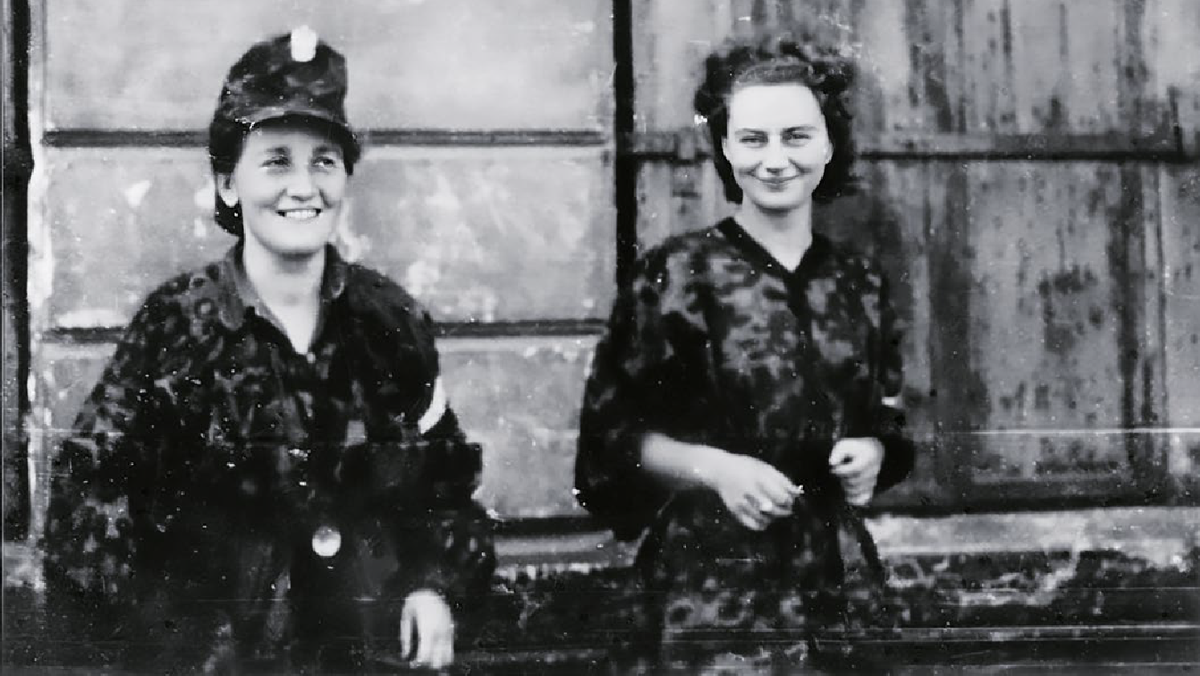
Both she and Maria fought in the uprising. At that time, Julia was 29, and Maria was 21. Maria served under the name Woroniecka and used the pseudonyms Maryna or Marysia. She was a combat runner and a nurse in the “Wydra” Motorised Column of the “Krybar” Combat Group. She participated in the attack on the University of Warsaw, probably passing through the sewers as a runner. In one of the photos, she is seen with her unit, holding a captured machine gun.
Some participants of the Warsaw Uprising fought against the invader alongside their entire families, while others, despite pleadings and bans, ran away from home to join the struggle.
Julia, known as “Elżbieta” during the Uprising, was assigned to the “Radosław” Group as a staff runner. Her role was to maintain communication between the commander and his soldiers on the front lines. She was injured and was taken a hospital in the Old Town, where she remained despite the evacuation to care for the seriously wounded. She escaped death at the hands of the Germans because wounded Wehrmacht soldiers in the hospital testified that they received good medical care. She was injured again when a bomb explosion caused the building’s ceiling to collapse.
Both women survived the Uprising and the war. One remained in Poland, the other abroad. Both were awarded the Silver Cross of the War Order of Virtuti Militari. After the fall of the Uprising, Maria was held in German POW camps. After liberation, she stayed in the West, first in England, then in North Africa, and finally, after numerous travels during which she was very involved in social activities, she settled in the United States. She never returned to her homeland, despite her deep desire to do so. She dreamed of returning to a free country. She died in 1989.
Julia lost her foot as a result of her injuries. After the fall of the Uprising, she was evacuated to Pruszków with the seriously wounded. After the war, she began working professionally at the Polish Geological Institute. She died in Warsaw in 1970, also without seeing the homeland she had fought for.
There were many similar stories. Some of the participants were much younger. Others were more experienced. Some of them fought against the invader alongside their entire families, while others, despite pleadings and bans, ran away from home to join the struggle. Many women had at least partial training for roles as orderlies or in communications, but there were also cases where untrained volunteers contributed mainly through maintenance work. While many names have gone down in history, some will unfortunately remain unknown.
Despite the immense contributions of women during the war, public consciousness often views war as a male domain. Men are seen as the ones who put on uniforms and head to the front lines with weapons. In the eyes of many, women are still perceived as too frail and fragile to fit into the image of wartime chaos. However, these deeply rooted stereotypes do not reflect reality.
Women participated throughout the entire liberation struggle, forming independent organisations and military units that fought on the barricades and operated especially in the rear, as the effects of the conflict primarily impacted the civilian population. They helped build the infrastructure of the Polish Underground State, shaped patriotic attitudes within their families, bore the burden of daily life, raised future generations of Poles, and often took an active role in the fight against the occupier.
Many young girl scouts died while aiding the wounded on the battlefield, serving as nurses in hospitals and rescue points, clearing rubble, or participating in communication patrols to carry orders and reports
Women constituted 50 percent of Polish society at that time and made up about 20 percent of all insurgents during the Warsaw Uprising. Many perished while performing their assigned tasks. The fate of women was more difficult and dangerous because they worked in the services and most often without weapons.
They served as authors, editors, and distributors of the insurgent press, and as defenders of cultural monuments. Many young girl scouts died while aiding the wounded on the battlefield, serving as nurses in hospitals and rescue points, clearing rubble, or participating in communication patrols to carry orders and reports, or, for example, while digging potatoes under fire or delivering food to the insurgents on the front line. Social problems included lack of housing and difficulties with food. Women played a crucial role in addressing these issues by creating and managing communal kitchens. Despite often sleeping only two or three hours a day under immense stress, and frequently going hungry and being exhausted, they found time to support the soldiers through the Pomoc Żołnierzowi [Help for a Soldier] organisation, singing insurgent songs, writing poems, and organising theatre performances.
The nuns who participated in the uprising deserve recognition for their bravery. They extinguished fires, rescued the wounded, and contributed to building fortifications. Many of them perished under the rubble of bombed churches.
The role of a runner was particularly dangerous – carrying out tasks unarmed, burdened with reports, and crossing areas occupied by the Germans. They also supported sewer communications. The defence of districts often depended on maintaining these sewer lines. They served as guides for soldiers and civilians through the sewers, and carried ammunition, weapons, and equipment. Technically trained individuals also operated communication devices, particularly telephones, radios, and cipher equipment.
After the uprising, many women left insurgent hospitals or stayed with the wounded who were near death, often being executed by the SS alongside them. For many of them, it was a disgrace to secretly leave Warsaw with the civilian population, without a uniform or Home Army armband, even though they had received such an order.
[...] With contempt for death, they compete with each other to be given the most challenging and life-threatening tasks. They set a remarkable example of dedication to the fight for freedom and the defence of Poland. The country can be assured of its future when such extraordinary women enter the arena of Polish public life in great numbers - a phenomenon certainly unseen over the centuries [...].
Colonel Antoni Chruściel “Monter”