
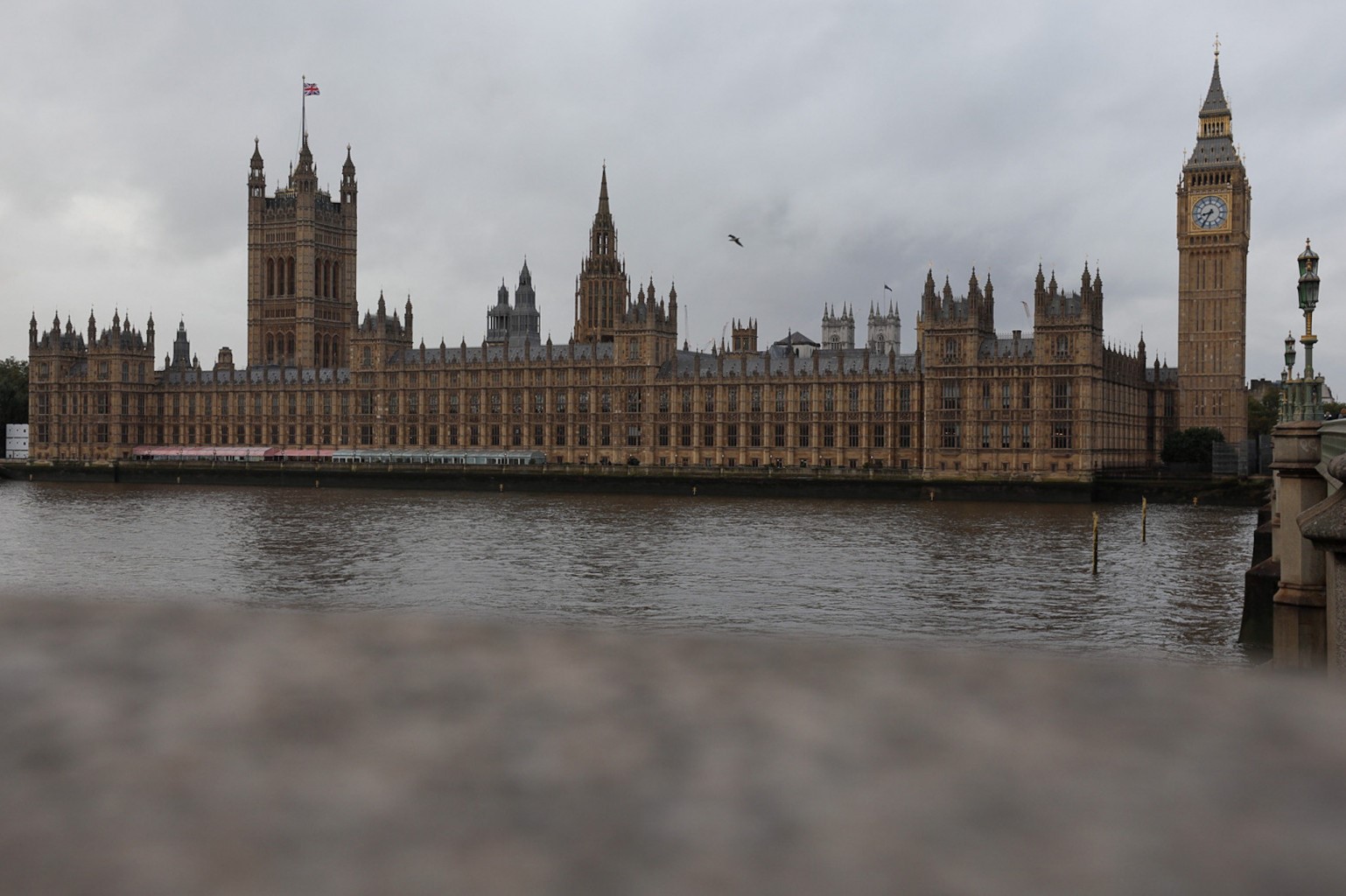
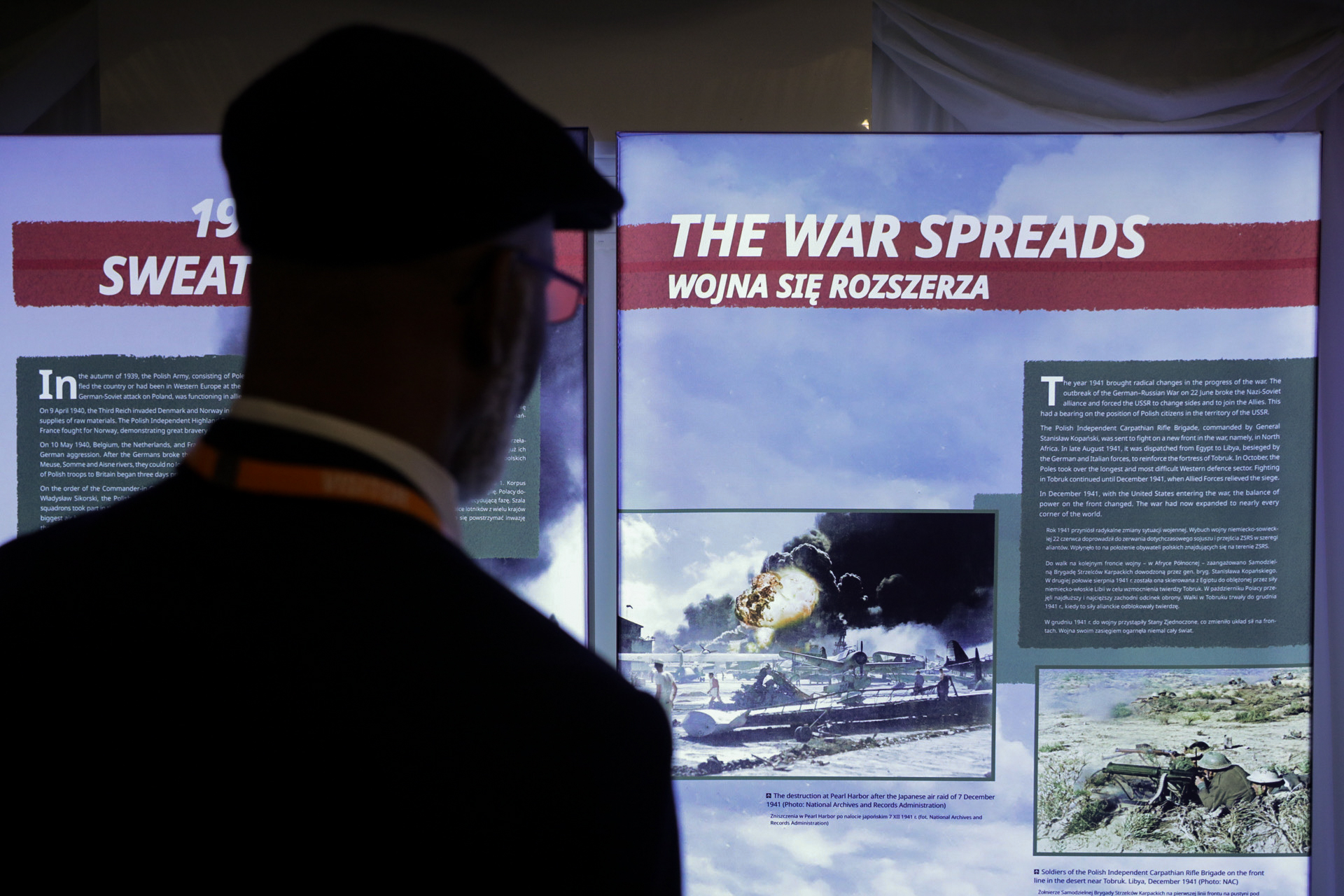
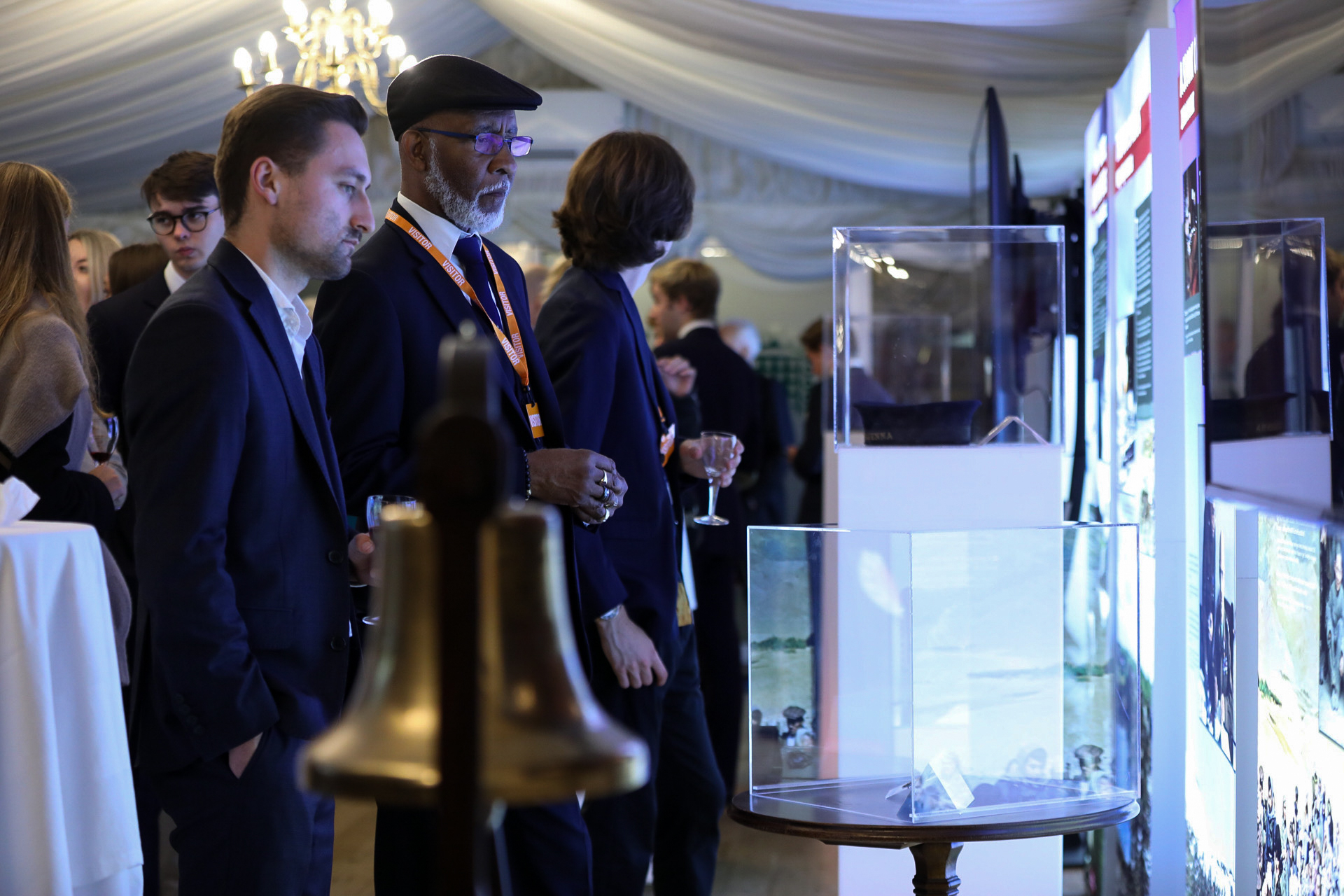
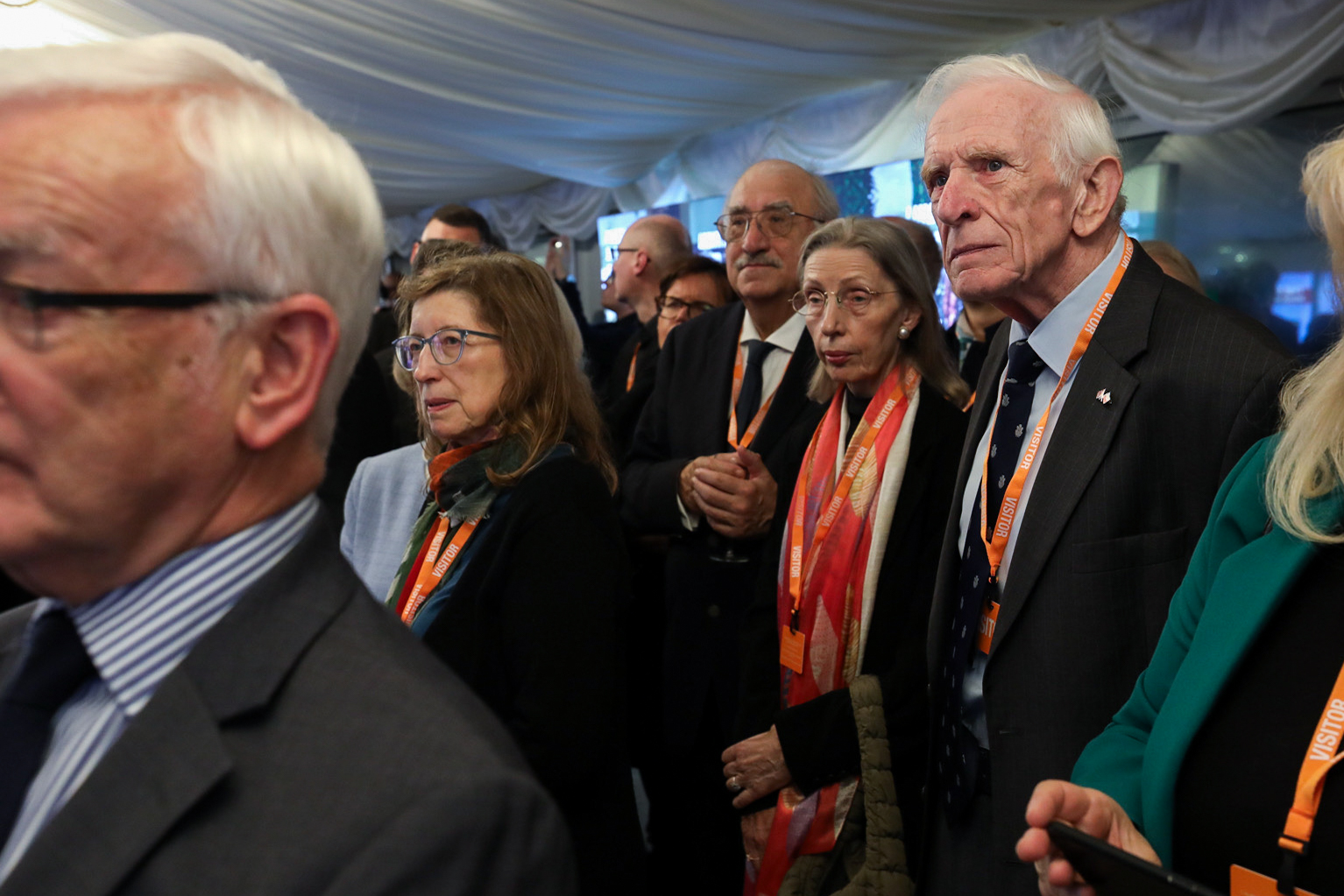
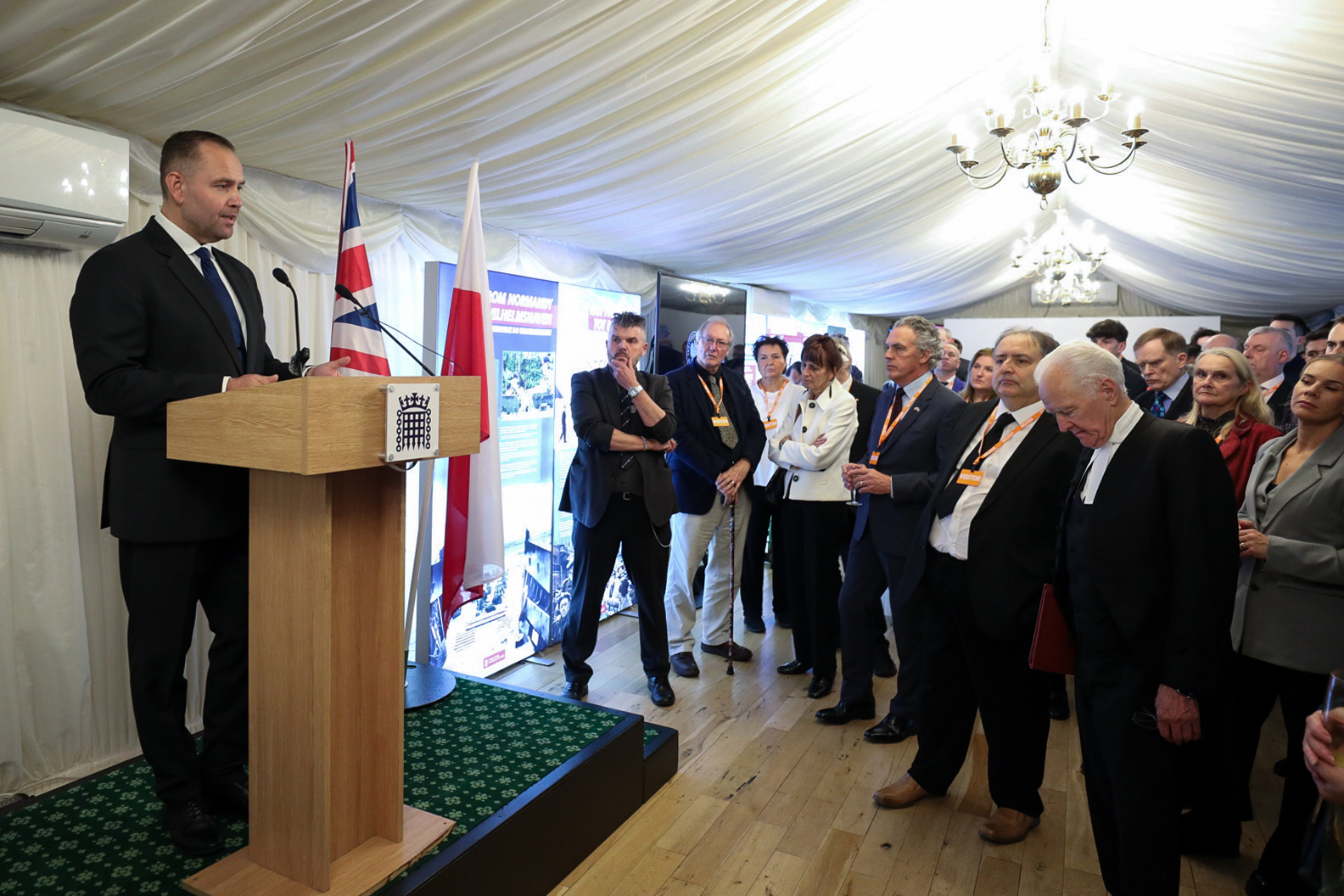
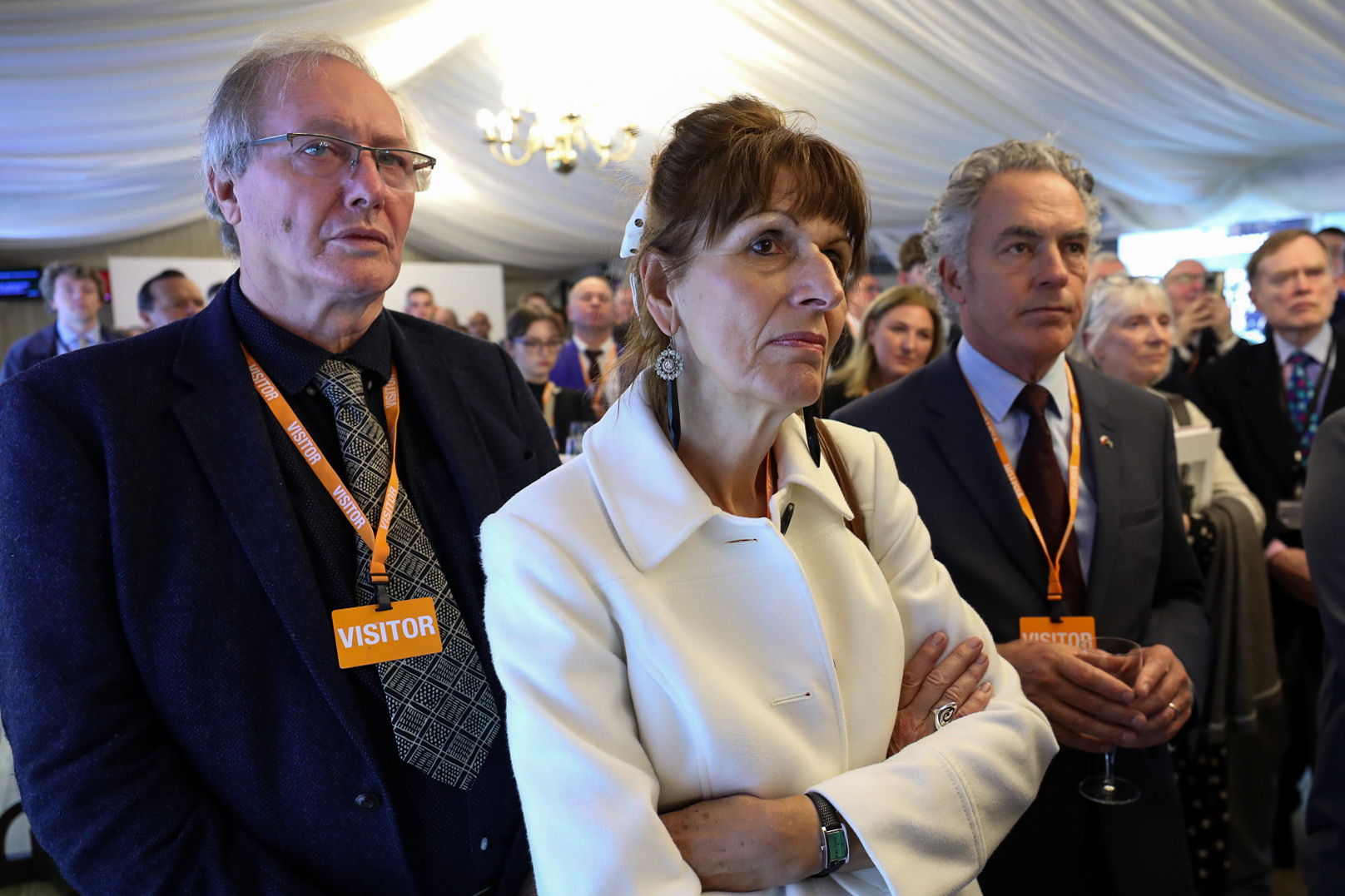
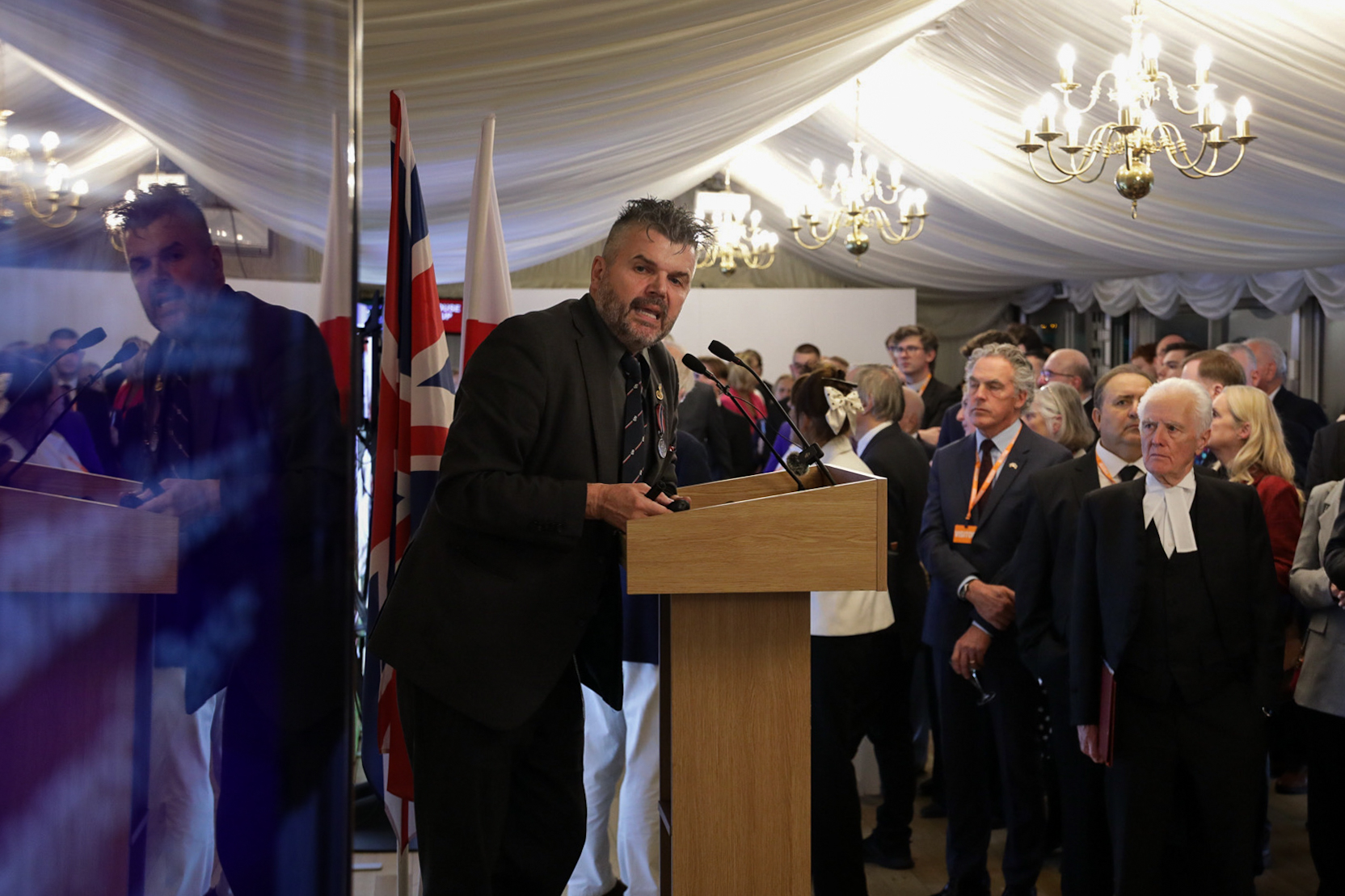
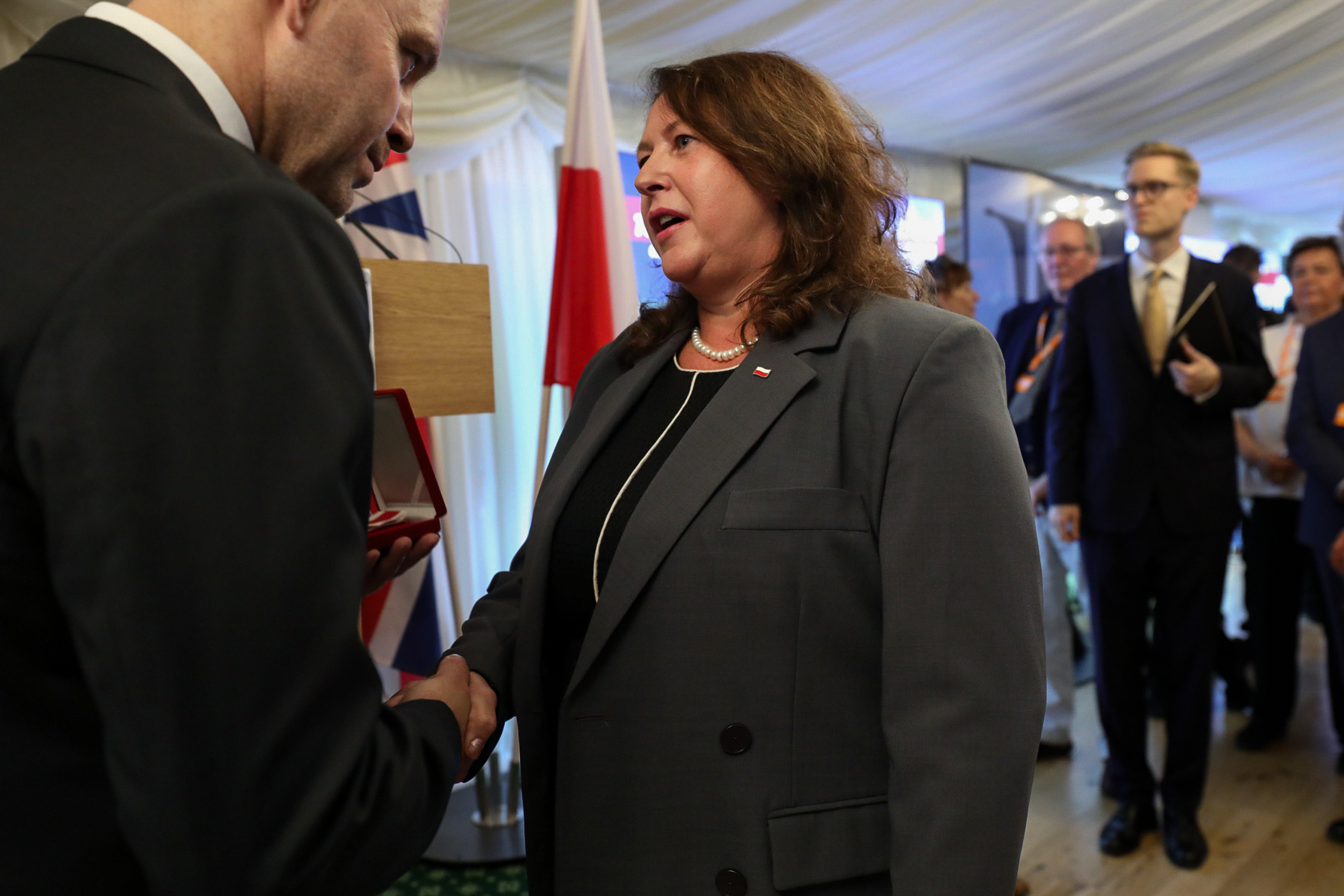
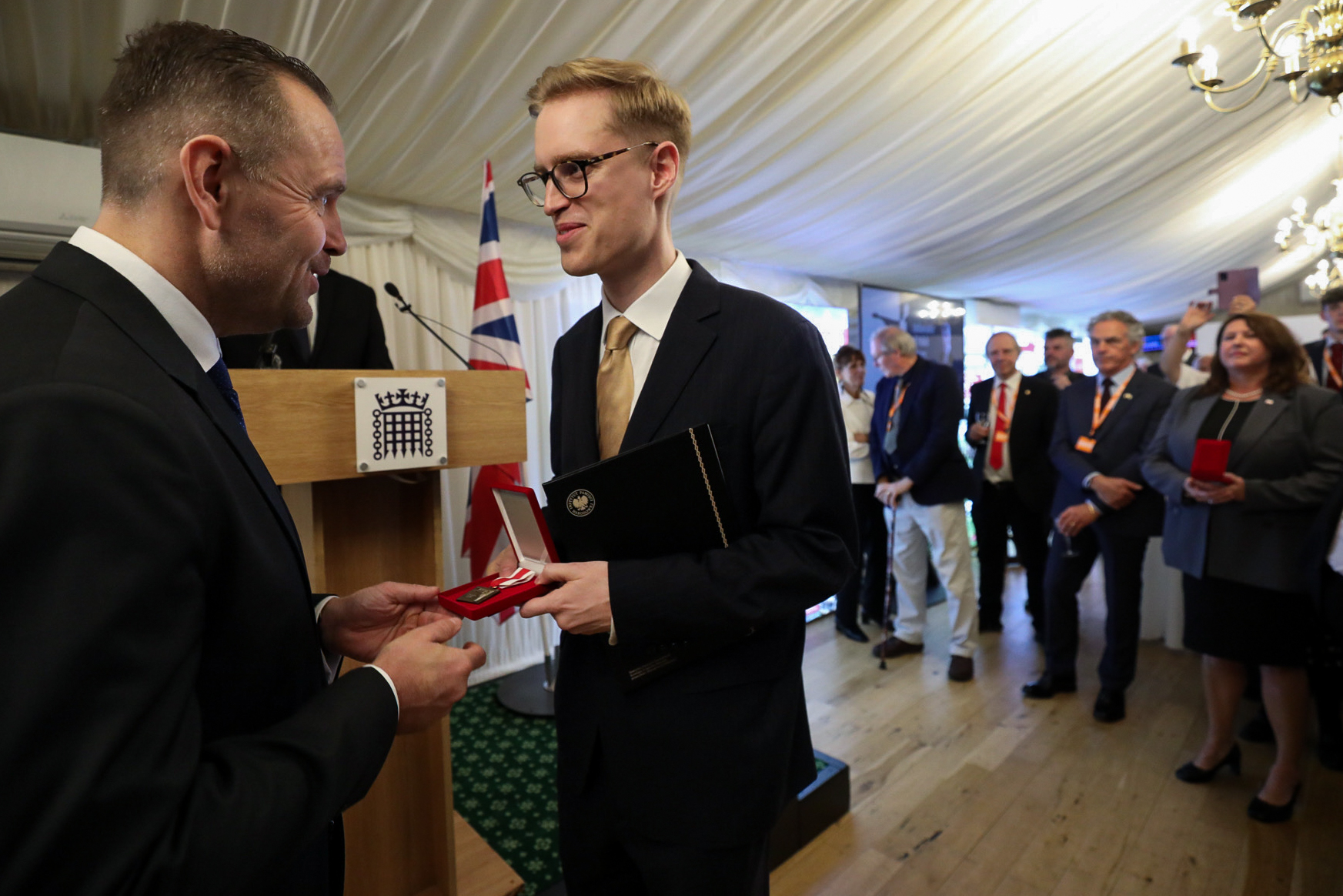
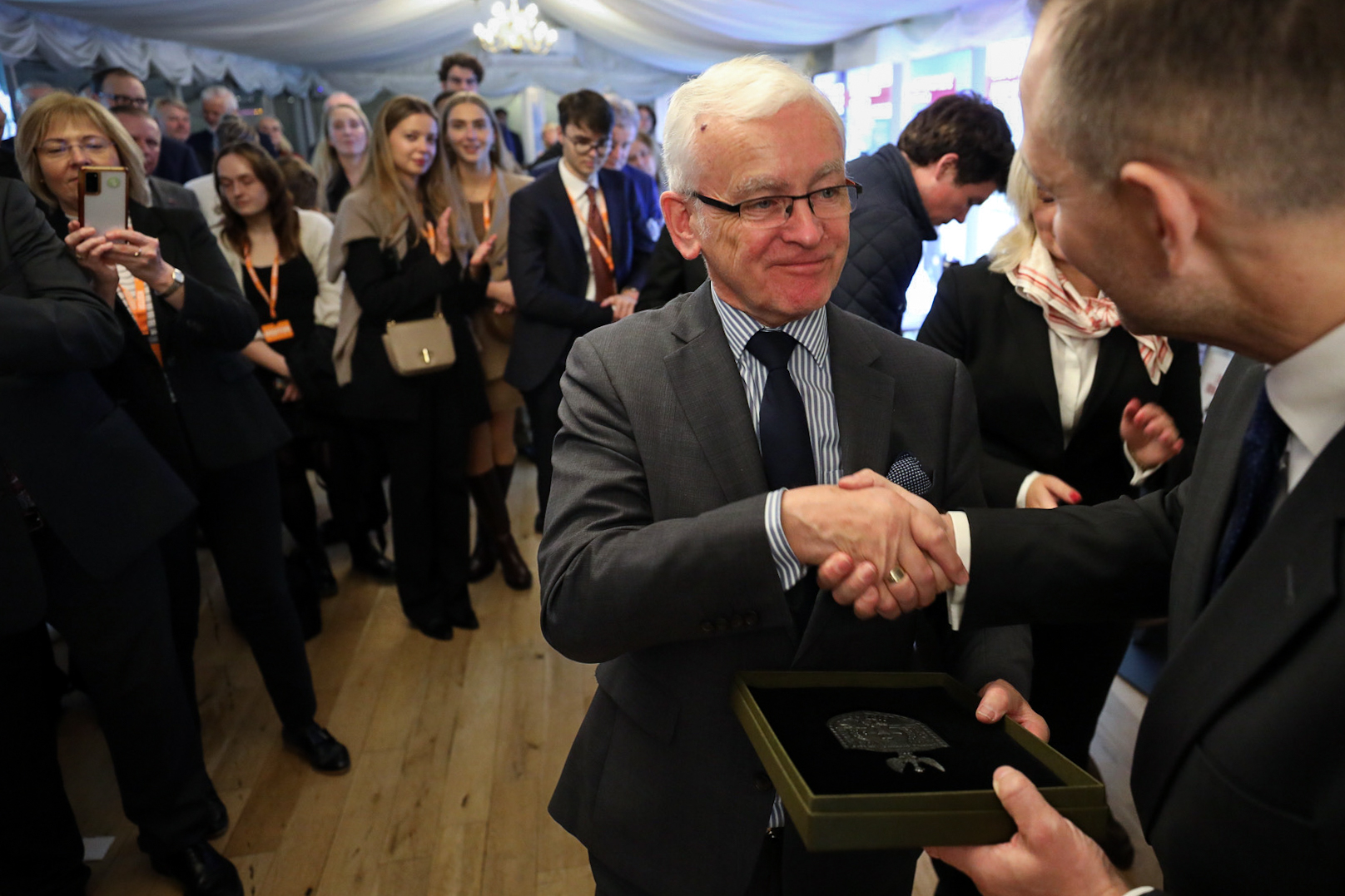
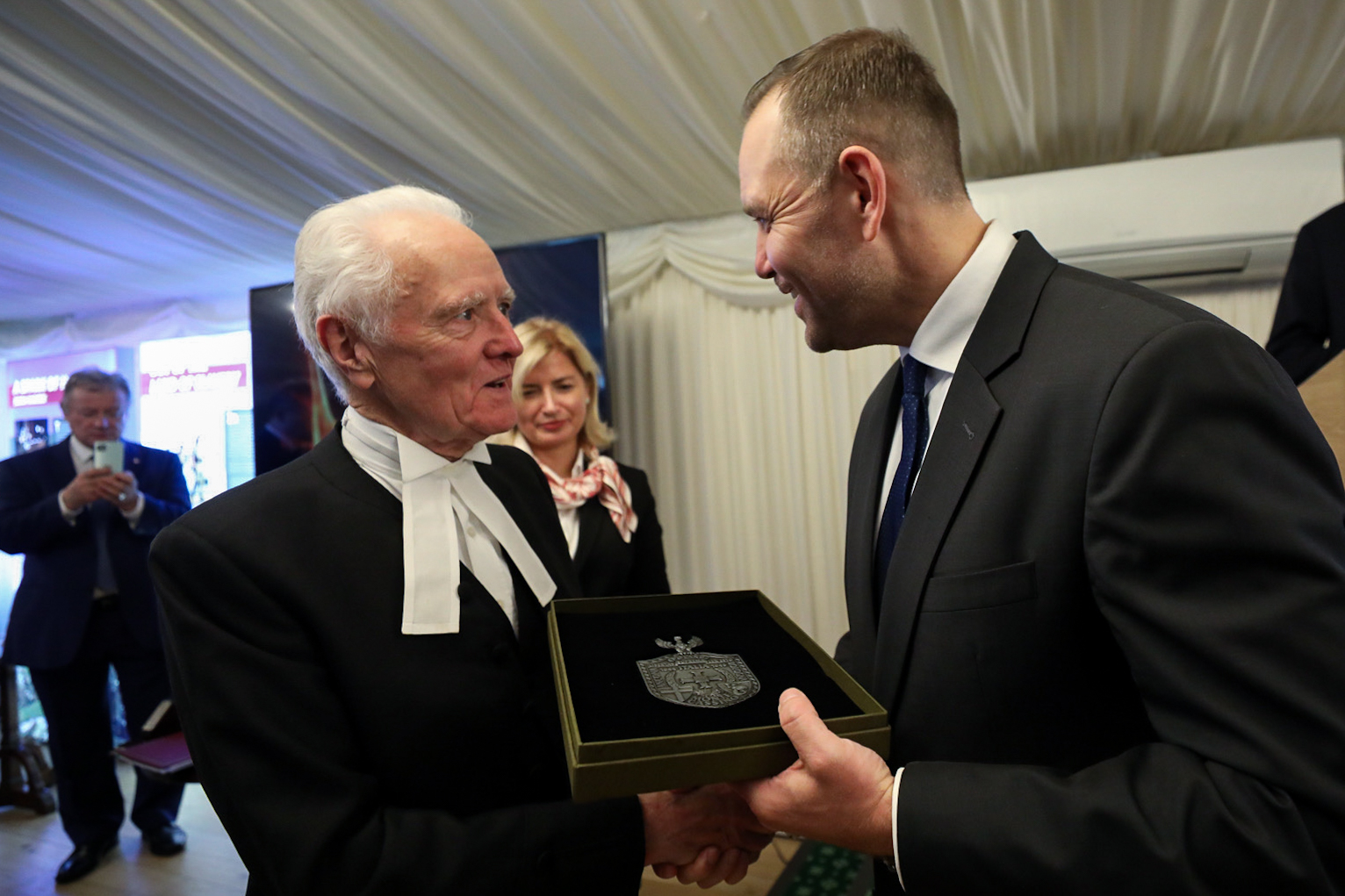
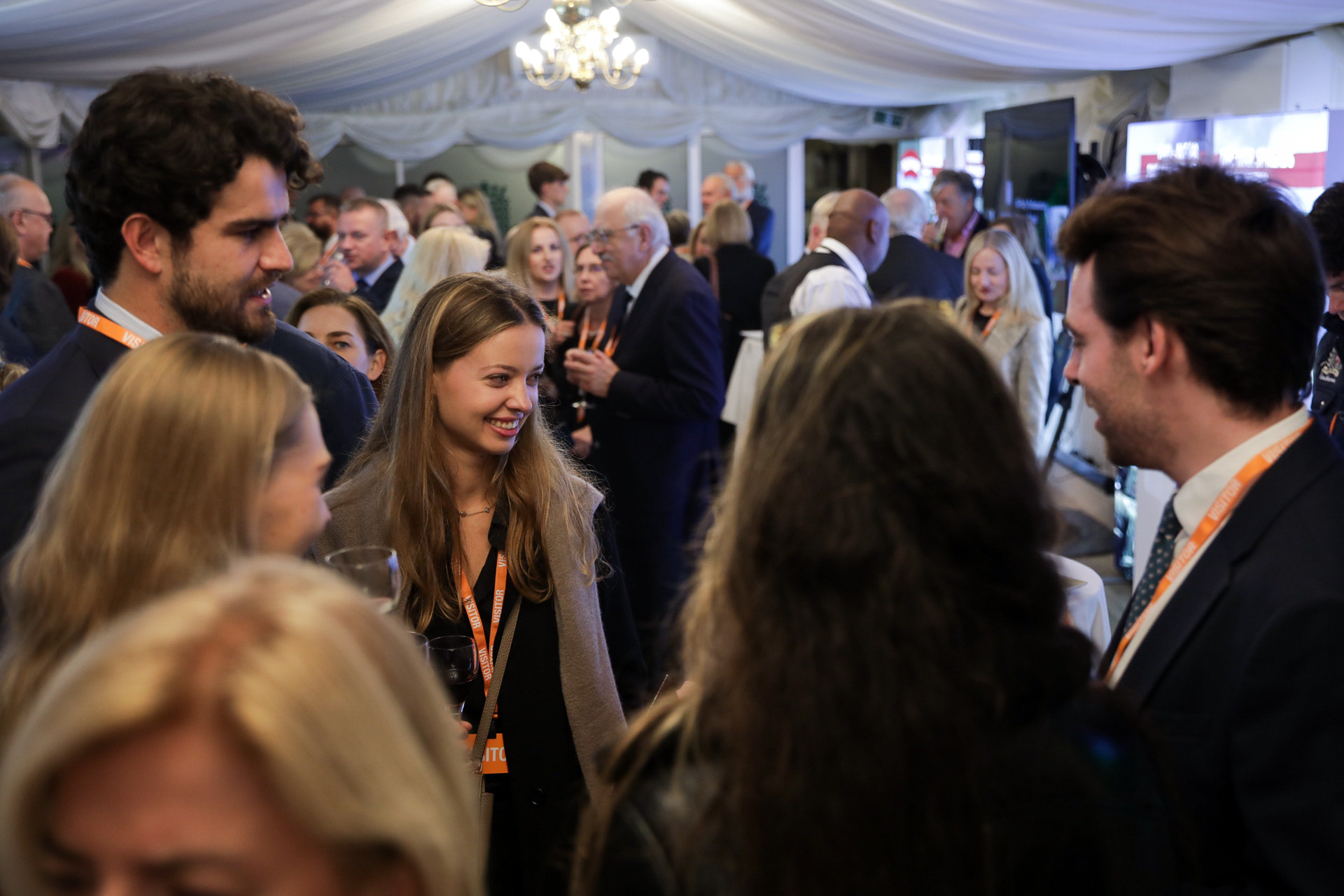
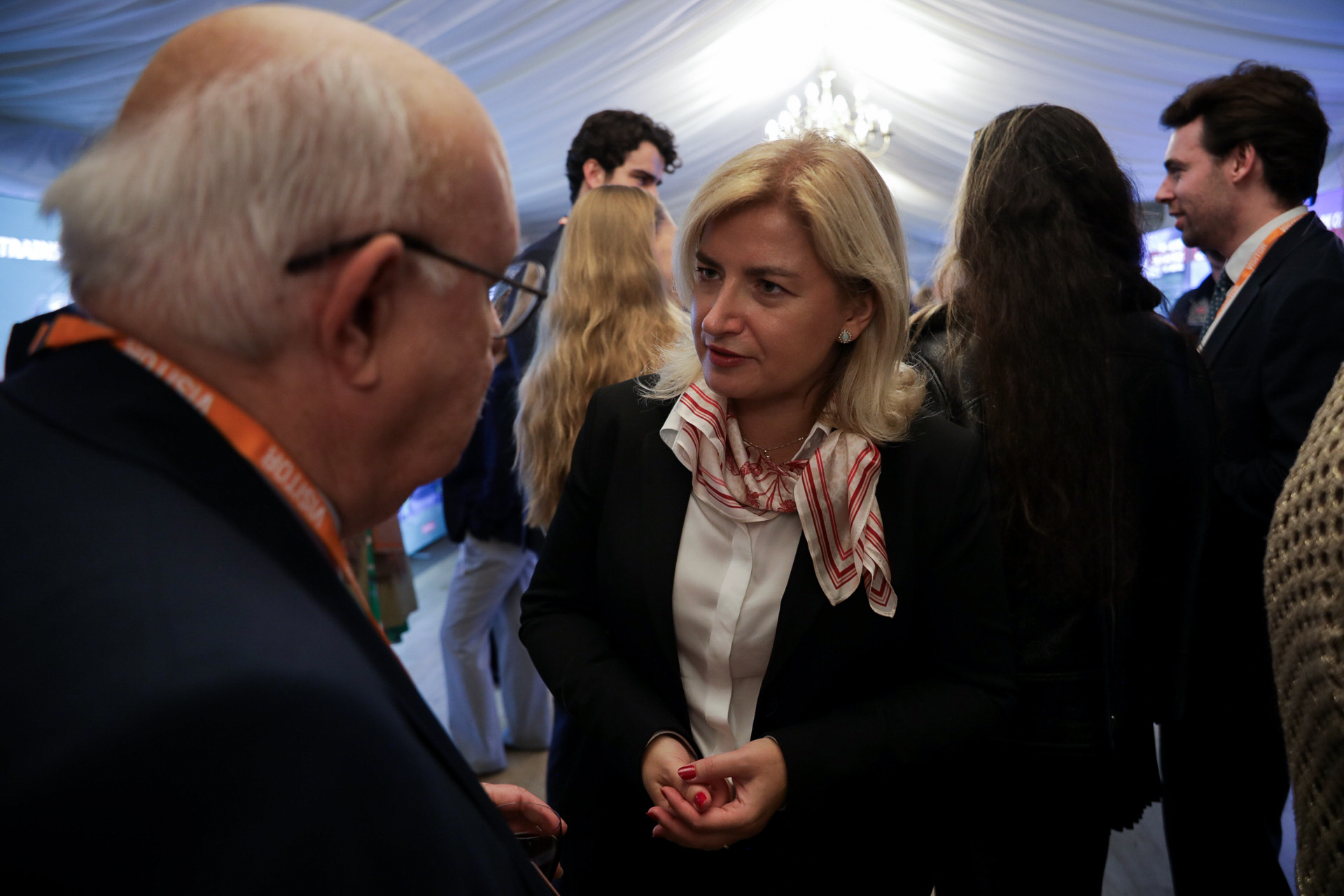
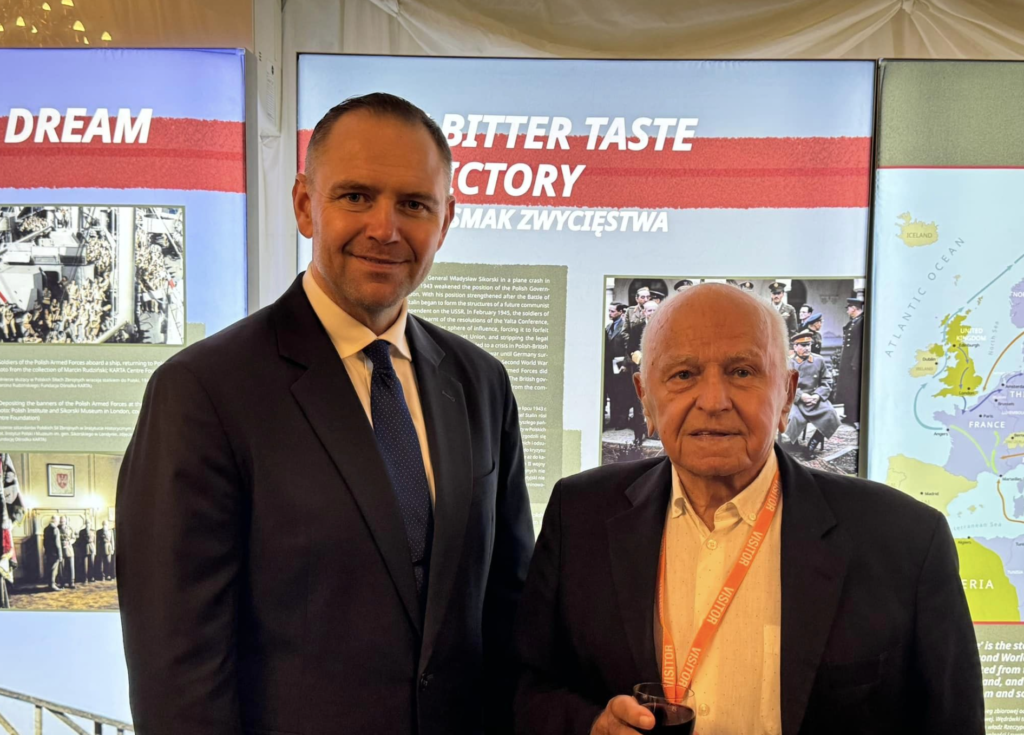
On 7 October 2024, the Palace of Westminster in London hosted the opening of the IPN exhibition entitled Trails of Hope. The Odyssey of Freedom. The Ambassador of Polish History awards were also presented. The event was attended by the President of the Institute of National Remembrance Karol Nawrocki, Ph.D.
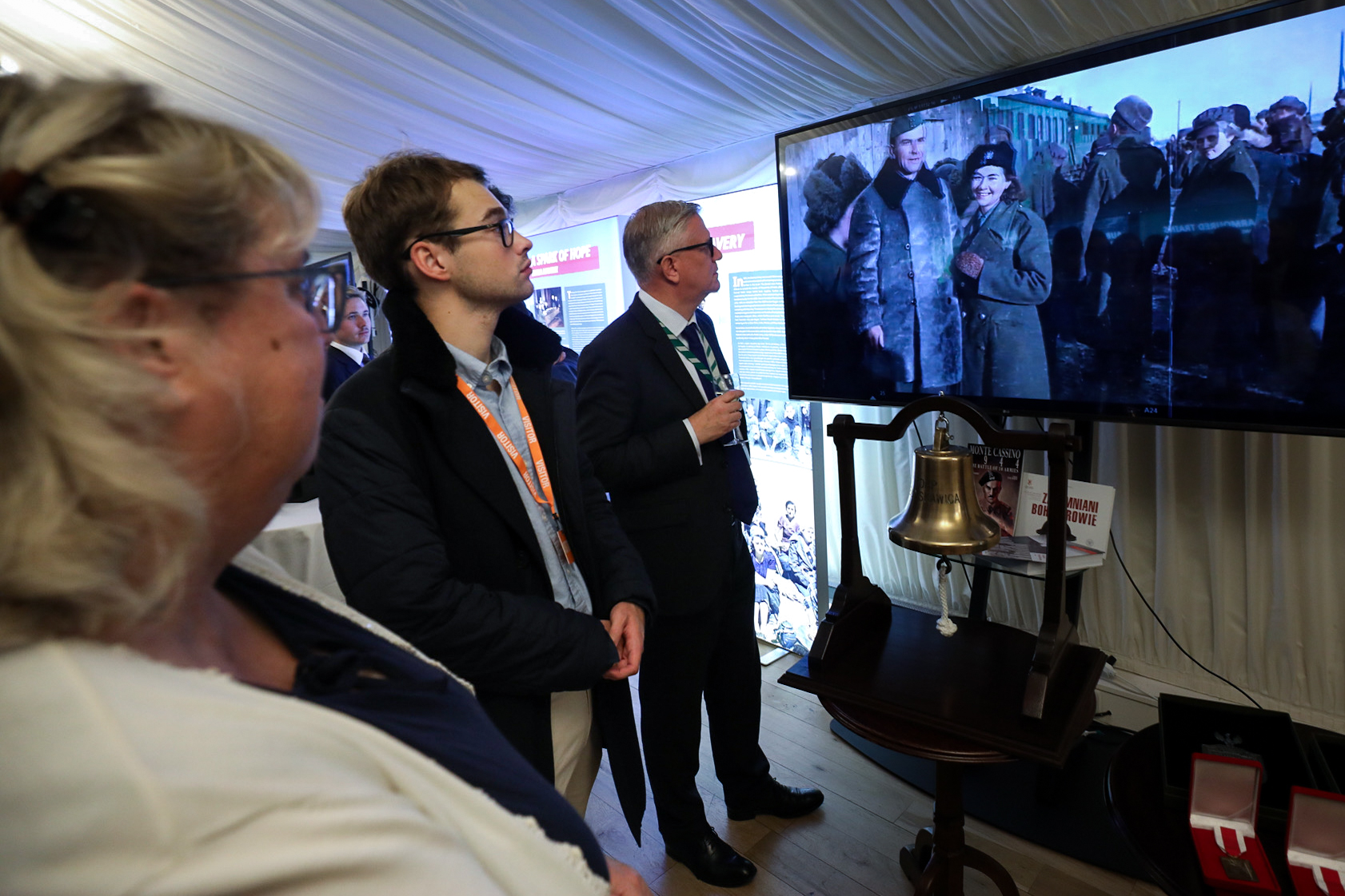
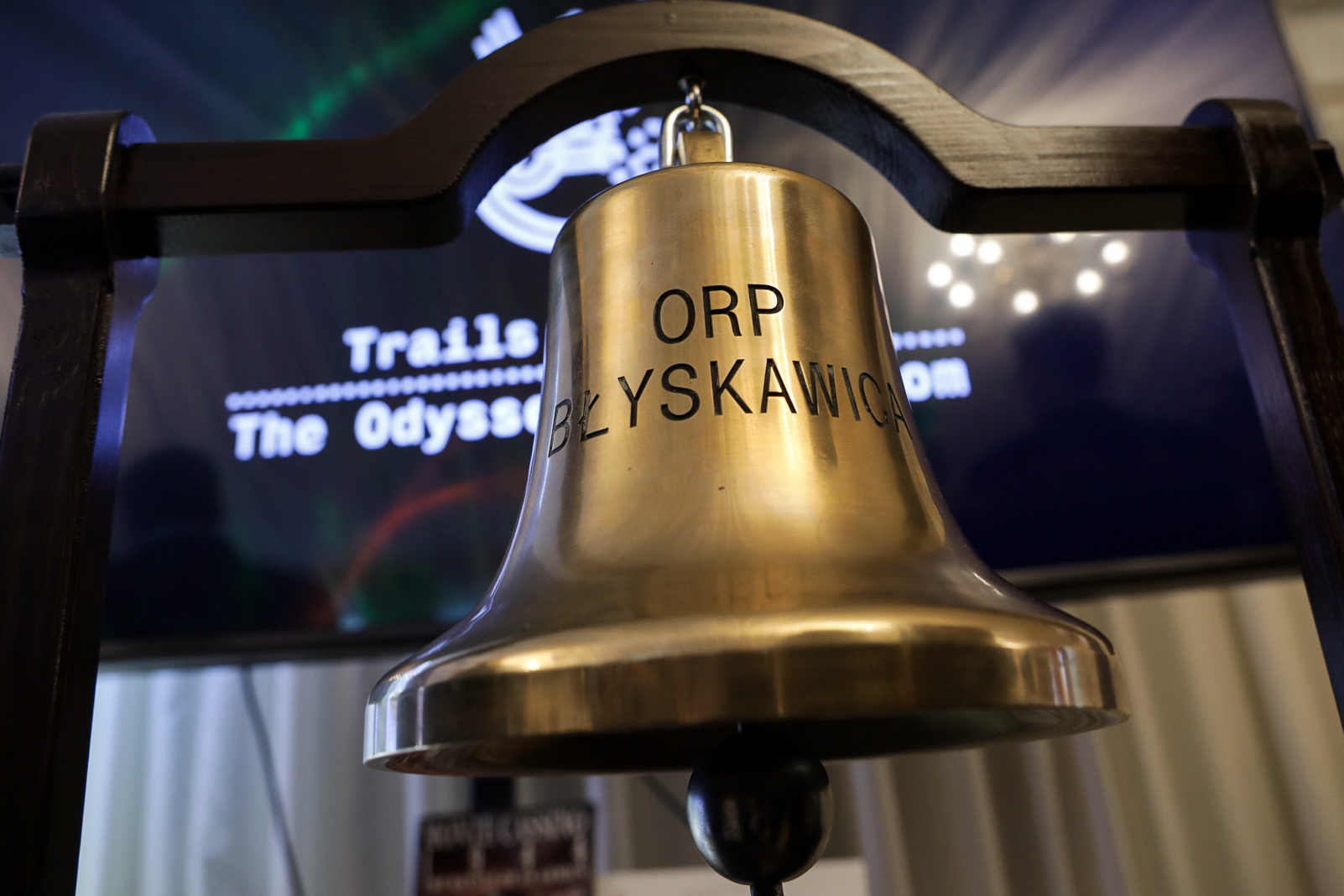
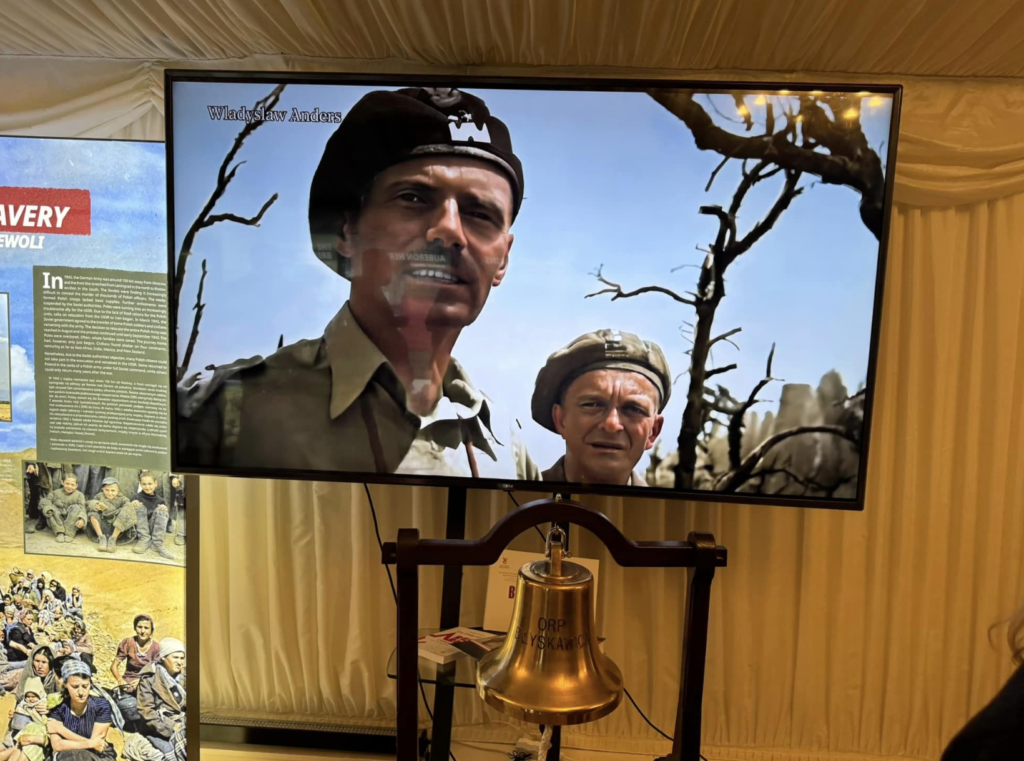
The event began with the symbolic striking of a bell from ORP "Blyskawica", which was loaned courtesy of the Polish Navy command. October 1 marked the 88th anniversary of the ship's launch.
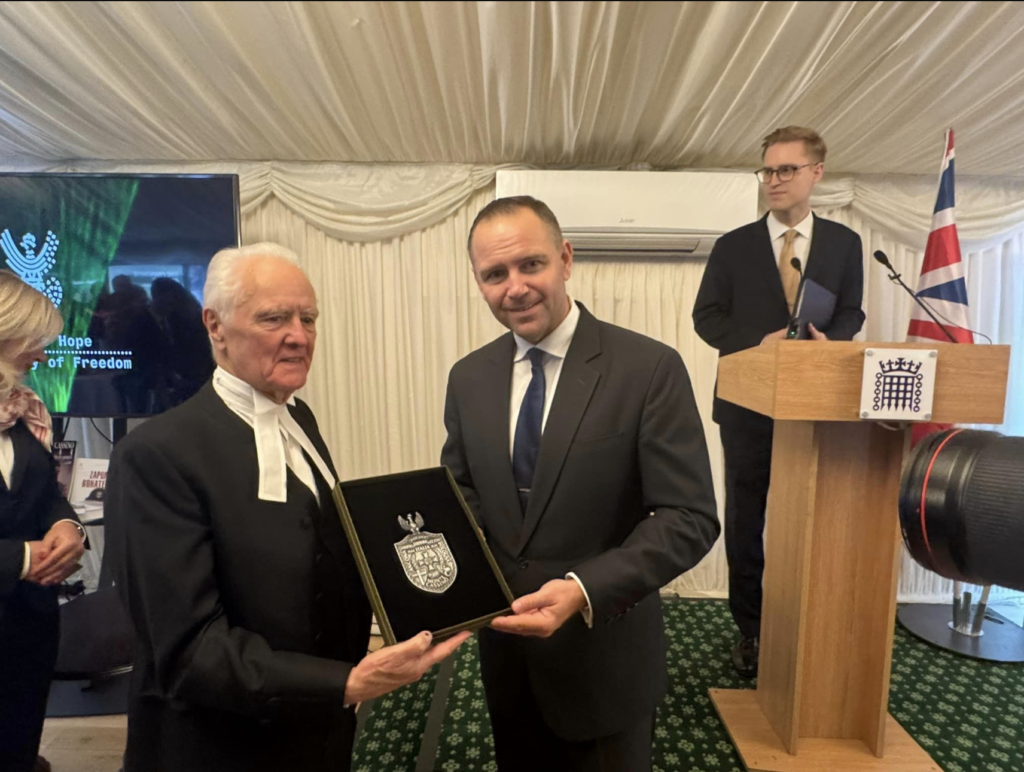
The Ambassador of Polish History award is intended for individuals and organizations outside of Poland. This honorary distinction, established by the President of the Institute of National Remembrance and awarded by the IPN, is given to individuals and institutions of particular merit in commemorating the history of the Polish nation and supporting the Institute in carrying out its statutory activities in educational and scientific areas.
It is an award for people and institutions involved in nurturing Polish historical memory, caring for the preservation, promotion and deepening of knowledge about the recent history of our country and the discovery of forgotten facts or people of merit for the Polish nation. The laureate of the award may be a person of non-Polish origin. It is also possible to apply for a posthumous honor.
The award winners were: Iwona Golińska, President of the Polish Sue Association in the UK, and George Byczynski, Editor-in-chief of the British Poles, a Polish web service in the UK.
The second and third generations of Poles are still cultivating Polish traditions. The Institute’s “Ambassador of Polish History” medal, which will be presented this evening, is awarded for an outstanding contribution to the dissemination of Polish national and cultural heritage. The laureates are here with us today, said the IPN President Karol Nawrocki, Ph.D.
The other winners of the award will be announced at a gala ceremony to be held on 23 October 2024 at the Łazienki Park in Warsaw.
Among the guests of the event were British Conservative Party politician Martin John Vickers, co-chair of the All-Party Parliamentary Group on Poland, Lord Speaker of the House of Lords John Francis McFall, Baron McFall of Alcluith, General Stanislaw Sosabowski's great-grandson Prof. Hal Sosabowski, , and British historian and author of publications on World War II Helen Fry. Diplomats and representatives of the military corps from Austria, Australia, Czech Republic, Croatia, Finland, France, Greece, Iceland, Luxembourg, Mongolia, Romania, Ukraine, Poland and the United Kingdom were also present at the event.
The exhibition: Trails of Hope. The Odyssey of Freedom
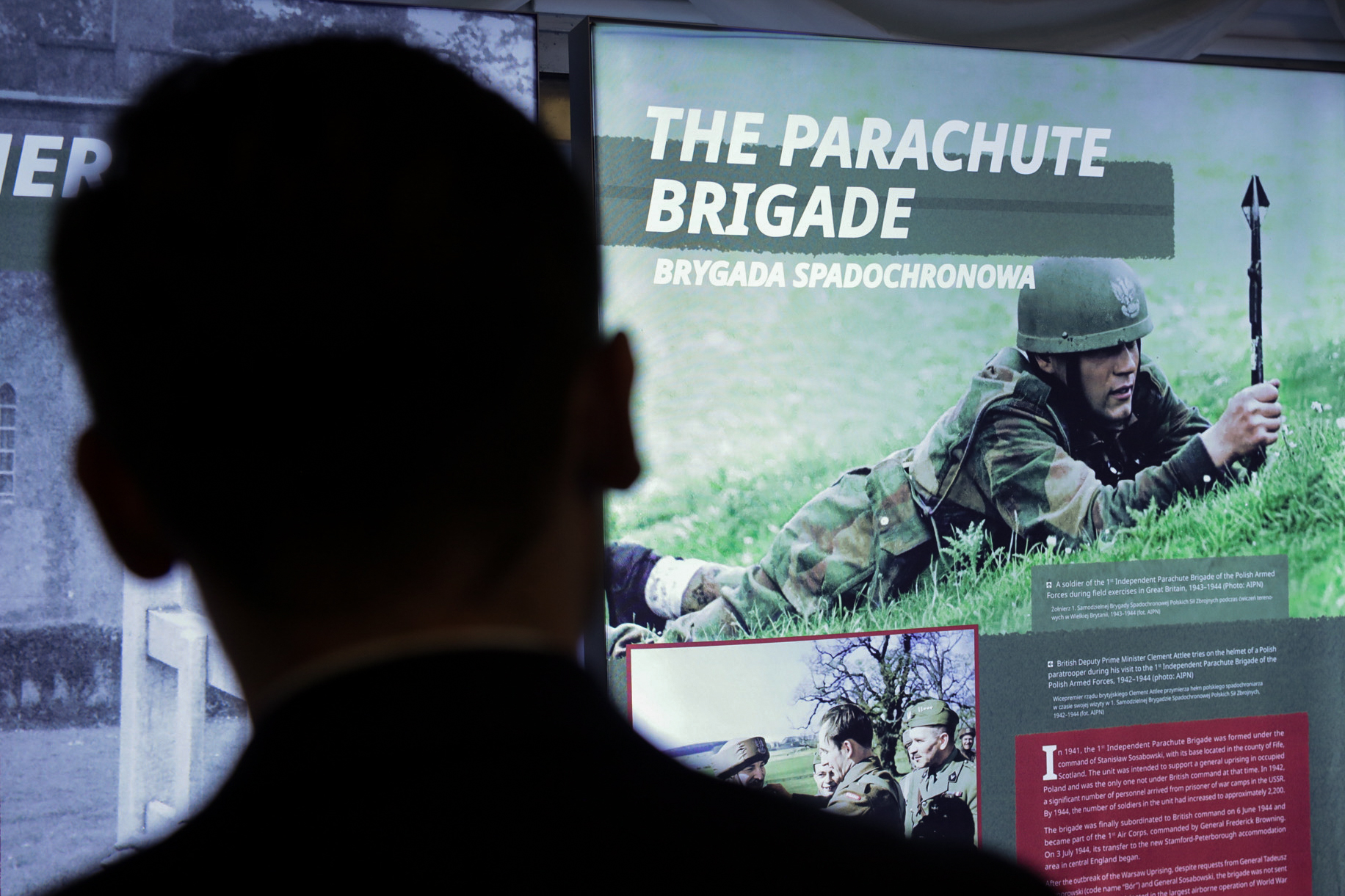
The Institute of National Remembrance developed the project “Trails of Hope. The Odyssey of Freedom” so that the memory of the soldiers of Anders’ Army and of their contribution to the victory over Germany were not forgotten. In this way, we want to honor the military effort of the Polish Armed Forces and the fate of civilians evacuated from the USSR with General Anders’ Army in 1942. This project is intended to let all the people deported to the camps in Siberia and Russia hinterland speak. It is an opportunity to recall the places of remembrance scattered throughout the world, from Asia via the Middle East, Africa, and Europe, to both the Americas.
During German occupation 5 million 200 thousand Polish citizens had perished. This constituted about 15% of the Polish population. Polish citizens lost their lives during the war operations, in public and secret executions, in concentration and death camps, regardless of their ethnicity. Poles, Jews and other inhabitants of Central and Eastern Europe were seen as subhumans, destined to be exterminated. Nearly 2 million Polish citizens, men, women and children, were sent to forced labor in Germany, which was also an element of the biological extermination.
After the war, there were over 250 thousand Poles living in the United Kingdom. Most of them later went back to Poland or moved to other countries. As Poland had lost its independence, and was controlled by the Soviets, those who remained in the British Isles became the custodians of the idea of a sovereign Polish Republic, said the IPN President Karol Nawrocki, Ph.D.
Wherever the exhibition is presented, there is a part telling about local aspects and stories of Poles living there. After the outbreak of war, it was the city of London that offered refuge to representatives of the countries attacked by the German and Soviet invaders. The Polish Government in exile was also seated here. London became the center of Polish political life in exile after the capitulation of France in June 1940. The Polish authorities in exile, residing in the territory of France since late September 1939, were invited to the UK by Prime Minister Winston Churchill. The preliminary conditions for the functioning of the Polish government within the territory of the United Kingdom were agreed upon with the British by General Władysław Sikorski, Prime Minister of Poland and Commander-in-Chief of the Polish armed forces.
Screening of the English version of the documentary about ORP Błyskawica.
The Polish destroyer was also commemorated during the event by a premiere of the English version of the documentary entitled ORP Błysakwica – the Faithful Ship.
When WW2 was about to start, the Polish Navy commanders knew that the Polish fleet would be no match for the German Kriegsmarine. „Operation Peking” was about to save three Polish Navy destroyers: „Burza”, „Błyskawica”, and „Grom” by evacuating them to Great Britain in late August and early September 1939.
In retrospect, it was a wise decision. ORP Byłskawica and other destroyers carried on fighting. She took part in the evacuation of the British soldiers from Dunkirk, the Battle of the Atlantic, and the Normandy landings. Now, it is the oldest preserved destroyer of the Western Allies in the world.
The destroyer was built in the shipyard of Cowes for the Polish Navy. Damaged by the storm in April 1942, it entered the shipyard for an overhaul. On the night of 4/5 May 1942, the Luftwaffe attacked the town. The vessel should have been disarmed, Captain Wojciech Francki, however after seeing the German reconnaissance planes violated the rules and ordered the crew to arm the destroyer and respond with fire. After the attack was repelled, the Polish sailors got to deal with the consequences of the air raid, fighting the fires and helping the civilians. The memory of the Polish assistance is still alive in Cowes today.
Read more about the IPN Trails of Hope. The Odyssey of Freedom project
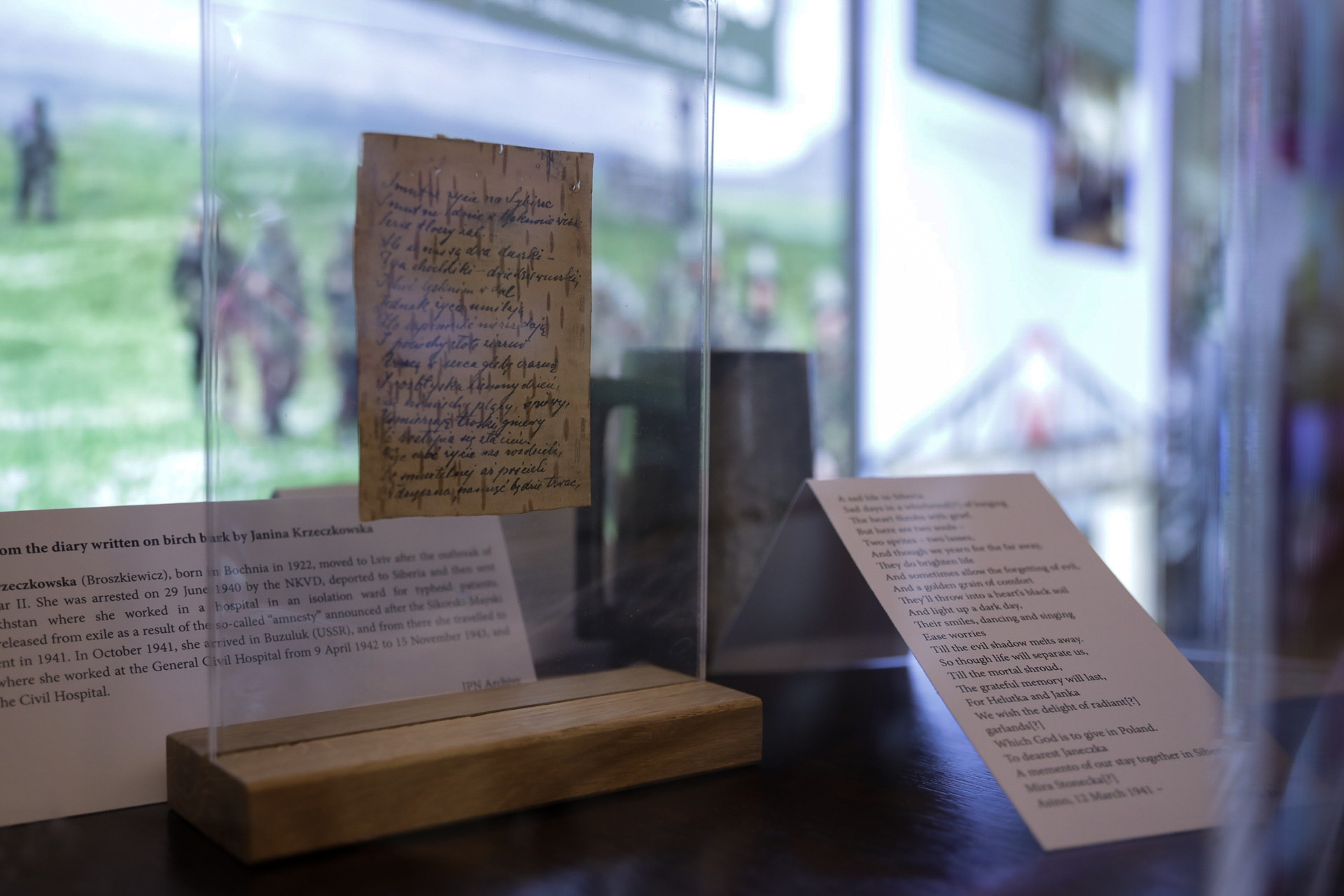
The exhibition featured some of the most valuable artifacts from the collections of the IPN Archive donated as part of the Full Memory Archive project, including a diary from Siberia written on the bark of a tree ( https://archiwumpamieci.pl/?lang=en )
Following artifacts were presented during the event:
An Armoured Train Badge belonging to Tadeusz Starzyński
Tadeusz Starzyński – a pre-war policeman, evacuated to the south-eastern territories of the Second Polish Republic in September 1939. On 21 September, he crossed the border into Hungary, where he was interned. After making his way to France, he served in the 2nd Infantry Rifle Division. In October 1940, he was transferred to the UK. There, he was assigned to the 1st Armoured Train Division and later the 1st Column of Ambulance Cars. He volunteered to serve in occupied Poland. After clandestine training, he was sworn into the Special Branch of the Supreme Commander's Staff in December 1942. He made his combat jump into German-occupied Poland on the night of 8-9 April 1944, and began to operate in conspiracy. During the Warsaw Uprising, he remained at the disposal of the Division Commander and, after the capitulation, he was to be responsible for securing counter-intelligence documents.


IPN Archive
A page from the diary written on birch bark by Janina Krzeczkowska
Janina Krzeczkowska (Broszkiewicz), born in Bochnia in 1922, moved to Lviv after the outbreak of World War II. She was arrested on 29 June 1940 by the NKVD, deported to Siberia and then sent to Kazakhstan where she worked in a hospital in an isolation ward for typhoid patients. She was released from exile as a result of the so-called “amnesty” announced after the Sikorski-Mayski Agreement in 1941. In October 1941, she arrived in Buzuluk (USSR), and from there she travelled to Tehran where she worked at the General Civil Hospital from 9 April 1942 to 15 November 1943, and later at the Civil Hospital.

IPN Archive
A Polish Navy uniform from the archives of Henryk Kołodyński
Henryk Kołodyński – lieutenant of the Polish Navy, deported with his family in February 1940 from the Eastern Borderlands into the depths of the USSR. After the conclusion of the Sikorski-Mayski Agreement and the announcement of an “amnesty” for Poles, Henryk Kołodyński reached the concentration point of the Polish Army in the USSR in Buzuluk and with it, via Krasnovodsk, reached Pahlevi in Iran. Later, in the years 1942-1945, he served in the Polish Navy.

IPN Archive
A metal tankard made in Iran for soldiers of the Polish Army evacuated from the USSR
The item features an engraving depicting a map of the Middle East with the route of the Polish Army and the locations of refugees. The metal used to make the tankard was collected on the battlefields of World War II. The item, donated by Bogdan Czułczyński, is a souvenir from the period of the Allied forces' stay in Iran.
Bogdan Czułczyński together with his mother and brother were deported from Lviv deep into the USSR to the settlement of Altynay, from where they reached Krasnovodsk after the announcement of an amnesty. From Krasnovodsk, the last transport across the Caspian Sea took them to the Iranian town of Pahlevi, then through Tehran they were transported to Ahvaz. Czułczyński’s mother, Tamara, worked at the Polish legation there, while Bogdan attended a Polish school. In 1945, they were relocated to Beirut, where they lived in mountain settlements. With the help of the International Red Cross, they managed to find their father and return to Poland in July 1947.

IPN Archive
An RAF Forage Cap and three badges: No. 300 “Land of Mazovia" Bomber Squadron, No. 301 "Land of Pomerania” Polish Bomber Squadron, Polish Air Force pilot’s badge with a green laurel wreath.
Zygmunt Radecki (1910-1970). After the start of World War II in September 1939, he was evacuated with his parent unit to Romania, from where he was transported to France in late autumn of 1939. In the spring of 1940, he was assigned to an Air Base in Morocco for training in flying bomber planes, before being evacuated to the UK with other soldiers. He was assigned to the Polish Armed Forces (RAF registration number P-1395) and was given the British rank of Pilot Officer.
He took part in numerous bombing operations in the Third Reich and carried out airdrops over Warsaw during the Warsaw Uprising.


Collection of Capt. Zygmunt Radecki’s memorabilia (donated by Rev. Włodzimierz Torbus)