
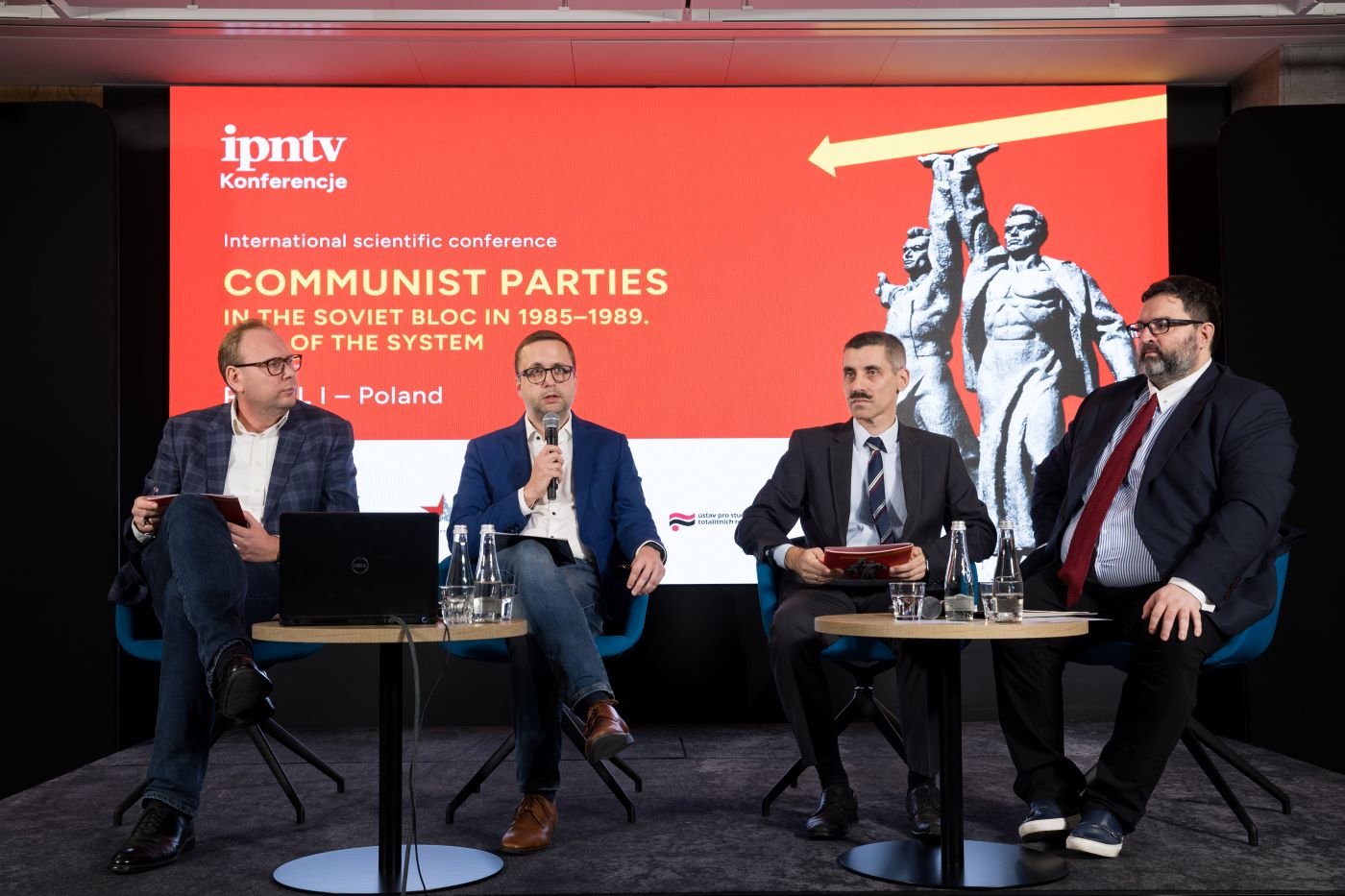


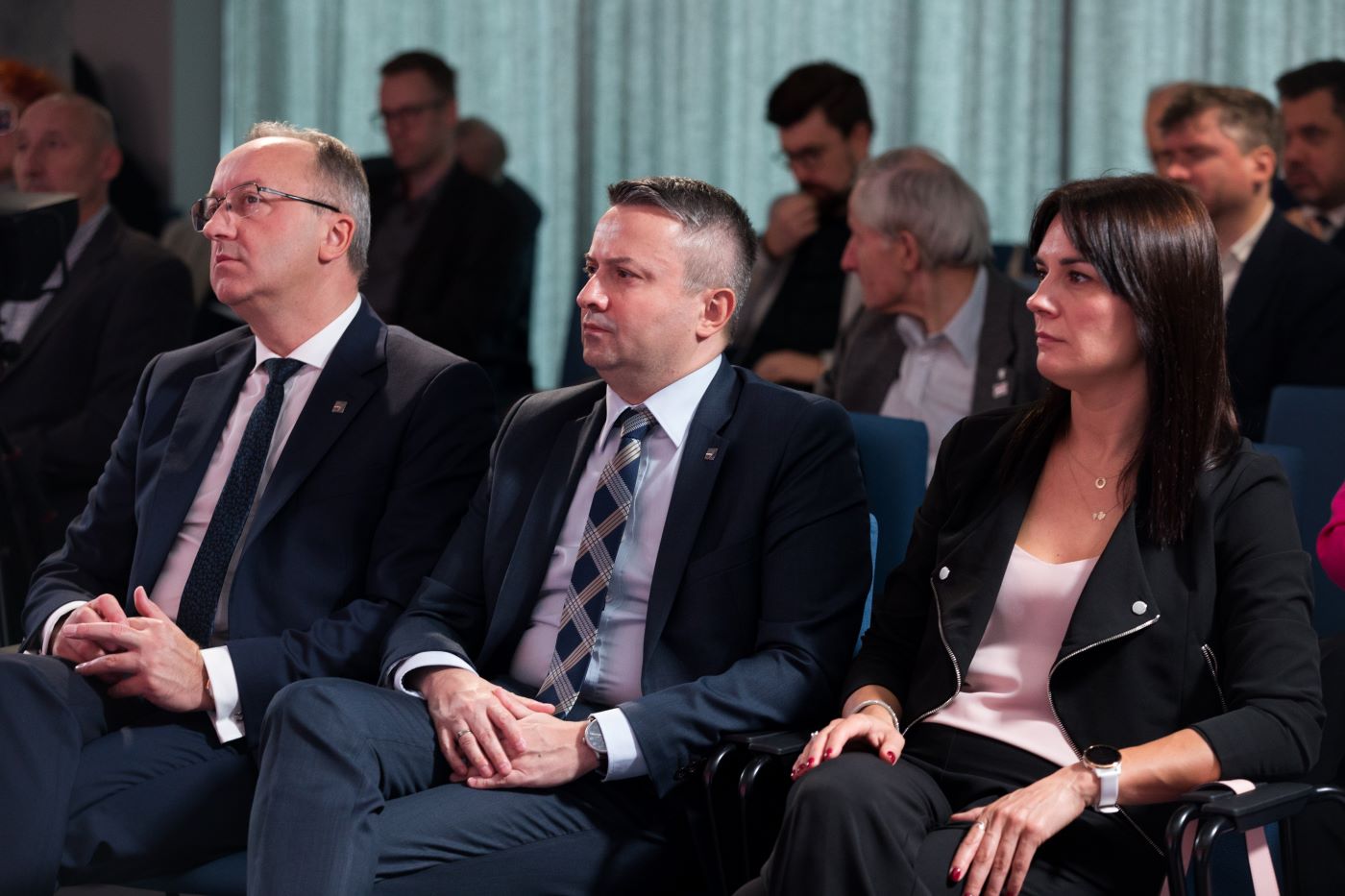
An international scientific conference entitled “Communist Parties in the Soviet Bloc in 1985-1989: Fall of the system.” is being held at the IPN's President Lech Kaczynski Central History Point on 9-10 October 2024. The event has been organized by the IPN Historical Research Office in cooperation with partner institutions from the countries of the Visegrád Group: the Slovak Nation’s Memory Institute (UPN), the Hungarian Committee of National Remembrance (NEB) and the Czech Institute for the Study of Totalitarian Regimes (USTR). The conference brings together researchers from Poland, the Czech Republic, Slovakia, Hungary, Romania, Bulgaria, Serbia and Slovenia.
The conference was officially opened by IPN Deputy President Prof. Karol Polejowski, who read out a letter from IPN President Karol Nawrocki Ph.D.
The aim of this conference is the comparative analysis of the activity of communist parties which exercised power in the countries of Central and Eastern Europe after 1944, in terms of their common features and local differences. The integration of the community of researchers from the countries of our region who are studying this phenomenon has most definitely added aa new dimension to the discussion. A very significant period of our history, mutual experiences of Central and Eastern European countries when the crisis of the communist system throughout the Soviet bloc resulted in its collapse, is going to be analysed as part of this conference. The process, which began here in Poland, led to the revolutions of 1989 and the overthrowing of the communist regime.
The aim of the conference is to show the activities and development of communist parties in the Soviet bloc in the last period of its existence - from the election of Mikhail Gorbachev as General Secretary of the Central Committee of the CPSU (1985) to the “Autumn of Nations,” the transition and collapse of the system. The main issues to be discussed at the conference will be the reaction of the communist parties to the policy of perestroika in the USSR; the parties' attitudes toward changes in international politics; international cooperation of the communist parties; attempts by the communist parties to reform the economy; personnel changes in the party leadership; the position of the communist parties towards opposition activities and social protests.
A recording of the conference will be available on the IPNtv channel at a later date. The language of the conference is English.
Agenda:
Wednesday, 9 October
10.00–10.20 Opening of the conference
10.20–11.40 PANEL I: Poland
- Tomasz Kozłowski, Ph. D.
(IPN Historical Research Office, Institute of Political Studies of the Polish Academy of Sciences)
Jaruzelski between East an d West. Geopolitical Determinants of Reforms in Poland (1985–1989) - Prof. Mirosław Szumiło
(IPN Historical Research Office, Maria Curie-Sklodowska University in Lublin)
The leadership of the Polish United Workers’ Party in 1988–1990 - Rafał Łatka, associate professor
(IPN Historical Research Office, Cardinal Stefan Wyszyński University in Warsaw)
Wojciech Jaruzelski’s strategy of action against the Church in Poland (1985–1989) - Discussion
11.40–12.00 Coffee break
12:00–1:30 PANEL II: Poland in international relations
- Przemysław Gasztold, Ph.D.
(IPN Historical Research Office, War Studies University)
PUWP’s Foreign Policy and the Future of Marxism. Relations with Third World Communist and Revolutionary Parties (1985–1989) - Sylwia Szyc, Ph.D.
(IPN Historical Research Office)
The Twilight of Fraternal Friendship: Polish-North Korean Relations in the late 1980s - Daniel Filip-Afloarei, Ph.D.
(The Institute for the Investigation of Communist Crimes and the Memory of the Romanian Exile)
The relations between the Romanian Communist Party and the Polish United Workers’ Party under Gorbachev’s „reign” - Discussion
1:30–2:30 Break
2:30–3:50 PANEL III: Hungary
- Pál Germuska, D.Sc.
(Office of the Committee of National Remembrance, Hungary)
Reforming Socialism or Building Capitalism? The International Financial Institutions and the Hungarian Economic Reforms in the second half of the 1980s - Attila Apor, Ph.D. candidate
(Pazmany Peter Catholic University in Budapest, Hungary)
The Fall of János Kádár. The May 1988 Party Conference and its Consequences - Gábor Szilágyi, Ph.D.
(Office of the Committee of National Remembrance, Hungary)
Why Did It Have To Be Grósz? Candidates and Alternatives for János Kádár’s Succession - Discussion
3:50–4:10 Coffee break
4:10–6:00 PANEL IV: Czechoslovakia
- Tomáš Malínek, Ph.D.
(Institute for the Study of the Totalitarian Regimes, Czech Republic)
The Communist Party of Czechoslovakia and its response to the East German refugee crisis in 1989 - Martin Halmo
(Nation’s Memory Institute, Slovakia)
Too little – too late. The Period of Reconstruction in Czechoslovakia through the lens of the documents of the Communist Party of Slovakia - Peter Jašek, Ph.D.
(Nation’s Memory Institute, Slovakia)
Communist Party of Slovakia and its attitude towards the public opposition movement from the Candle Manifestation to the Gentle Revolution. Between the hard line and dialogue - Adam Bielesz, Ph.D.
(Nation’s Memory Institute, Slovakia)
Meetings of the Central Committee of the Communist Party of Slovakia during the Velvet Revolution - Discussion
Thursday, 10 October
10:00–11:20 PANEL V: Bulgaria and Romania
- Anton Mioara, Senior Researcher
(„Nicolae Iorga” Institute of History, Romanian Academy)
The final countdown. Nicolae Ceaușescu at the end of the totalitarian utopia - Detelina Dineva, Ph.D.
(Institute for Historical Studies, Bulgarian Academy of Sciences)
The Process of Perestroika and Bulgaria - Krasimira Todorova, Ph.D.
(Sofia University St. Kliment Ohridski, Bulgaria)
The fall of the Communist Regime in Bulgaria (1989–1990) - Discussion
11:20–11:40 Coffee break
11:40–12:45 PANEL VI: Yugoslavia
- Prof. Aleksandar Životić
(Department of History of Yugoslavia Faculty of Philosophy, Belgrade University, Serbia)
League of Communists of Yugoslavia and political changes in the Soviet Union (1985–1989) - Aleš Gabrič, Ph.D.
(Institute of Contemporary History in Ljubljana, Slovenia)
Intellectuals as opposition in Slovenia in the 1980s
12:45 Discussion and closing of the conference