
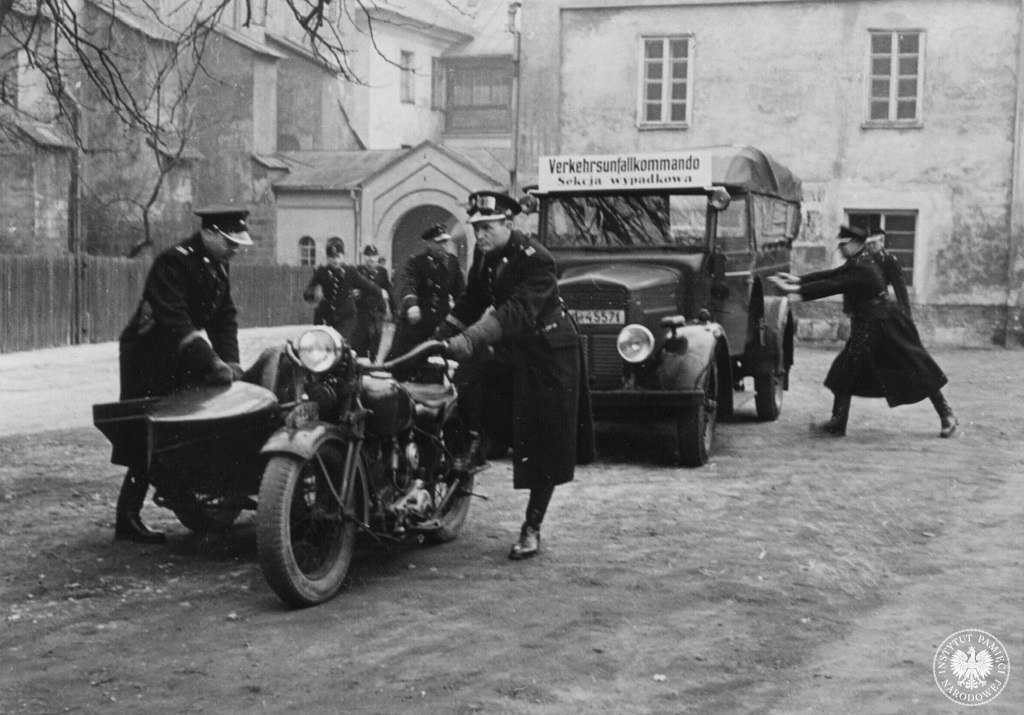
Every officer, as a member of the German services, was obliged to follow German orders. The Germans required that Jews staying outside designated areas be either murdered on the spot or be handed over to the gendarmerie. From the point of view of the Polish state, those who carried out such murders were traitors.
Stanisław Płużański talks to Maciej Korkuć, Ph.D., Head of the IPN Branch Office for Commemorating the Struggle and Martyrdom in Cracow and Lecturer at the Ignatianum University in Cracow.
What was the Blue Police?
Maciej Korkuć: It follows from the very definition of the police that it is a formation of a particular state. The Blue Police, or Polnische Polizei, was a German uniformed formation created on 17 December 1939 by Governor-General Hans Frank. He exercised authority in the General Governorate (GG) on behalf of the German Reich, using the German legal order and the decisions of the Reich Commander in Chief. The Blue Police was created as the lowest link in the structure of the German Ordnungspolizei (Order Police) in the General Governorate. It was part of it. From the beginning, it was conceived as a German tool, recruited from Poles and partly from Ukrainians, for the execution of occupation laws. It was also meant to be freely used by the “racially” higher German gendarmerie formations and their counterparts, the Schutzpolizei, or Schupo, in several major General Governorate cities.
Keeping in mind who this formation was set up by is key in assessing its performance. In various disputes this is most often overlooked. And without this, the essence of the matter is easily lost. It should be emphasized that there was no state or legal continuity between the Blue Police and the pre-war Polish State Police. The Blue Police was created by the German authorities as part of their own legal order. They had control over it, they decided on its structure, promotions and how it was to be used. No one asked Poland for permission.
Who were the members of the Blue Police?
They were mainly Polish citizens employed in the State Police before the war, forced by the Germans under the threat of the “highest penalties” to register with the German occupation authorities and then forcibly sent to serve in the German Polnische Polizei. The Germans were also looking for officers who had been in conflict with the law before the war, e.g. policemen dismissed from service for disciplinary reasons. Sometimes also those who had retired. At some point they also opened up to volunteers - people who had no police experience before the war.
The Germans needed tools to control the large areas that came under their rule. The Polish territories directly incorporated into the Reich were to be served by "racially" German police formations. In the remaining lands incorporated into the Reich, in the form of the administrative structure created by Hitler under the name the General Governorate, the Germans needed additional tools to manage these peculiar reservation areas for Poles and Jews. They needed people who spoke Polish and knew the local community.
The largest group in this formation were those who were recruited forcibly. Another thing is that, as a result of doubts about the potential loyalty of these Poles, the idea of creating an autonomous, vertical hierarchy of the Polnische Polizei in the General Governorate was abandoned. The vertical structure within this “blue” part of the Orpo theoretically ended with the district commander. However, the actual commanders of the blue policemen were the local German Schupo and gendarmerie commanders. The district commanders were reduced to the role of those who, under German regulations, were to provide the organisational and economic facilities to carry out German orders. Commanders of the local gendarmerie, on the other hand, were explicitly referred to as the “Polnische Polizei Fuhrer” in German documents. The gendarmes had to be saluted even by formally senior blue officers. At the higher levels of command in the Orpo, only the functions of “Polish liaison officers” were created. They had no formal power. They were like assistants and Polish-speaking advisors to the German officers. The Germans made sure that the blue police structures remained atomised. They believed that even Poles enlisted in their service should not be allowed to join forces.
What was the attitude of the Polish Underground State towards the Blue Police?
The attitude was the same as towards the German service through which the German Reich unlawfully exploited Polish citizens. The Republic of Poland, and the Polish Underground State, which was part of its structures, approached the situation in which individual citizens found themselves - policemen forcibly conscripted into the ranks of the German Polnische Polizei - with understanding. However, a dignified attitude was expected of them. Participating in the fight against criminals harassing the civilian population was not a problem. But participation in German repression and crimes was. The Reich and the Orpo superiors required them to be loyal, and therefore to diligently carry out the orders of their German superiors. Each policeman formally declared that he considered the oaths he had previously taken to the Polish state to be invalid. However, these were internal German procedures. Despite these circumstances, the Polish state expected them - as citizens of the Republic of Poland - to be loyal to the Republic of Poland and its laws.
Those who showed zeal in carrying out the orders of their German superiors, who committed crimes (under the Polish Penal Code), who, taking advantage of German protection, abused their power, showed brutality or participated in German crimes, were to face, after the war, individual criminal responsibility for the acts they committed. This also applied to Jews - Polish citizens who became involved in the Jewish Order Service (Judischer Ordnungsdienst) created by the Germans in the ghettos. Traitors were to be held accountable in the courts of free Poland. Particularly dangerous and zealous blue policemen who were within reach of the Polish underground were killed without waiting for the end of the war. Death sentences were also passed on them as part of the state order - as part of the punishment of a Polish citizen who had become a traitor and a criminal. The most zealous were the most influential under the Germans and most visible to society. Therefore, in the public perception, the Blue Police was a formation generally regarded as an element of occupation oppression. It was secretly despised for its servility towards the occupants. The Germans offered the opportunity for racial advancement to some of the most dedicated officers - they could become Volksdeutsche.
From the point of view of the German state, a Polish death sentence on a blue traitor meant the loss of its own officer. This is why the Germans counted the blue policemen killed in such a way as their own losses in their internal documentation. This is all logical and coherent, but only if one remembers that during this war there was both a German state and a Polish state.
How big was the role of the Blue Police and the Jewish Police in the extermination of the Jews?
It was as the Germans intended. During the liquidation of ghettos, the blue policemen were most often assigned auxiliary tasks. They took part in setting up cordons around villages, escorting, guarding. As part of these duties, the Germans expected them to be ready to stop and shoot those Jews who were trying to escape. A more important role - from the point of view of the technical handling of the mass murder - was fulfilled by officers of the already mentioned Jiidischer Ordnungsdienst, also established by the Germans and composed of Jews, often called OD-men. They were a tool for enforcing German orders in the ghettos. Jews who volunteered for this service usually counted on “settling in” under German rule. As a service enforcing the most brutal orders of the occupier, it was sincerely hated by ordinary Jews. Many OD-men wanted to earn recognition in the eyes of the Germans. They knew the Jewish communities, they knew the people, and they also knew who and by what methods might try to organize a hiding place in houses in order to survive the liquidation of the ghetto. They were the ones who searched houses and delivered hiding Jews to the Germans. Both they and the Blue Police were tools of the German occupiers.
Finally, it is also worth remembering that during the occupation, blue policemen were used in various places to execute both Poles and Jews.
What is worth commemorating in the activities of the Blue Police and what should be unequivocally condemned?
In Poland, the activities of the Blue Police as a German occupation formation must not be commemorated or glorified in public places. There is a legal prohibition on glorifying this type of services of totalitarian states. On the other hand, it is something completely different to commemorate officers who, while wearing the uniform of the Blue Police, i.e. officially serving the German Reich, were in reality soldiers of the Home Army or activists of other independence structures. While serving "in foreign skin", they acted against the Reich - for the benefit of the Polish state and its independence. For example, Franciszek Banaś, a policeman from Cracow, deserves to be remembered not as a Blue Policeman, but as a clandestine soldier of the Home Army, who used the service and the uniform of a Blue Policeman for anti-German activities, gathering information about traitors, helping those in danger, even for external protection of the Home Army men who carried out sentences. Such people should be remembered as soldiers of the Polish Home Army, not the German Polnische Polizei. This is a fundamental difference. It was Banaś, among others, who helped little Tadeusz Jakubowicz (later post-war long-time chairman of the Cracow Jewish community) escape from the Cracow ghetto. He bribed Gestapo men and saved his and his mother’s life. Taking advantage of the enemy uniform and the opportunities it provided, he saved two Polish citizens, in addition to many others.
On the site of the former Plaszow Concentration Camp there is a plaque commemorating the officers of the pre-war State Police, soldiers of the Home Army. The Germans murdered them after discovering that they were only pretending to serve the Reich in the Blue Police and were, in fact, serving Poland. These are beautiful figures, such as Franciszek Erhard and Ludwik Drożanski. And on the plaque commemorating them there is not a word about their blue “outer skin”. Instead, it mentions “Polish policemen of the Second Republic, soldiers of the Union of Armed Struggle-Home Army (ZWZ-AK)”. This is an important separation of two state orders. And it was no coincidence that the aforementioned Tadeusz Jakubowicz also took part in the ceremonial unveiling of this plaque.
According to some historians, the Blue Police were so involved in the murder of Jews that they often operated even without the participation of the Germans. Is that true?
Every officer, as a member of the German services, was obliged to follow German orders. The Germans required that Jews staying outside designated areas be either murdered on the spot or be handed over to the gendarmerie. From the point of view of the Polish state, those who carried out such murders were traitors, from the point of view of the Reich, they performed their duties. There were some blue policemen who sabotaged German orders, helped people escape. We also have an example of a policeman who hid Jews himself and at the same time made himself credible to the Germans by e.g. zealously murdering others. It also happened that the blue policemen, knowing about the Poles who were hiding Jews, preferred to kill them on the spot rather than hand them over to the Germans. Because the person being interrogated could betray everyone who helped him. These situations are not easy to judge. However, the murder of an innocent man remains murder. Such conditions were created by the Germans under the occupation, but the problem of individual responsibility remains. Today this is all very hard to imagine while living comfortably in a free country.
Finally, it should be noted that there were also degenerates who were dedicated to tracking down both Jews and the Poles who were helping them. They murdered both, hoping for recognition in the eyes of the Germans - such as the notorious Kazimierz Nowak from the Miechów area. The Home Army also carried out a sentence on him.
How, with hindsight, should we judge the activities of the Blue Police during World War II?
Firstly, it should be judged just like every service created by a specific state to achieve specific results. Trying to answer the question of how much the Germans succeeded in making it work and how much they did not - participation in the murder of Jews or Poles, abuse, involvement in activities against the health and safety of other Polish citizens was tantamount to treason against Poland and was to carry the prospect of criminal liability after Poland regained independence. After the war, everything was to be judged by the institutions of independent Poland. However, its reconstruction was prevented by the Soviets. Instead of Poland, there was a communist state with all its consequences, but that is a topic for a separate conversation.