
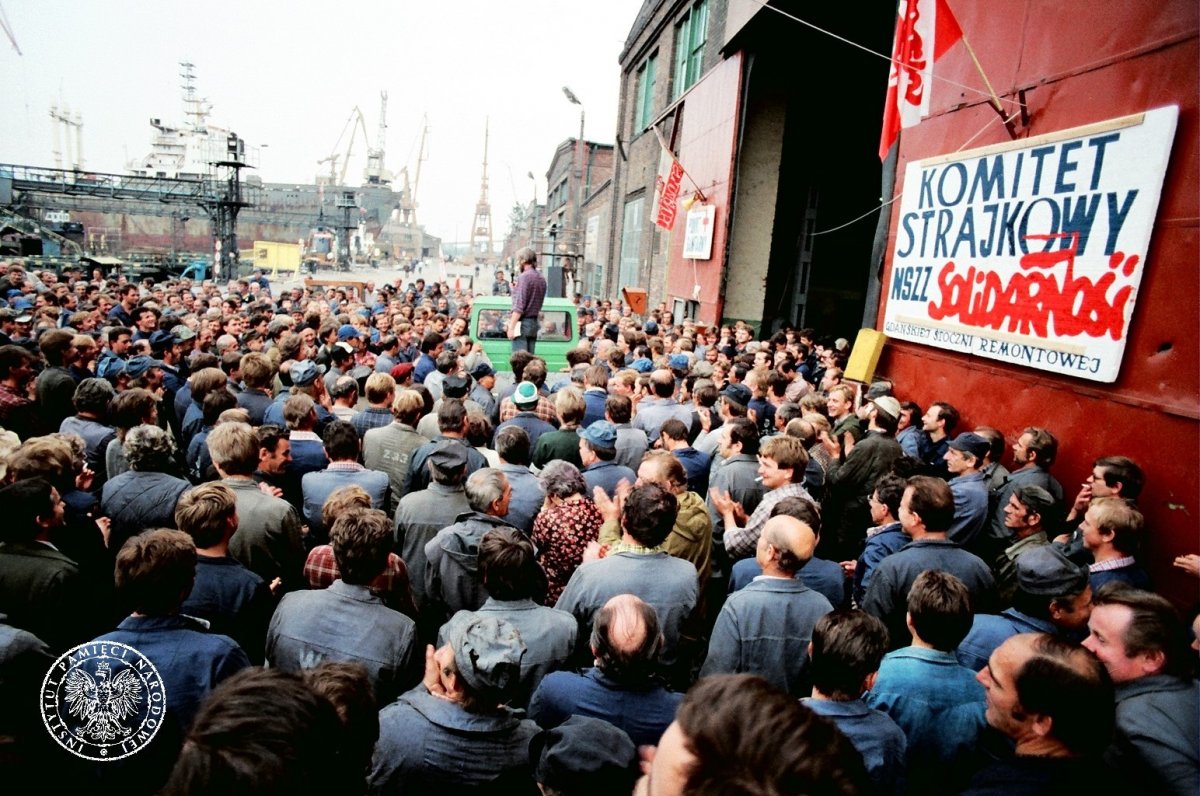
We hereby invite you to the conference Freedom was born in Poland. “Solidarity” and opposition movements in Central and Eastern Europe in the 1980s, organised as part of the “Solidarity and Social Resistance in the People’s Republic of Poland 1956–1989” IPN Central Research Project. It will take place on 9–10 September 2025 in Warsaw. We expect your applications until 31 March 2025.
2025 marks the 45th anniversary of the birth of the “Solidarity” Trade Union, an organisation that played a decisive role in the emergence of Poland and the whole of Central and Eastern Europe from communism. Residents of countries which were included into the Soviet territory after the Yalta agreement tried to break free from this nightmare by organising different forms of resistance and protest against the system.
Poles tried to oppose communism many times. Unfortunately, apart from tactical concessions by the leaders of Polish United Workers’ Party, protests of 1956, 1968, 1970 and 1976 were not successful. However, the resistance of the society meant that in Poland as the only country of the Soviet bloc it was not possible to collectivise agriculture, and the Catholic Church maintained its independence. The economic crisis was spreading in the mid-seventies, shortages of basic products were slowly becoming an everyday reality. The action taken at the turn of 1975 and 1976 to change the constitution led to the revival of the opposition.
Birth of “Solidarity” in August 1980 was a breakthrough in the modern history of Poland. Poles had been waiting for such a moment of the national uprising since the end of World War II. Yet, “Solidarity” was not only a hope for improving the economic situation. It awakened the long dormant pursuit of freedom, a sense of dignity, restored Christian elements to public life and brought moral renewal.
This movement also inspired the residents of other countries of Central and Eastern Europe to take up opposition and, consequently, led to the collapse of the system. During the First National Congress of Delegates of the Solidarity Trade Union in September 1981, one of the key documents was issued – the “Message to the Working People of Eastern Europe”. It was a symbolic gesture of solidarity, opening to other nations controlled by USSR. It was also an announcement of mutual path to freedom.
It was “Solidarity” in 1980 that started the biggest process of peace coup after World War II, which led to the fall of the symbol of division of Europe – the Berlin Wall. Autumn of Nations 1989, although different from the Polish negotiations of 1988–1989, resembled the energy and spirit of August 1980. The events in the Soviet bloc at the turn of the 80s and 90s confirmed how important Polish August 1980 had been for the history of the continent.
Appreciating the importance and significance of these events, the Historical Research Office of the Institute of National Remembrance plans to organise an international scientific conference devoted to issues related to the anti-communist opposition in the Polish People’s Republic and other countries of Central and Eastern Europe in the years 1980–1989.
Its main goal would be the presentation of value of “Solidarity” for the process of changes in Central and Eastern Europe, which led to the fall of communism.
The conference will address issues related to the following thematic areas:
- birth of “Solidarity” and opposition and social resistance in Central and Eastern Europe in 1980–1989
- independent social and political initiatives in Central and Eastern Europe inspired by “Solidarity” (political thought, independent publishing movement, forms of activity, similarities and differences in opposition activities in Poland and other countries of Central and Eastern Europe, etc.)
- contact of “Solidarity” opposition in Poland with the opposition of Central and Eastern Europe
- foreign travels of representatives of “Solidarity” in the 80s to publicise the political situation in Poland and their effects
- reactions of so-called Eastern bloc states to the birth of “Solidarity”
- repression of communist special services and state administration (judicial administration, etc.) against people and circles expressing support for “Solidarity”
- cooperation of secret services in combating the effects of the solidarity revolution
- regime propaganda of the countries of the Eastern bloc towards the creation and development of “Solidarity”
- 1989 as a peaceful dismantling of the political system in Poland and the beginning of changes in other countries of Central and Eastern Europe
- models of transition from monoparty dictatorships to parliamentary democracies in individual countries of the so-called Eastern bloc
- modern remembrance of “Solidarity” in countries of Central and Eastern Europe
Conference’s organisational committee:
Dr Sebastian Pilarski – Head of Historical Research Office
Dr Marzena Grosicka, tel. 41 340 50 67, e-mail: marzena.grosicka@ipn.gov.pl
Dr hab. Cecylia Kuta, tel. 12 289 20 70, e-mail: cecylia.kuta@ipn.gov.pl
Attendance is free of charge. Conference fee will not be collected. The organisers provide catering for speakers.
The deadline to register for the conference is 31 March 2025.
Please send your application, including the title of your speech and abstract, to the following e-mail addresses:
Dr Marzena Grosicka: marzena.grosicka@ipn.gov.pl
Dr hab. Cecylia Kuta: cecylia.kuta@ipn.gov.pl
Please send applications in English from foreign participants to the e-mail address:
Paulina Borowa: paulina.borowa@ipn.gov.pl
Speakers will be required to submit articles based on the refereed papers by the deadline of 30 November 2025.
The organisers reserve the right to choose the applications and texts submitted for publication.
Conference location: Warsaw, Central History Stop of President Lech Kaczyński, Marszałkowska 107, Warsaw
Date: 9–10 September 2025
Conference language: English