
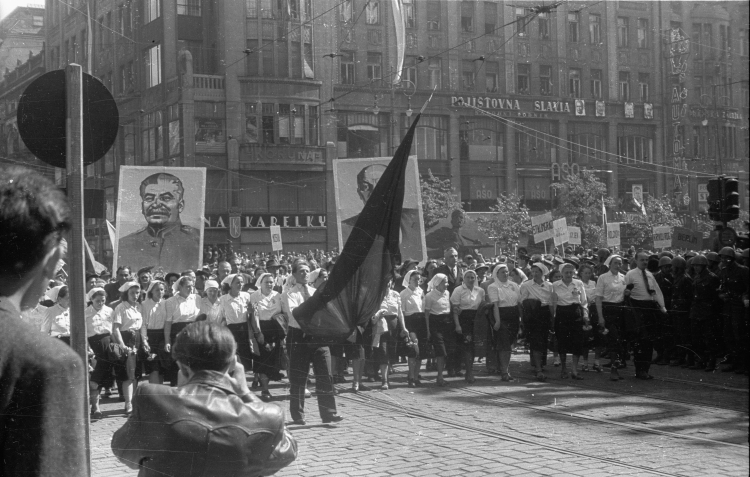
The Historical Research Office of the IPN in Warsaw invites you to participate in the international conference "Direction - Stalinism: A Postwar Signpost for Central and Eastern Europe." This event will take place on May 28-29, 2025, at the IPN Central History Pointat 107 Marszałkowska Street in Warsaw.
In February 1945, as the end of World War II approached, the three major world powers convened at the Yalta Conference to establish the principles of the post-war world order. One significant outcome of this meeting was the creation of a Soviet sphere of influence in Central and Eastern Europe. Between 1944 and 1948, the existing political systems in the Soviet satellite states were dismantled. The Communists formed what appeared to be coalition governments under a system they called people's democracy, which were legitimized through rigged elections.
As tensions grew between the USSR and Western countries, leading to the onset of the Cold War, the transformation of the Soviet sphere of influence accelerated. After the conference held in Szklarska Poręba in September 1947, the anti-Western stance of the communist movement gained strength, increasing the control exerted by Moscow over its satellite states. Consequently, these countries were swiftly reorganized according to the principles of Stalinism. Only after the death of the Soviet dictator in 1953 did a shift away from Stalinism become possible.
The organizer will provide simultaneous translation into Polish and English
The conference is organized as part of the Central Research Project "The Communist Movement and the Apparatus of Power 1917-1990."
Program
28 May 2025
Institute of National Remembrance, President Lech Kaczynski Central History Station, 107 Marszalkowska Street, Warsaw
9:30–10:00 Introduction
Chair: Tomasz Kozłowski (Institute of National Remembrance)
10:00–12:00 Panel I: Sovietization
10:00–10:20 Aleksandar Životić (Belgrade University, Serbia): Interrupted Sovietization. Ideological and Political Strongholds of the Yugoslav Experience of Stalinism (1944–1948)
10:20–10:40 Mirosław Szumiło (Institute of National Remembrance / Maria Curie-Skłodowska University in Lublin, Poland): Communist Power Elites in Poland and Czechoslovakia in 1948–1953. An Attempt at Comparison
10:40–11:00 Adam Dziuba (Institute of National Remembrance, Poland): “Revolutionary Vigilance”. The Origins and Consequences of the Third Plenary Debate of the Central Committee of the Polish United Workers’ Party (11–13 November 1949)
11:00–11:20 Artur Troost (University of Warsaw, Poland): Stalinism as a Directive Not Only for Central and Eastern Europe. The Hardening of the Course of Western Communist Parties in the Early Post-War Period
12:00–12:15 – Break
12:15–13:55 Panel II: The Foundation of the Governance: the Security Apparatus
Chair: Władysław Bułhak (Institute of National Remembrance)
12:15–12:35 Nadia Boyadjieva (Bulgarian Academy of Sciences, Bulgaria): The Soviet Union, the Bulgarian State Security Apparatus, and the Imposition of Stalinist Rule in Bulgaria (1944–1949)
12:35–12:55 Paweł Sztama (Institute of National Remembrance / Museum of Cursed Soldiers and Political Prisoners of the Polish People’s Republic, Poland): “The Security Organs of the Polish Committee of National Liberation Also Work Badly [...]”. On the First Cadres of the Communist Security Service in Poland (1944/1945)
12:55–13:15 Robert Klementowski (University of Wrocław, Poland): Stalinism – an Episode in the Process of Security Apparatus’s “Longue Durée”
13:55 – 15:00 Break
15:00 – 16:15 Panel III: Economic Planning and Industrialization
Chair: Bogusław Tracz (Institute of National Remembrance)
15:00–15:15 Goran Arčabić (Zagreb City Museum, Croatia): Planned Industrialization in Yugoslavia (1947–1952)
15:15–15:30 Thomas Sniegon (Lund University, Sweden): Czechoslovakia in the Shadow of Hiroshima and the Gulag
15:30–15:45 Magdolna Baráth (Historical Archives of the Hungarian State Security, Hungary): Laying the Economic Foundations of the Proletarian Dictatorship in Hungary
29 May 2025
Institute of National Remembrance, President Lech Kaczynski Central History Station, 107 Marszalkowska Street, Warsaw
9:00–11:20 Panel IV: Ideology and Propaganda
Chair: Rafał Opulski (Institute of National Remembrance / The Pontifical University of John Paul II in Cracow)
9:00–9:20 Mario Jareb (Croatian Institute of History, Croatia): The Imposition of Communism in Croatia/Yugoslavia at the End of the Second World War Through the Eyes of the First Croatian/Yugoslav Dissident Bogdan Radica
9:20–9:40 Klejdi Këlliçi (University of Tirana, Albania): The Politicization of Motherhood in the Early Years of Socialism in Albania
9:40–10:00 Monika Wiśniewska (Institute for the History of Science of the Polish Academy of Sciences, Poland): “State children.” Institutional Child Care in Socialist Countries as Exemplified by the Polish People’s Republic and the German Democratic Republic
10:00–10:20 Bogusław Tracz (Institute of National Remembrance, Poland): Stalin’s Cities as Part of the Personality Cult
10:20–10:40 Tomislav Anić (The Catholic University of Croatia, Croatia): The Court as an Organ in the Struggle Against the Class Enemy: Judiciary, Private Property, and the Seizure of Assets in Croatia/Yugoslavia after World War II
11:20–11:40 Break
11:40–13:40 Panel V: Diplomacy and Internationalism in the Stalinist World
Chair: Adam Dziuba (Institute of National Remembrance)
11:40 – 12:00 Anna Patecka-Frauenfelder (University of Łódź, Poland): In Anticipation of a Peace Treaty with Germany. The Polish Press and the Post-War Reality in Germany
12:00–12:20 Rafał Opulski (Institute of National Remembrance / The Pontifical University of John Paul II in Cracow, Poland): The Socio-Political Situation in Central and Eastern Europe in the Light of the Reports of the Diplomatic Missions of Poland in the First Years of Stalinism
12:20–12:30 Konrad Rokicki (Ministry of Foreign Affairs, Poland): The Forms and Content of Poland’s Communist Diplomacy in the First Post-War Decade
12:30–13:00 Sylwia Szyc (Institute of National Remembrance, Poland): The Burden of Internationalism. Eastern Bloc Countries Towards the Korean War (1950–1953)
13:40–14:30 Break
14:30–16:00 Panel VI: Towards Destalinization
Chair: Grzegorz Wołk (Institute of National Remembrance)
14:30–14:50 Mark Kramer (Harvard University, USA): Stalin’s Death and Outbreaks of Mass Unrest in East-Central Europe, May–June 1953: A Reassessment
14:50–15:10 Paweł Sasanka (The Witold Pilecki Institute of Solidarity and Valor, Poland): The Crisis of the Party Bureaucracy as an Element of the Crisis of the System of Power in Poland in 1955–1956
15:10–15:30 Paul Maddrell (Loughborough University, UK): Walter Ulbricht, the Stasi, and Destalinization
16:00 – End of the Conference