
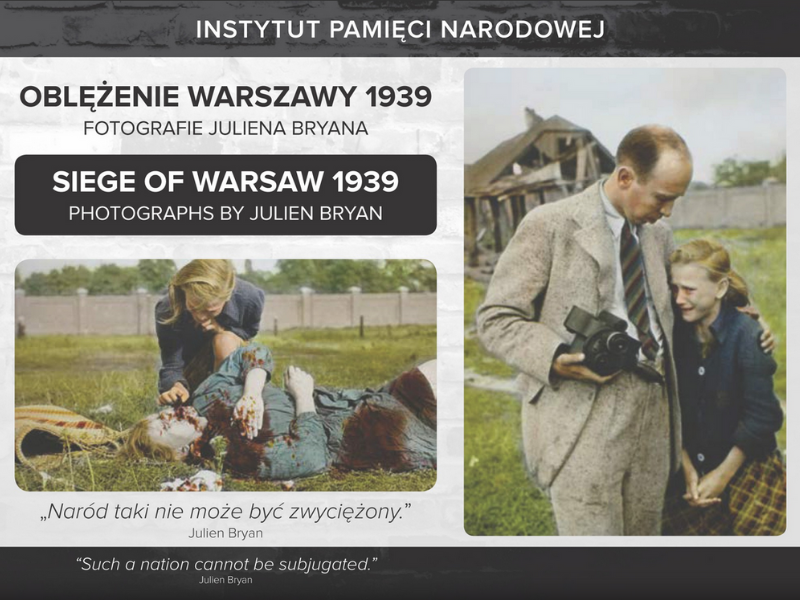
Julien Bryan (1899–1974), an American documentary filmmaker and photographer was credited as the only foreign correspondent in Warsaw at that time. He arrived in the capital on 7 September 1939 just as all foreigners, diplomats and government officials were fleeing from Warsaw. He contacted the mayor of Warsaw, Stefan Starzyński who provided him with a car, a guide and an interpreter so that he would be able to travel across Warsaw and document German methods of total war and the bombing of the city by the Luftwaffe. In two weeks between 7-21 September, he managed to take hundreds of still photographs documenting the siege of Warsaw and to shoot a few hours of video material of bombings, collapsing houses and hospitals, human bodies lying in the streets, the building of barricades, the tragedy of civilians, the German strength and arrogance.
Bryan’s photos from this period became legendary, and with the help of the American press they were seen all over the world. On 21 September 1939, he left Warsaw, taking with him rich material documenting the lives of civilians and the brutality of German soldiers. The film tapes were then used to produce the film "Siege", depicting the heroic struggle of Warsaw’s inhabitants. The film was screened in American cinemas in the spring of 1940. It received the American Film Academy Oscar nomination in 1941 in the ‘best short documentary’ film category.
Interestingly, during his stay in Warsaw, Bryan used, among others, Kodak's color films, which he took with him to test this innovative solution. The pictures taken by Julien Bryan are the only color photographs that show the siege of Warsaw in September 1939 from the point of view of a benevolent observer, showing the despair of Varsovians, the rubble, the wounded and the homeless. Other well-known color photographs depicting these events were taken by the German propaganda units. They, however, show a completely different story - instead of rubble and despair, they portray German dominance and military strength.
After the war, Bryan returned to Poland several times: in 1946, 1958, 1959 and 1974. He managed to find many of the people he photographed in 1939. The story of this search was included in the book "Warsaw. 1939 Siege. 1959 Warsaw Revisited ”. He died in New York on 20 October 1974, shortly after returning from Poland.
Thanks to an agreement concluded in 2010 with the son of the photographer Sam Bryan, the Archive of the Institute of National Remembrance is in possession of digital copies of Julien Bryan's photos.
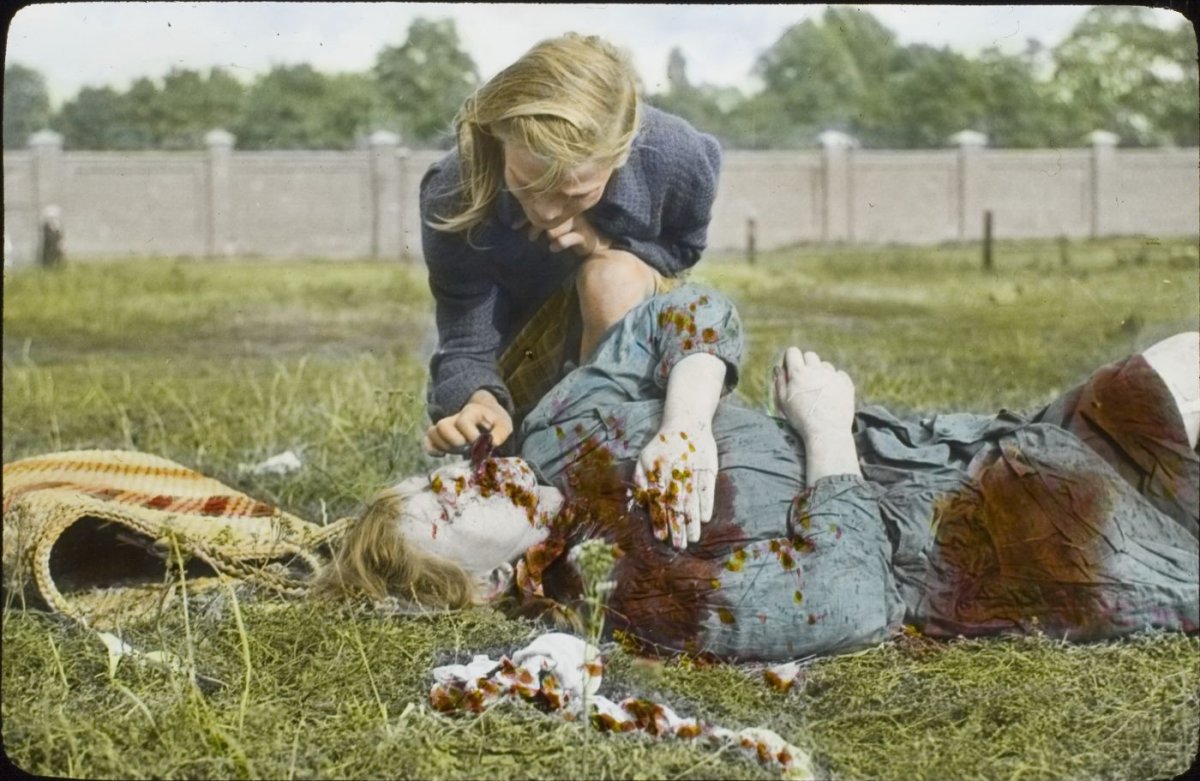
"As we drove by a small field at the edge of town we were just a few minutes too late to witness a tragic event, the most incredible of all. Seven women had been digging potatoes in a field. There was no flour in their district, and they were desperate for food. Suddenly two German planes appeared from nowhere and dropped two bombs only two hundred yards away on a small home. Two women in the house were killed. The potato diggers dropped flat upon the ground, hoping to be unnoticed. After the bombers had gone, the women returned to their work. They had to have food. But the Nazi fliers were not satisfied with their work. In a few minutes they came back and swooped down to within two hundred feet of the ground, this time raking the field with machine-gun fire. Two of the seven women were killed. The other five escaped somehow. While I was photographing the bodies, a little ten-year old girl came running up and stood transfixed by one of the dead. The woman was her older sister. The child had never before seen death and couldn't understand why her sister would not speak to her... The child looked at us in bewilderment. I threw my arm about her and held her tightly, trying to comfort her. She cried. So did I and the two Polish officers who were with me..." [Source: Bryan, Julien. "Warsaw: 1939 Siege; 1959 Warsaw Revisited."]