
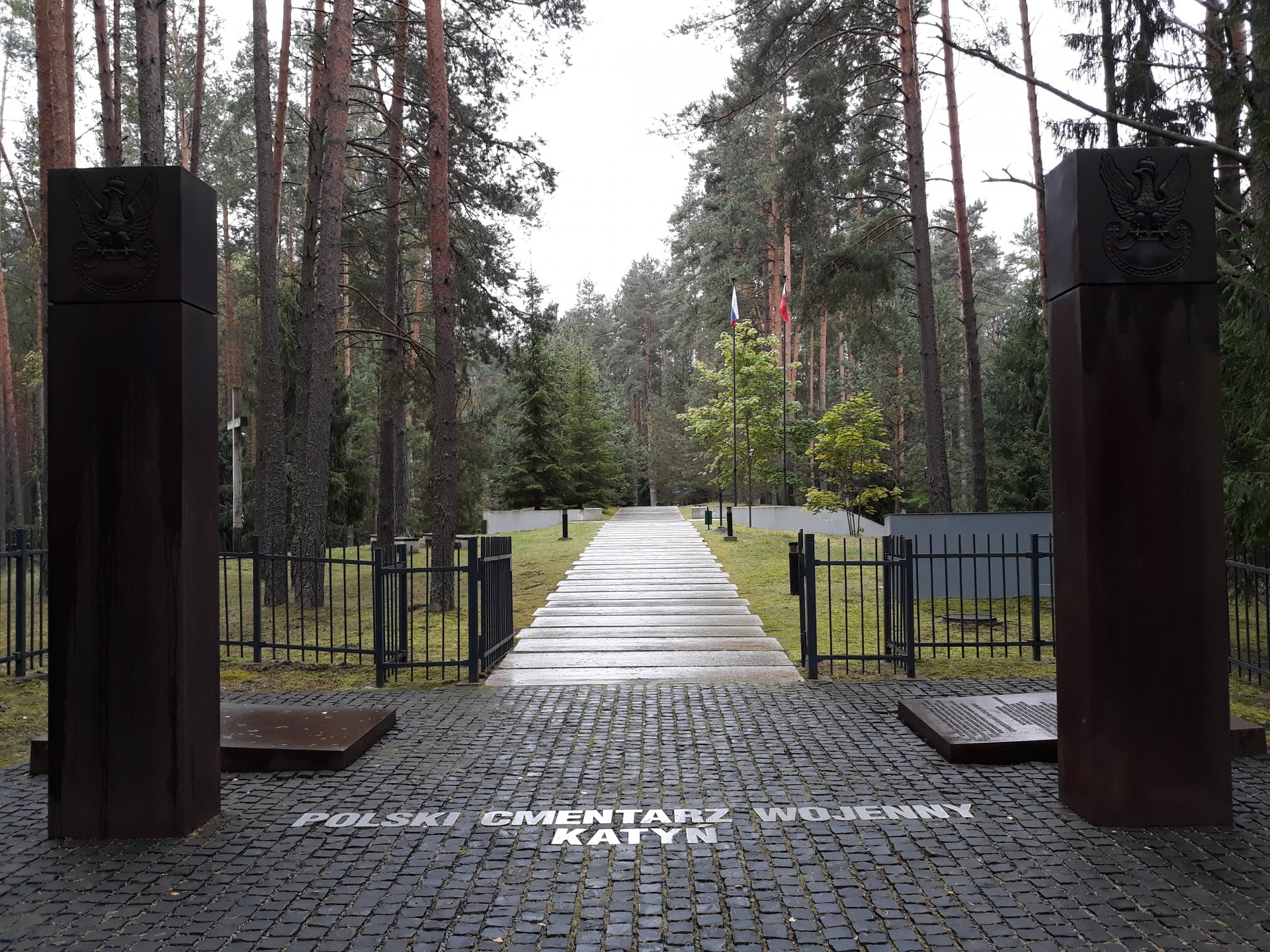
Statement by the Institute of National Remembrance on the removal of Polish bas-reliefs from the memorial in Katyn
The Institute of National Remembrance strongly condemns the act of vandalism committed by the authorities of the Russian Federation at the War Cemetery in Katyń by removing the bas-reliefs depicting the Polish Virtuti Militari War Order and the Cross of the September Defensive War of 1939.
According to the decision of the Russian prosecutor's office, Polish symbols: the Order of Virtuti Militari, with which Poland commemorated its victory over the Russians in 1792, and the Cross of the September Defensive War, which recalls the German-Soviet invasion of 1939, the first phase of World War II, violate the Russian Federation's regulations on cultural heritage objects and the commemoration of the Soviet people's victory in the Great Patriotic War.
The Order of Virtuti Militari was established in 1792 by the last King of Poland Stanisław August Poniatowski as a distinction for outstanding military service. It is one of the oldest military decorations in the world. It was awarded for exceptional bravery to both soldiers and military units. The decoration has five classes, the highest of which is the Grand Cross.
The Cross of the September Defensive War honours the heroes who defended Poland in 1939, and pays tribute to their sacrifice. Both decorations embody the continuity of the Polish struggle for freedom. Together, they reflect Poland's path towards independence, and preserve the memory of the determination and courage shown by many generations.
The Cross of the September Defensive War of 1939 highlights the Polish struggle against two totalitarian regimes: German National Socialism and Soviet communism. Contrary to the claims of the Russian authorities that these decorations are Russophobic, they were established to commemorate specific historical events and the heroism of soldiers. Their significance is rooted in the fight for Polish independence, not in contemporary or national prejudices.
***
Russian historiography has often dated the beginning of World War II to 21 June 1941, when Germany invaded Soviet Russia. However, this view does not align with historical facts. The criminal pact signed in August 1939 by the two totalitarian regimes – the Molotov–Ribbentrop Pact, along with its secret protocol dividing spheres of influence in Europe – directly triggered the outbreak of World War II, and its implementation marked the first stage of the conflict.
It’s important to remember that under this pact, Germany and Soviet Russia jointly invaded Poland in September 1939, partitioned it, and established a common border, before proceeding to occupy additional territories. Before Germany turned against its Soviet ally, it attacked Norway, Denmark, Western Europe, Greece, and Yugoslavia. Before Stalin’s Russia was forced to defend itself against the German Reich, it seized the Baltic States, Finland, Romanian Bessarabia, and Northern Bukovina.
In 1939, Soviet Russia invaded Poland in coordination with the German Reich. In 1944–1945, after heavy losses among its own soldiers, Russia took Polish territory from Germany only to impose a puppet government and establish a communist regime against the will of the Polish people. Repression by the Red Army, the NKVD, and security services controlled by Polish communists affected hundreds of thousands of Polish citizens.
According to Article 5a(1) of the Act of 1 April 2016 monuments may not serve the purpose of commemorating individuals, organizations, events, or dates that symbolize communism or any other totalitarian system, nor may they in any way promote such a system. The law also provides for the removal of any monuments referring to individuals, organizations, events, or dates symbolizing the repressive, authoritarian, and non-sovereign system of power in Poland from 1944 to 1989.
All war cemeteries where Red Army soldiers are buried are under the care of the Republic of Poland. In doing so, Poland adheres not only to international agreements but also to the Act of 28 March 1933 on war graves and cemeteries, which explicitly requires that graves and war cemeteries—regardless of the nationality, religion, or military unit of those buried—be preserved and treated with due respect.
The Institute of National Remembrance urges the authorities of Russia’s Smolensk Oblast to restore the damaged reliefs, which are an integral part of Poland’s national identity and historical memory. The destruction of such sites of remembrance is conduct unworthy of civilized nations.