
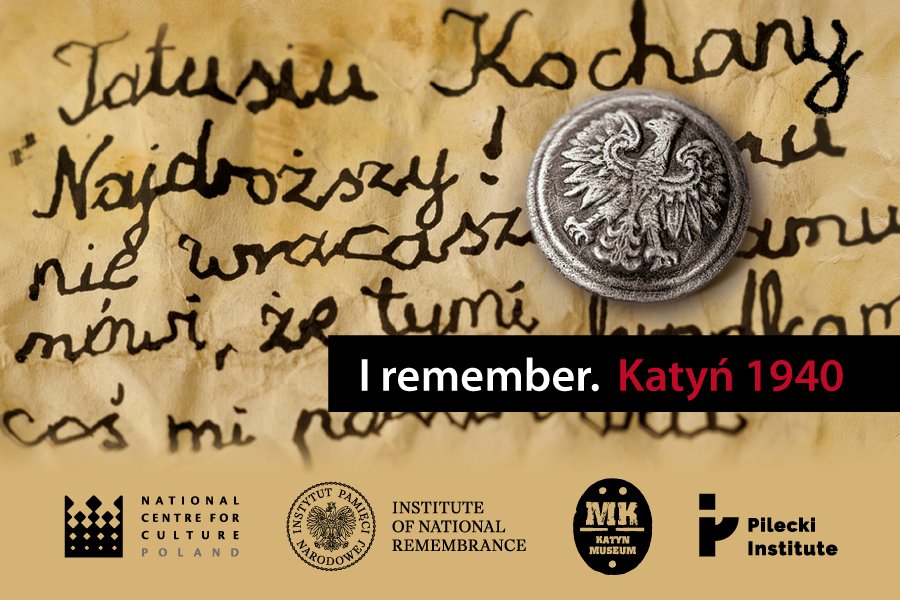
In connection with the approaching 86th anniversary of the Katyn Massacre, we have launched the next edition of the nationwide social and educational campaign “I Remember. Katyń 1940”. A commemorative pin - a replica of a military uniform button, inspired by Zbigniew Herbert’s poem has been chosen as the the symbol of the initiative.It serves as a sign of remembrance of the victims of the Katyn Massacre and an expression of opposition to the falsification of one of the most tragic chapters in Polish history.
The campaign is organized by the National Centre for Culture, the Katyn Museum, the Pilecki Institute, and the Institute of National Remembrance.
The Katyn Massacre
In the spring of 1940, on the orders of the highest authorities of the Soviet Union, Soviet forces carried out the mass murder of over 22,000 Polish citizens. Among the victims were officers of the Polish Army, policemen, reservists, as well as doctors, teachers, lawyers, civil servants, and scholars.
Mass graves were discovered in Katyn, Kharkiv, Mednoye, and Bykivnia. The truth about these events was suppressed during the communist era in Poland. Although the USSR admitted responsibility for the crime in 1990, contemporary Russia has returned to promoting the so-called Katyn lie. The perpetrators have never been brought to justice before an international tribunal.
The Katyn Button: Campaign and Social Initiative
The Katyn button is a central element of the “I Remember. Katyń 1940” campaign, first launched in April 2007 by the National Centre for Culture, in the lead-up to the premiere of Andrzej Wajda’s film “Katyń.”
Continuing this long-standing campaign has gained particular significance in recent years, especially in the context of Russia’s aggression against Ukraine and the resurgence of anti-Polish rhetoric.
As Dr Rafał Kościański, spokesperson for the Institute of National Remembrance, explains:
“Today we are witnessing the return of the Kremlin’s imperial policy, including a revival of Russian propaganda claiming that the Katyn Massacre was committed by the Germans.”
A symbolic manifestation of this trend was the removal in 2025, by Russian authorities, of Polish military symbols from cemeteries in Mednoye and Katyn, including the Virtuti Militari Order - awarded to commemorate Poland’s victory over Russia in 1792 - and the September Campaign Cross, recalling the German-Soviet invasion of Poland in 1939.
Victims of the Soviet Crime
The commemorative pins will be accompanied by plaques featuring profiles of twenty selected victims of the Katyn Massacre, whose stories will be highlighted in the campaign’s informational outreach, including that on social media.Each button represents a single human life - abruptly ended and, for many years, deliberately obscured.
The “Pin the Button of Remembrance” initiative
From April 11 to 13, as part of the “Pin the Button of Remembrance” initiative, the pins will be available at locations including the Katyn Museum in Warsaw, Kordegarda (the National Centre for Culture gallery on Krakowskie Przedmieście), IPN branches and sub-branches across Poland, as well as at the Pilecki Institute in Warsaw and its branches in Augustów (the House of Remembrance of the Victims of the Augustów Roundup), Berlin, and New York. Pins will also be distributed to individuals and organizations engaged in local initiatives in Poland and abroad.
Educational Package
An important component of the project is an educational package prepared for schools by the campaign partners. It includes, among other materials, the mini-series “Sztafeta”, which tells the story of a teenager searching for information about the fate of his great-grandfather murdered in Katyn.
The package also features the audiovisual material “I Saw It with My Own Eyes” - a testimony by Józef Mackiewicz illustrated with photographs from the Katyn Museum’s collection - as well as the virtual exhibition “Niepamięci”, an artistic narrative about the fate of Poles imprisoned in Soviet labor camps.
The “I Remember. Katyń 1940” campaign is an expression of care for historical memory and responsibility for the truth. In the face of contemporary attempts to distort history, it plays a vital role in fostering an informed and conscious civic community - both in Poland and abroad.
Calendar of Events
- Workshops titled “The Katyn Investigation” (Institute of National Remembrance- various cities across Poland)
- Warsaw, April 10–20: Mini-exhibition of Katyn artifacts, including the original book “The Truth About Katyn” by W. Wasilewska (Pilecki Institute)
- Warsaw, 12 April: Anniversary commemorations at the Katyn Museum with the participation of victims’ families and the opening of a new temporary exhibition
- Warsaw, 12 April: Katyn March of Shadows through the streets of Warsaw
- Warsaw, 13 April: Distribution of Katyn buttons at Kordegarda gallery Augustów, 13 April: Educational events in schools (Pilecki Institute)
- Berlin, 13 April: Lecture and debate on the discovery of the Katyn graves
- New York, 13 April: Informational campaign at the Pilecki Institute and the Katyn Memorial in Jersey City
- Warsaw, 13-20 April: Educational week with workshops for students at Dom Bez Kantów
- Warsaw, 15 April: Historical debate on the Katyn lie at the IPN Central “History Point” in Warsaw