
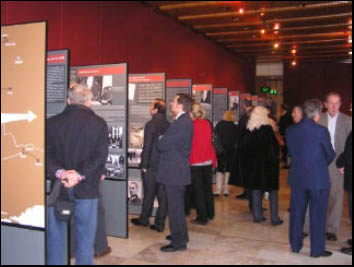
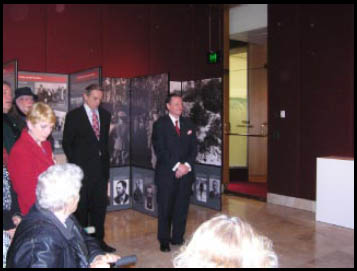
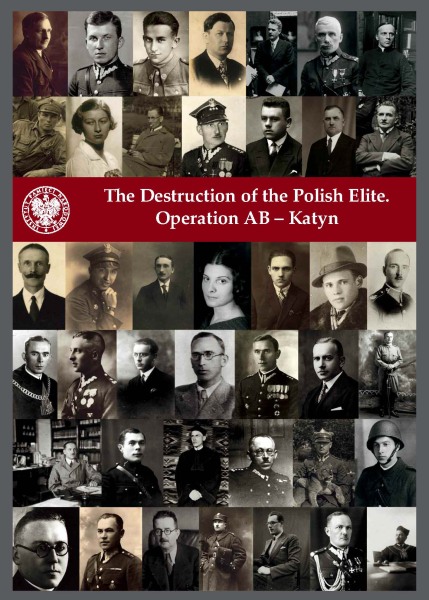
On July 7, at the Parliament of the New South Wales in Sydney a ceremonial opening of the exhibition „The Destruction of the Polish Elite. Operation AB – Katyń” took place. The exhibit was prepared by the IPN’s Public Education Office in cooperation with the Federation of Polish Associations in New South Wales. It was available to visitors at the NSW Parliament until July 30, and presented in English.
On March 15, 1940, in German-occupied Poznań, at a meeting of commanders of detention camps, SS Commander Heinrich Himmler said: „All the professionals of Polish descent should be used in our defence industry. Later, all Poles will disappear from the world. ... It is therefore necessary that the great German nation focuses on annihilating all Poles.”
The Third Reich planned to eliminate the Polish “leadership element” even before the outbreak of war. Proscription lists were drawn up with 80,000 Poles designated for elimination. The lists included e.g. political activists, former participants of anti-German risings in Silesia and Greater Poland in 1918–1921, leaders of civic organizations, teachers, Catholic priests, and judges. From the beginning of German occupation, these plans were carried out in two ways. Poles were either killed in mass executions or sent to concentration camps. The killings were carried out primarily by operational groups of the Security Police (Einsatzgruppen der Sipo) which entered into Polish territories following the Wehrmacht units. Here, they were joined by Selbstschutz units, consisting of local Germans, led by SS officers who arrived from the Reich. As part of „political cleansing” of the territory, the Germans killed about 50,000 people. The mass deportation to concentration camps conducted in April and May 1940 encompassed more than 20,000 Poles.
In 1939–1941, the Soviet authorities conducted very similar operations against Polish citizens in the occupied eastern areas of the Polish Republic. More than 100,000 people were arrested, and more than 300,000 deported to the east into the depths of the USSR. The memory of the Katyń Massacre and almost 22,000 Polish Army officers, policemen and political prisoners murdered by decision of the Political Bureau of the Central Committee of the VKP(b) of March 5, 1940, is still living among Poles.
The occupiers were killing both those members of Polish elites who immediately resisted them, and those who posed even the slightest potential threat. In fact, the extermination attempted to transform the Polish nation into a cultureless society. Given that the annihilation of the Polish elites lasted — with varying intensity and determination — until 1956, it is reasonable to ask once again the questions about the effectiveness of the action symbolized by AB and Katyn operations and their impact on the identity of the Polish nation. Has the extermination of a considerable part of the elite in the period 1939–1956 changed us? Did it help the Communists to create “new elites” after 1944/1945 ? What was the long-term societal impact of the communist state structures and the „new elites” created by them?
The exhibition „Destruction of the Polish Elite. Operation AB — Katyń”, in addition to presenting horrifying crimes perpetrated on the Polish society by the two biggest 20th-century totalitarian regimes, poses questions about the scope of mutual cooperation of German Nazis and Soviet Communists. It also gives a true picture of the activities of the occupation authorities, whose purpose was — as cynically announced on September 18, 1939 — „to restore peace and order in Poland, destroyed as a result of the collapse of the Polish state, and to help Polish people rebuild the conditions for their political existence”. As demonstrated during the entire period of German and Soviet occupation and of the Polish People’s Republic, a significant part of the society refused to uphold such vision of foreign power in Poland — which allows us today to be a free people living in a sovereign state.
Prof. Janusz Kurtyka
President of the Institute of National Remembrance
Exhibition „The Destruction of the Polish Elite. Operation AB — Katyń” was divided into several thematic blocks. In the first, the Soviet-German political and military alliance in the years 1939-1941 was shown, as well as a joint invasion of Poland, its partition and occupation, during which the cooperative powers introduced the genocidal policy towards the citizens of the conquered country. In the next blocks there were presented both criminal operations of 1940, first the Katyń Massacre, and then the AB Operation. There were reconstructed preparations for the crime, its course and the major culprits. Authors of the exhibition tried as well to show some profiles of the victims, including the families of Czarnkowie, Wnukowie, Dowbor–Muśniccy and Chrzanowscy, which were, victims of both aggressors. The recapitulation of the exhibition is an attempt to show the balance of the genocidal operations’ , depicting their geographical range and the fact of a lack of a punishment for the vast majority of the Third Reich and the USSR officers, who were responsible for crimes, and particularly the lack of a punishment for the perpetrators of the Katyń Massacre.