
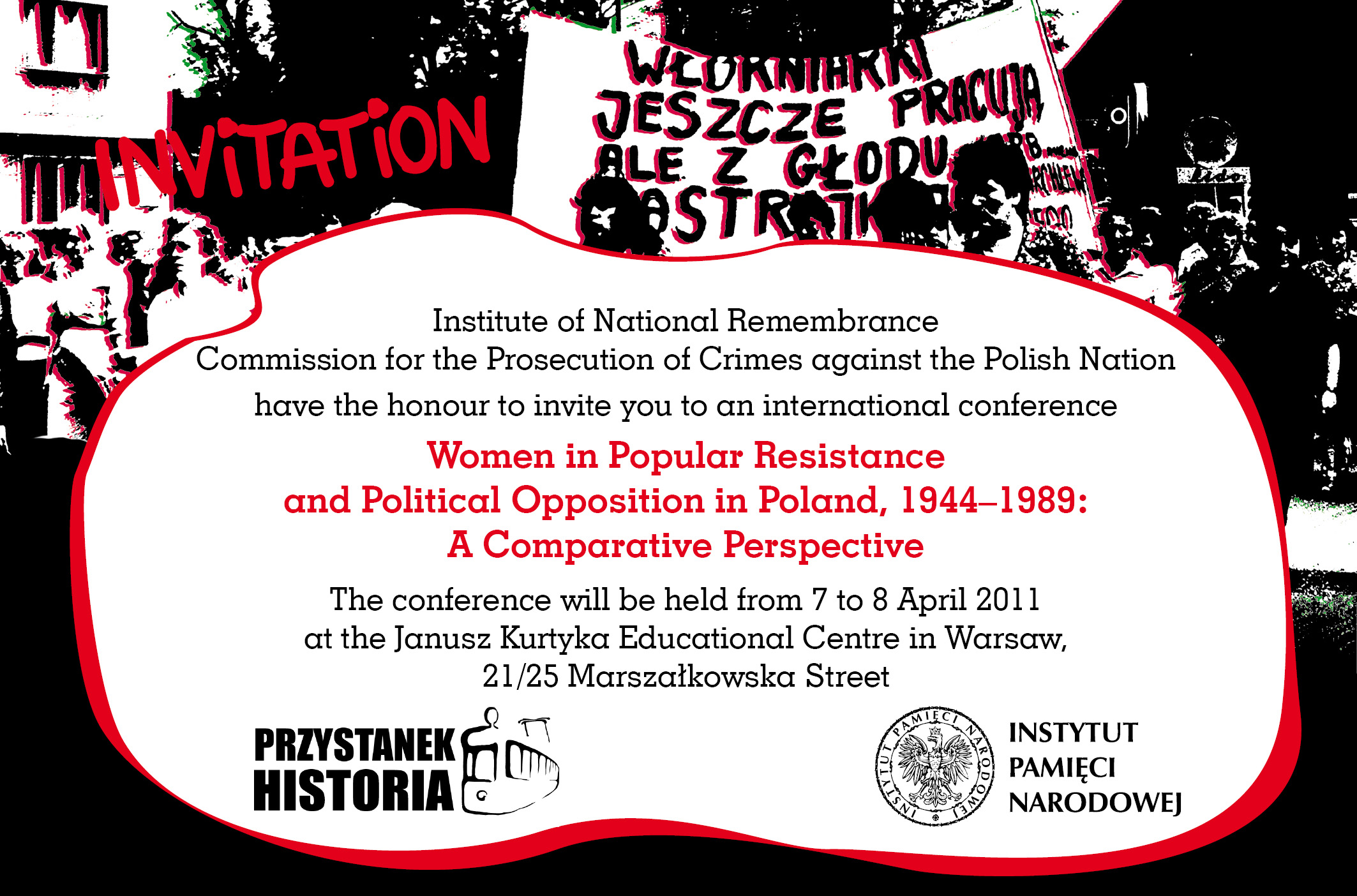
INTERNATIONAL CONFERENCE
WOMEN IN SOCIAL RESISTANCE AND OPPOSITION IN POLAND 1944–1989:
A COMPARATIVE PERSPECTIVE
Institute of National Remembrance
the Janusz Kurtyka Educational Centre, 21/25 Marszałkowska Street.
Warsaw, 7–8 April 2011
The history of social resistance and opposition in the People’s Republic of Poland raises great interest among researchers of contemporary history, which is reflected in numerous scientific publications. However, the issue of gender rarely appears in these studies. It seems worth considering whether there were specific forms of women’s involvement in the opposition and resistance that have not yet been sufficiently investigated and described. Women took part in strikes, actively opposed the religious policies of the state, participated in the opposition of the 70’s, the “Solidarity” and the underground activities of the 80’s. The specificity of their engagement and experience, as well as the role of gender in conflicts with the state seem to require a discussion that will allow better understanding of the political and social history of the People’s Republic of Poland.
The aim of the conference entitled “Women in social resistance and opposition in Poland 1944–1989: a comparative perspective” was to increase the knowledge on this subject and create an occasion for the abovementioned discussion. In order to offer a wider context for the investigated phenomena, one of the panels were dedicated to women’s participation in social resistance and opposition in other communist countries.
The conference was held in Polish and English (with simultaneous interpretation). Admission free.
PROGRAM
7 April 2011
9.00–9.05 – Opening of the conference
9.05–11.40 – Session I – Repression
Chair – DR HAB. GRZEGORZ MIERNIK
– DR MARCIN ZAREMBA (Poland), Sexual violence towards women in Poland straight after the Second World War.
– DR ANNA MULLER (Poland/USA), “Between resistance and the will to survive”: An attempt to elaborate the notion of resistance using the example of Stalin era female prisoners.
– AGNIESZKA SŁAWIŃSKA (Poland) The camp for juvenile female political offenders in Bojanowo.
TOMÁŠ BURSÍK (Czech Republic) We have lost a lot of time… Female prisoners of the 1950s and 1960s in Czechoslovakia.
– VIRGINIA ION (Romania), Women in prisons of Communist Romania: Arrests of members of families of pre-Communist dignitaries.
– Discussion
11.40–12.00 – Coffee break
12.00–13.00 – Session II – Everyday life and passive resistance
Chair – DR MAŁGORZATA FIDELIS
– DR HAB. MÁRIA PALASIK (Hungary), Mothers, wives, daughters and sisters in Hungarian society between 1945 and 1956: Women in everyday life during the revolution and reprisals.
– KATARZYNA FLORCZYK (Poland), Resistance as resilience: The practices of women’s resistance in Poland, 1945–1956.
– Discussion
13.00–15.00 – Lunch break
15.00–17.10 – Session III – Economic resistance and strikes
Chair – DR MARCIN ZAREMBA
– DR HAB. GRZEGORZ MIERNIK (Poland), Women’s resistance against the collectivization of agriculture in Poland.
– DR MAŁGORZATA FIDELIS (Poland/USA), The heroines of labour and rebels: Women’s strikes in Żyrardów, 1945–1951.
– DR ADAM LESZCZYŃSKI (Poland), What were “female strikes”? “Solidarity”, 1980–1981 and gender.
– DR MAŁGORZATA MAZUREK (Poland), Racketeers and inspectors: Women on the two sides of the postwar “battle against profeteering”.
– Discussion
17.10–17.30 – Coffee break
17.30–19.00 – Session IV – Religion
Chair – PROF. ANTONI DUDEK
– DR HAB. RYSZARD GRYZ (Poland), “Elements attempting to disrupt public safety and order”: Women in the struggle for new churches in the Polish People’s Republic.
– MAŁGORZATA KRUPECKA (Poland), The Catholic nuns and the Communist authorities in Poland.
– PROF. DR HAB. VIRGINIJA JURENIENE (Lithuania), Family in Lithuania – a hearth of passive resistance against the Soviet occupation.
– Discussion
8 April 2011
9.00–11.00 – Session V – Political opposition and dissent, part 1
Chair – DR ŁUKASZ KAMIŃSKI
– AGNIESZKA KLARMAN (Poland), The magazines published by the Women’s Section of the Polish Peasant Party.
– DR BARBARA KIJEWSKA (Poland), Women in the democratic opposition in the Gdańsk Region, 1976–1980.
– MARTINA HYNKOVÁ (Czech Republic), The gendering of the Czech opposition movement: The typology of the role of some female participants.
– SHANA PENN (USA), The gender of anti-Communist opposition in Czechoslovakia and Poland: A comparative examination.
– Discussion
11.00–11.25 – Coffee break
11.25–13.00 – Session V – Political opposition and dissent, part 2
Chair – DR ŁUKASZ KAMIŃSKI
– DR SHEILA SKAFF (USA), Women filmmakers of the opposition.
– IEVA GUNDARE (Latvia), Female dissidents of Latvia: Maija Silmale and Lidija Lasmane-Doronina.
– CRISTINA PETRESCU (Romania), Women confronting Romanian Communism: retreat into professional niches vs. acts of open dissent
13.00–15.00 – Lunch break
15.00–16.20 – Session VI – “Solidarity” and underground opposition movement in the 1980s., part 1
Chair – DR ADAM LESZCZYŃSKI
– DR ADAM MIELCZAREK (Poland), Women – ordinary activists of the underground opposition movement in the 1980s in the light of survey research.
– JAN OLASZEK (Poland), The role of women in the underground movement in Warsaw in the 1980s.
– DR ŁUKASZ KAMIŃSKI (Poland), Women in the Fighting Solidarity.
– NATALIA JARSKA (Poland), On the other side: Wives and mothers of the internees.
16.20–16.40 – Coffee break
16.40–18.00 – Session VII – “Solidarity” and underground opposition movement in the 1980s., part 2 (Statements)
Chair – DR ADAM LESZCZYŃSKI
– JOANNA KARBARZ-WILIŃSKA (Poland), Ewa Kuberna and her opposition activities in the 80s: The autorities’ reprisals aganist a woman from Stalowa Wola.
– EMILIA ŚWIĘTOCHOWSKA-BOBOWIK (Poland), The forms of women’s participation in Białystok opposition movement.