
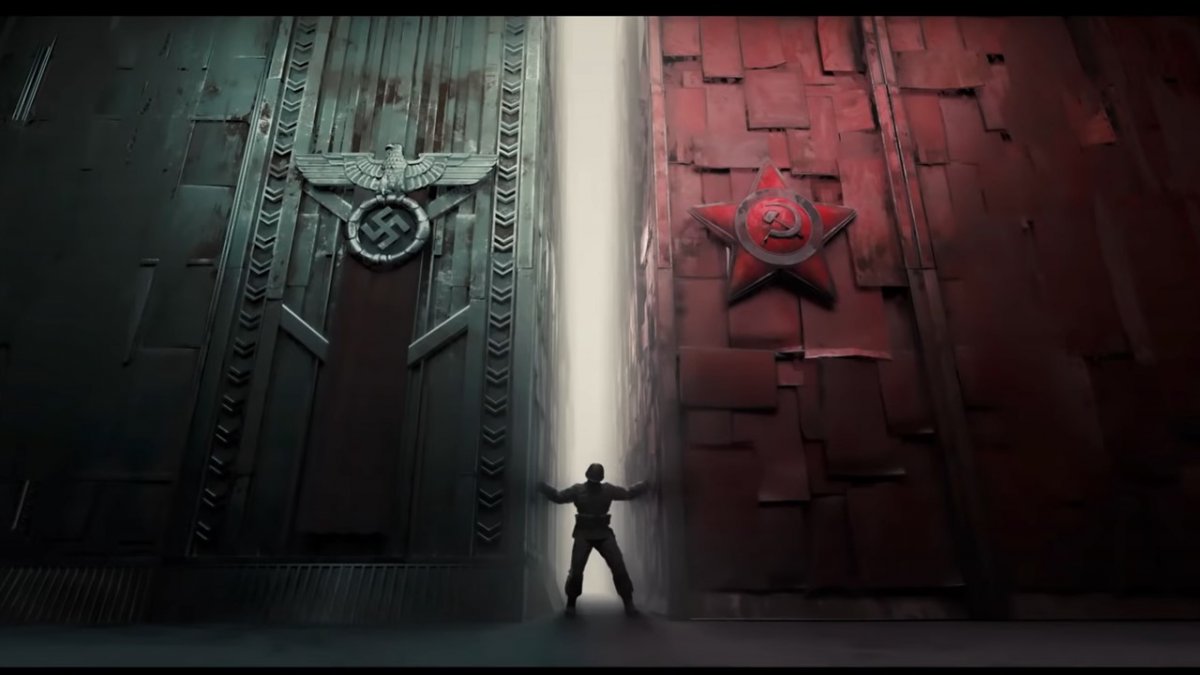
In the interwar period, the Republic of Poland was vitally interested in maintaining peace on the European continent. It concluded two non-aggression pacts with both totalitarian neighbours: in 1932 (with the USSR) and in 1934 (with the German Reich). Both agreements meant renunciation of war in mutual relations. In this way Poland intended to consolidate peace and existing borders, the Polish-German and the Polish-Soviet one.
There were no secret protocols attached to these pacts, nor were there any hidden agreements on the division of spheres of influence in Europe. Instead, there was a desire to secure Polish citizens against the threat of war and enslavement.
Signed on 23 August 1939 in Moscow, the Molotov-Ribbentrop Pact was of a completely different nature. Under the pretence of a "non-aggression pact", Germany and the Soviet Union delineated their spheres of influence in a secret protocol, dividing the territories of other independent states among themselves. In this way, both countries prepared for a policy of imperial conquests of free nations – in order to enslave them and subordinate them to totalitarian regimes of Moscow and Berlin. This pact was an introduction to the Second World War.
The current Russian attempts to rehabilitate the German-Soviet agreement of 1939 and silencing its long-term tragic consequences are nothing more than an attempt to falsify history and defend the policy of totalitarian regimes – the victims of which were not only Poles, Jews, Lithuanians, Latvians, Estonians, Romanians, Finns, Ukrainians, Belarusians and many other nations, but also Russians themselves.
The German Reich, after terminating the 1934 declaration, invaded Poland on 1 September 1939. The Soviet Union broke the 1932 pact with its armed invasion of Poland on 17 September 1939, in alliance with Adolf Hitler.
The Institute of National Remembrance reminds it all with its „Between the Walls. Poland 1939-1945”, an exhibition prepared on the 80th anniversary of the outbreak of World War II. It has the form of an installation inspired by the walls from the film "Unconquered" – an animated production of the Institute of National Remembrance, recognized in the world for its unconventional approach to Polish history.
The exhibition is presented in two spatial configurations. In visual, artistic and substantive terms, it touches upon the subject of the history of two totalitarianisms: the German Reich and Soviet Russia. The underlying theme of the narrative is the outbreak of World War II, its tragic consequences and the fight of Poles for freedom against the two occupiers.
Texts and photographs placed on the outer walls of the installation introduce the viewers to the dramatic reality of war.
The wall dedicated to German occupation presents terror against civilians, the Polish Underground State (including the resistance movement in concentration camps and Pilecki's report), Polish-Jewish relations (the “Żegota” Council for Aid to Jews, Jan Karski's mission, and the Warsaw Ghetto Uprising), the Warsaw Uprising, the Polish Armed Forces in the West (Battle of Monte Cassino, Battle of Britain, General Maczek’s 1st Armoured Division, the Silent-Unseen, the Polish intelligence).
On the wall dedicated to Soviet occupation the viewers can familiarize themselves with deportations, the Katyn Massacre, Soviet camps and the march of the Anders Army, as well as the Yalta arrangements that sanctioned the introduction of the communist regime in Poland.
On the inner planes of the walls one can find quoted memories of the war and photographs referring to everyday life during occupation, marked by repression and crimes. The underlying intention was to show that the occupation reality was a constant struggle for Polish citizens in the conditions of ubiquitous terror. The human, emotional perspective of the exhibition allows the visitors to experience the universal tragedy of World War II.
Opening the exhibition, the IPN’s President Jarosław Szarek said, "The Molotov-Ribbentrop Pact meant the fourth partition of Poland. After World War II, the communists wanted to erase the truth about its secret protocol, which enslaved the nations of Central and Eastern Europe.”
"Unconquered", the IPN’s film integrated into the project, presents the Poles’ courageous fight for freedom in the 20th century, from the first day of WWII to the fall of communism in 1989, and features such heroes as Witold Pilecki, Irena Sendler, Gen. Stanisław Maczek or Jan Karski.
"Nobody thought the war and its effects would last half a century for Poland. First, Germany attacks, then Soviet Russia. We don’t give up despite being left on our own. We create an underground state, complete with the government, army, schools and courts.”
The film ends with the words by Gen. Witold Urbanowicz, a former CO of world-famous 303rd Fighter Squadron, which confronted the Germans in the Battle of Britain, "We don’t beg for freedom. We fight for it.”