
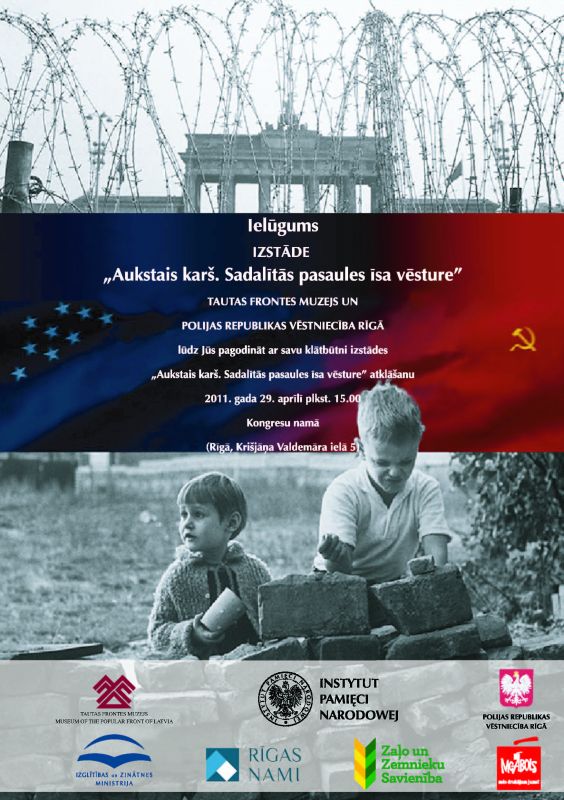
The exhibition entitled “Cold War. Short History of Divided World” was presented in the House of Congresses in Riga in the period between 29 April until 31 May 2011. It has been prepared by Warsaw Branch Office of the Institute of National Remembrance at the invitation of the Director of the Popular Front of Latvia, Meldra Usenka.The opening ceremony took place on 29 May, 2011, at 3 p.m. It was attended by Prof. Jerzy Eisler, Jacek Sasanka, PhD, and Sławomir Stępień, as well as representatives of Polish Diplomatic Corps and the state authorities of Latvia.
The vernissage was proceeded by Prof. Jerzy Eisler’s lecture on cold war. The lecture was delivered on 28 April at 4 p.m. at the Stradiņša University.
Moreover, further cooperation with IPN in the fields of education, expositions and scientific research was discussed at the meeting on 29 April at 11 a.m. at the Embassy of the Republic of Poland in Riga.
The exhibition “Cold War. Short History of Divided World” was prepared by Warsaw Branch Office of the Institute of National Remembrance in relation to the 20th anniversary of reunification of Germany.
The exhibition is an invitation to go back to the near past, to the reality of conflict which dominated Europe for over five decades after the WWII, influenced lives of millions and shaped the modern world.
The totalitarian and multifaceted character of cold war confrontation left its mark on so many different areas of life that each attempt of showing it in one place and one time would surely leave one unsatisfied.
Taking the above into consideration, the authors proposed their own, naturally subjective point of view on the cold war, folding it up into a multiplot story. Those plots include events, phenomena with their various aspects and their main characters, significant for the course of events of the conflict – but often less familiar or even forgotten.
Cold war bore traces of true war, and the term “cold” should not be misleading. The war was often even too fiery, even though open military confrontations between the superpowers were occasional. Often the description of cold war boils down to a few expressions and notions. The most often recalled are: Berlin wall, arms race, the wars in Korea, Vietnam and Afghanistan, as well as Cuban crisis. But undoubtedly few people could place in this context such events as civil war in Greece, the Kitchen Debate between Nixon and Khrushchev, the attack of communist China on the Yijiangshan island belonging to Kuomintang, or Americans’ Invasion of Grenada.
We hope that the exhibition gives opportunity to recall numerous statements that were pronounced by politicians on both sides of the cold war barricade and remained for good in the history, e.g. the speech by Winston Churchill in Fulton, with the words “an iron curtain”, the speech by John F. Kennedy in West Berlin, a year after Berlin Wall’s erection, or Leonid Brezhnev’s announcement of his doctrine (later called “Brezhnev Doctrine”).
The exhibition’s narrative is particularly strong due to photos. We tried to focus not only on the photos which are already icons of the cold war and the less familiar documentary photos, which complement the exhibition, but also on those that will be treasured in our minds and are thought-provoking. Therefore, the form of the presentation should be very favorable i.e. big, eye-catching, photo-enlargements, well arranged in space, accompanied by a few-sentence comments. Those who wish to learn more will find extensive information on several separate boards.
Thus, the exhibition’s subheading “Short History of Divided World” captures its core meaning and the authors’ intention – to reflect upon the conflict which for almost half a century had dominated the history of the world, and yet not to aspire to be comprehensive chronicle of the events.