
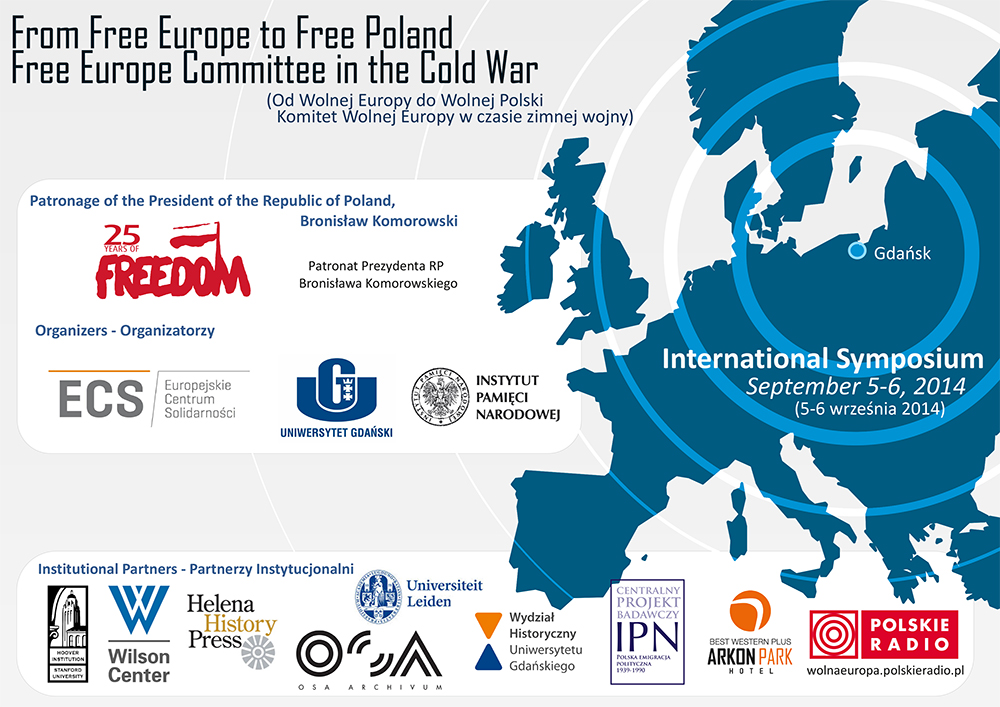
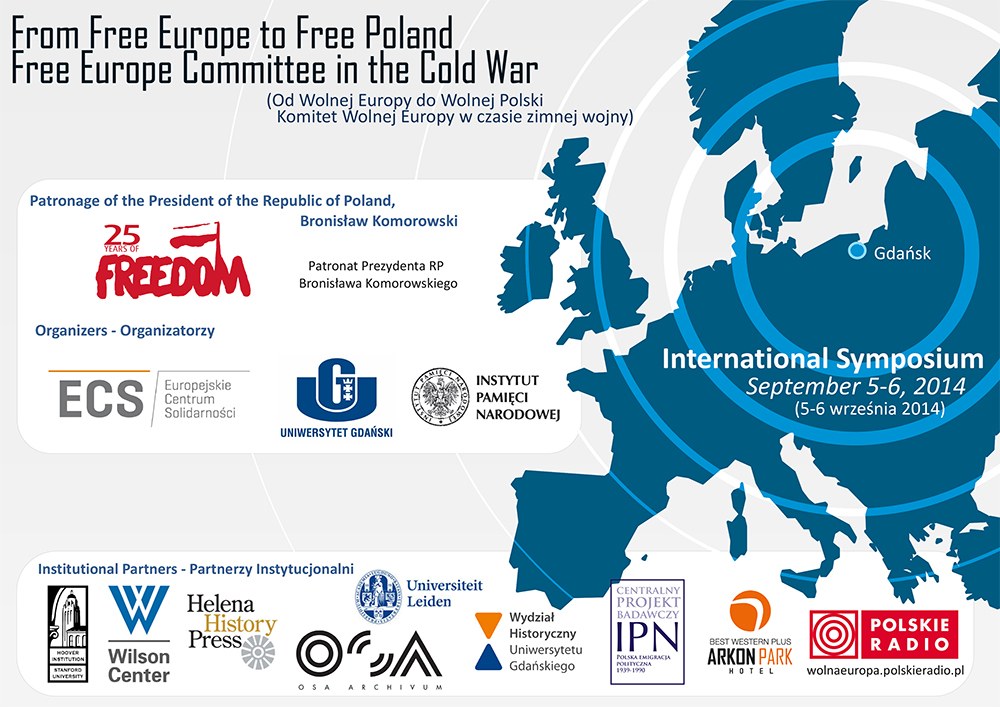
The two-day symposium, jointly organized by the Faculty of History of the University of Gdansk, the European Solidarity Center and the Institute of National Remembrance took place on 5-6 September 2014 at the University of Gdansk. Over 50 guests from all around the world – scholars, archivists from 11 countries gathered, among them guests from the United States, Great Britain, Holland, France, Germany, Hungary, Slovakia, Czech Republic as well as China. Polish scholars and archivists participated in the conference as well. The symposium comprised five discussion panels, lead by Jakub Tyszkiewicz, A. Ross Johnson, Katalin Kádár Lynn, Władysław Bułhak and Giles Scott-Smith.
The scholars participated in workshops conducted by Giles Scott-Smith and Nick Siekierski as commentator. Apart from participants already mentioned in the program, also guests from Poland and abroad interested in the subject of the symposium arrived to Gdansk.
The symposium took place under the auspices of the President of the Republic of Poland, Mr. Bronislaw Komorowski. The event was opened by representatives of the organizers – Professor Dr. Józef Arno Włodarski from the University of Gdansk, Director of the European Solidarity Center Basil Kerski, President of the IPN Dr. Łukasz Kamiński as well as the Dean of the Faculty of History of the University of Gdansk Professor Dr. Wiesław Długokęcki, who read the letter sent to the organizers by the Secretary of State in the Chancellery of the President Mr. Sławomir Rybicki. Then Mr. Witold Dzielski from the Department of Americas in the Ministry of Foreign Affairs of the Republic of Poland welcomed the guests and read a letter from Mr. Leszek Soczewica, Undersecretary of State in the MFA.
The first day of the session (Friday, 5 September 2014) included four debates: "The role of the Émigrés in early Cold War American foreign policy"; "The Origins of the Committee of Free Europe and the Launching of Radio Free Europe"; "Exile Support Programs of the Free Europe Committee"; "From Leaflets to Books: The Printed World Program of the FEC and Beyond".
The first debate was about the relations between Cold War political émigrés and the American government and intelligence. The successive panels were dedicated to the national radio stations of the Radio Free Europe (Polish, Romanian, Czechoslovakian, Hungarian) and Central European national committees in the United States, supported by the Free Europe Committee. Committees comprised of representatives of Baltic countries, Hungary, Romania and Czechoslovakia were described. The last session of the day was extraordinary – scholars were joined on stage by history witnesses. After a theoretical introduction on second circulation publishing, the audience could listen to personal testimonies connected to the printing of publications forbidden behind the Iron Curtain, the smuggling of papers into the country and their further distribution.
The Ambassador of the United States to Poland Stephen D. Mull, honored the Saturday's session with his arrival. His speech touched upon the activities undertaken by the American diplomacy in order to support free media in Central and Eastern Europe in the past and today. Mr. Mull, known for the effective use of social media tools, referred to his experience from the 80's, when he was actively supporting the Polish opposition. The presentation of the Ambassador was a great introduction into the discussion about access to information during Cold War, which was the subject of debate during the last session – "Crusade for Freedom: Impact in America and behind the Iron Curtain."
At noon a special guest, the President of Estonia Mr. Toomas Hendrik Ilves arrived to the campus of the University of Gdansk. He gave an excellent speech on the risks in Central and Eastern Europe and underlined the necessity for European solidarity in the protection of countries – victims of aggression.
Owing to the cooperation with publishers, during the symposium it was possible to learn about the most recent publications on the discussed subject matter from Poland, Europe as well as the United States.
The Ministry of Foreign Affairs of Poland supported the organization of this unique international event which brought together scholars working on Cold War in Gdansk, the "free city." Other partners included the Hoover Institution Archives from the Stanford University, Open Society Archives from the Central European University in Budapest, Woodrow Wilson Center, Universiteit Leiden and the publishing house Helena History Press from the United States.
Polish Radio has devoted a special website to the Radio Free Europe (www.wolnaeuropa.polskieradio.pl) and published a report from the symposium (available in Polish) http://www.polskieradio.pl/13/53/Artykul/1224306,Od-Wolnej-Europy-do-Wolnej-Polski-Komitet-Wolnej-Europy-w-czasie-zimnej-wojny-
The whole symposium translated into Polish is available on IPN TV https://new.livestream.com/ipn-live/free. A report will soon be published one of the conference partners, the Woodrow Wilson International Centre.