
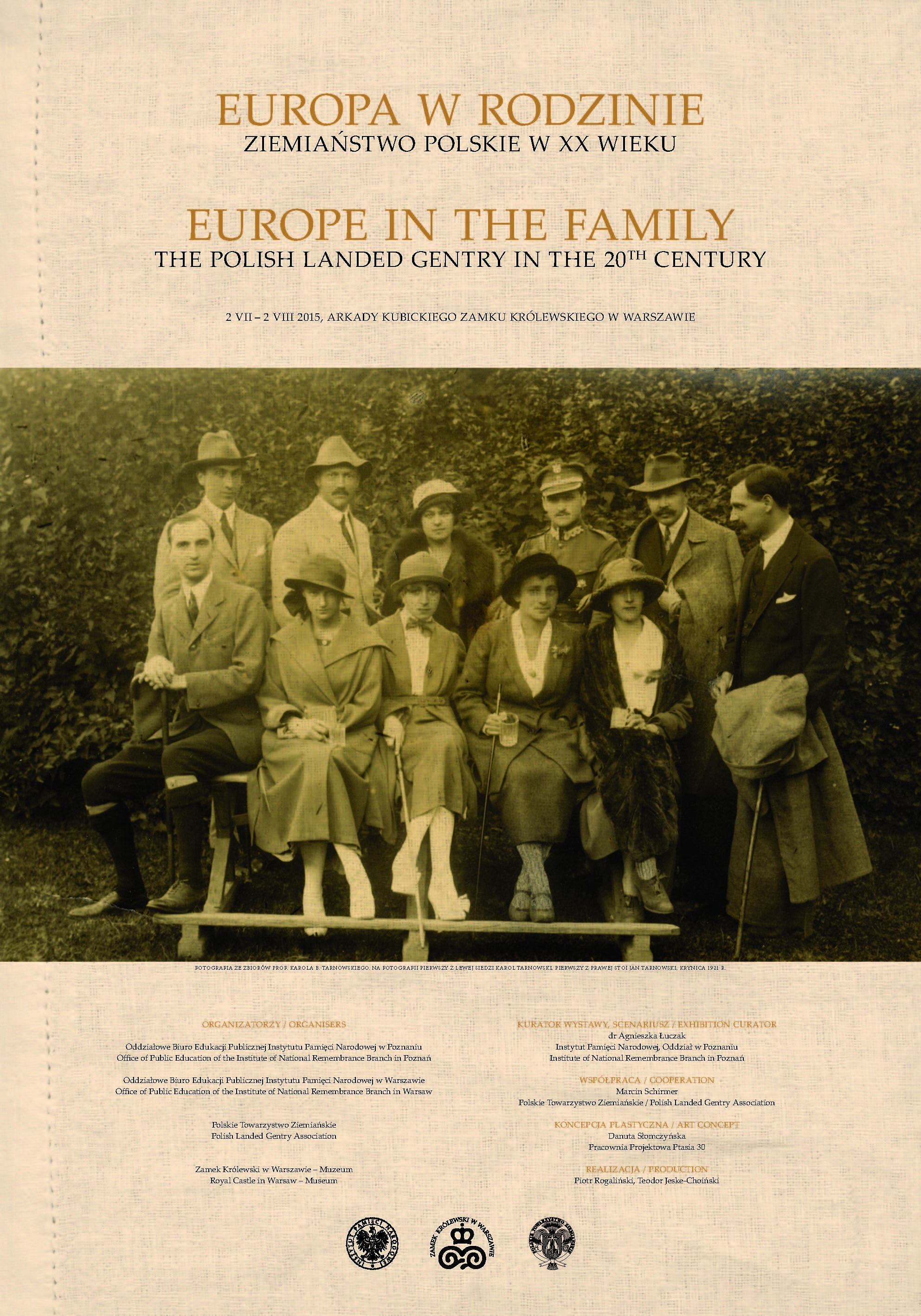
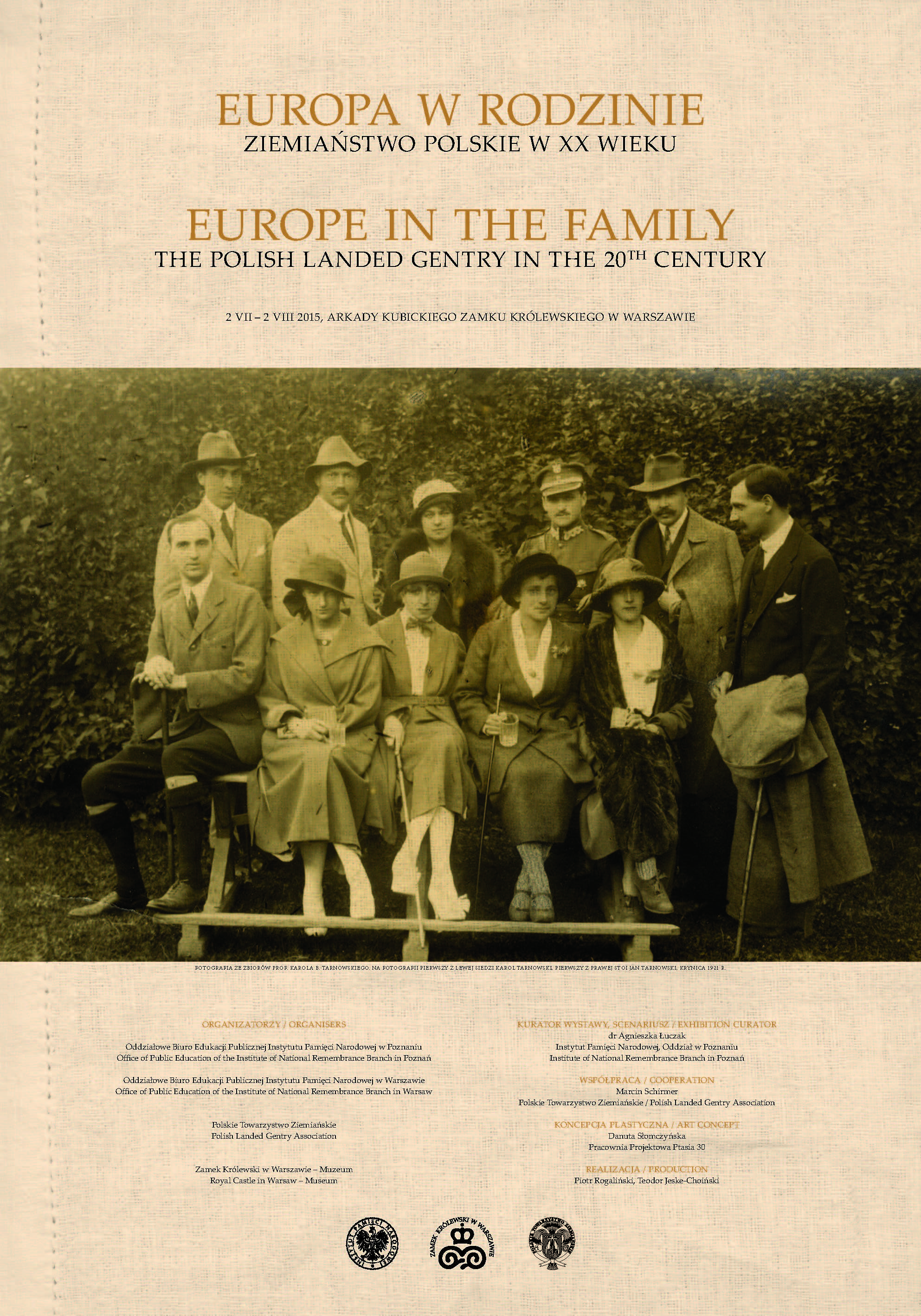
Witold Lutosławski, Józef Czapski, Witold Gombrowicz, and Captain Witold Pilecki are famous figures in the 20th century history of Poland and Europe. What do these, so different, figures have in common? The four men came from landed gentry families, whose lifestyle was based on specific traditional values. „Noble birth means, first and foremost, having more duties, not only privileges,” wrote Wincenty Lutosławski in 1939. The landed gentry played a role of local social leaders. The exhibition also talks about the destruction of this social group during 1939–1945 by the Nazi and the Soviet totalitarianism, its dispossession by the communist regime, and the dispersion of Polish landed gentry families all over the world. The authors wish to paint a collective portrait of the milieu and tell stories of the individual families to let all visitors reflect on the loss suffered with the liquidation of this social stratum.
Organisers:
Office of Public Education of the Institute of National Remembrance Branch in Poznań
Office of Public Education of the Institute of National Remembrance Branch in Warsaw
Polish Landed Gentry Association
Royal Castle in Warsaw – Museum
Art concept:
Danuta Słomczyńska (Ptasia 30 Design Studio)
Exhibition curator:
dr Agnieszka Łuczak (Institute of National Remembrance, Branch in Poznań)
Cooperation:
Marcin Schirmer (Polish Landed Gentry Association)
Scientific consultation:
Prof. dr hab. Andrzej Kwilecki
Reviewers:
dr Łukasz Lubicz-Łapiński
Sławomir Stępień
"The Polish Landed Gentry in the 20th Century” exhibition […] will surely become a cultural sensation of 2015. I expect that the society will take keen interest in it. This is a good occasion to recall an exhibition from the last century, opened in 1929 to commemorate the tenth anniversary of Poland regaining her independence, that is, the Public National Exhibition (Powszechna Wystawa Krajowa, commonly referred to as „PeWuKa”) organised in Poznań, with a separate section devoted to the landed gentry. The reason why I mention that popular exhibition is that it was the most momentous event in the life of the landed gentry milieu during the entire period of the Second Republic of Poland: it emphasised the landed gentry's contribution to the preservation of Polishness during the partitions and the subsequent rebirth of the Polish state after WWI; it tried to convince the government of the great importance that vast land estates had for the economy; and it also showed that the landed gentry milieu had substantial organisational potential and that many of its representatives had ambitions to change the country and society. And it became a meeting place for the landed gentry arriving from all parts of the country.
During the period between the 1929 and 2015 exhibitions there were events and changes in Poland with tragic consequences for the landed gentry. First, came the difficulties and losses occasioned by the Great Depression during 1929–1934; then during WWII the landed gentry suffered the persecutions and extermination policy implemented by the two occupiers; and after the war, in communist Poland, the landed gentry were removed from their manors and their property was confiscated.
The exhibition „Europe in the Family…” shows the altered historic circumstances. The visitors will be moved not only by the tragic situations and fates, but also by the landed gentry's resistance to life hardships and their ability to adapt and maintain family ties despite territorial dispersion.
In this context I feel I must quote Ludwik Gumplowicz, a classic Polish sociologist, who over a hundred years ago declared adaptation the most important social process pertaining to both groups of people and individuals.
Those adaptive skills of the Polish landed gentry of the 20th century might be seen today as an effect of the upbringing in manors and palaces, based on a regular rhythm of life, discipline, cultivation of tradition, respect for knowledge, and regular carrying out of duties from an early age. I think that the content of the exhibition will induce many a visitor to individual reflection and participation in the discussion on the characteristic social traits of the Polish landed gentry.
To conclude my remarks, let me mention yet another significant social function performed by the „Europe in the Family...” exhibition: by presenting new facts from the life of the landed gentry, it broadens our knowledge, and by presenting the abundance and diversity of these facts, it stimulates our imagination and induces us to formulate new questions.
Professor Andrzej Kwilecki (from his review of the exhibition)