
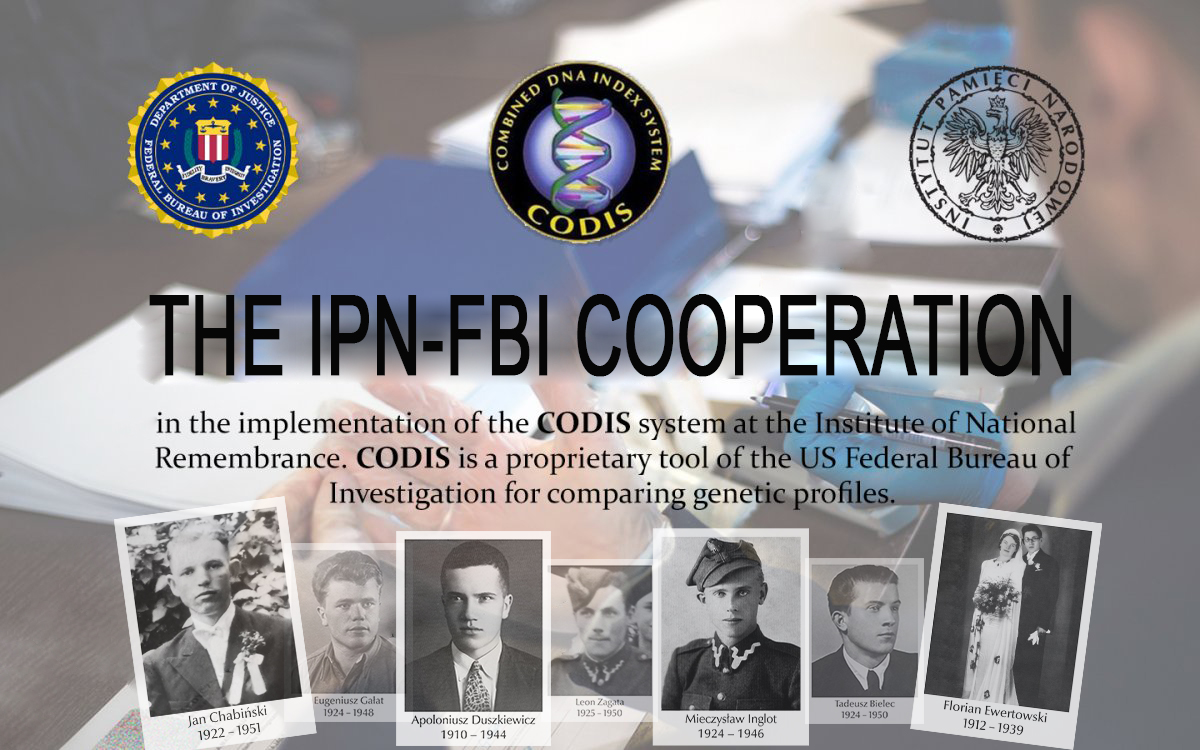
Pursuant to the Act on the Institute of National Remembrance, on 12 August 2021, during an official ceremony at the Presidential Palace, the President of the IPN publicly presented information about the identification of 26 victims of German and communist crimes. The names of five of the identified victims have been restored to national memory owing to the cooperation established by the Institute of National Remembrance with the US Federal Bureau of Investigation (FBI).
In 2016, the Polish Parliament imposed an obligation on the President of the Institute to establish and maintain a Genetic Material Database in order to identify the victims of totalitarianism. The IPN’s Office of Search and Identification was entrusted with the administration of the Database.
The need to conduct an advanced analysis of genetic data collected in the Database and the inability of Polish laboratories to provide adequate software solutions for such a task prompted the IPN to look for partner institutions outside Poland. Establishing close cooperation with the United States Federal Bureau of Investigation (FBI) turned out to be an opportunity to obtain an appropriate tool that would meet the needs of the complex process of identifying the victims totalitarian crimes on such a large scale.
The FBI has been using its proprietary Combined DNA Index System (CODIS) to identify the victims of crimes for many years. It is the best tool in the world for conducting comparative analyses for identification purposes - on the basis of DNA profiles stored in the system. The system's functionalities are both so unique and effective that the FBI makes its system available all over the world. However, only public institutions performing investigative functions can apply for a license. The system is not available to laboratories operating as part of universities or for commercial laboratories. In the United States, 203 federal, state, and local laboratories are currently using CODIS. The program has been made available and implemented in 58 countries, including Poland [source: https://www.fbi.gov/]. Until recently, the only entity in Poland using CODIS was the Central Forensic Laboratory of the Police, which performs tasks in the field of, inter alia, genetic identification for the Police and Prosecutor's Office. Due to certain legal conditions, institutional separateness and the necessity to adapt the system to the specific data collected by the Institute of National Remembrance, it was necessary for the IPN to obtain a separate license.
With the support of the Polish Minister of Justice and the Public Prosecutor General, the Institute of National Remembrance obtained the FBI’s permission to use CODIS. A cooperation agreement was concluded in 2018, and the system was launched a year later, with the participation of FBI representatives. In the period between the signing of the agreement and the launch of the CODIS system, the IPN implemented the necessary software and organizational requirements. In August 2019, experts from the US Federal Bureau of Investigation conducted a comprehensive training course for the IPN’s employees.
From September 2019, with the support of the FBI, IT solutions and improvements to the system were implemented in order to adapt the program’s identification capabilities to the specific type of genetic data at the disposal of the Institute of National Remembrance (comparative material from distant relatives). Therefore, special attention was paid to the module enabling the creation of family trees on the basis the profiles of people related to the missing person.
In 2020, methodical work of entering DNA samples into the CODIS inventory was already in progress. That genetic database made it possible to achieve the most important goal – launch the procedure of regular and unlimited search of CODIS resources with the purpose of matching samples, as well as analyzing such matches by the Institute’s forensic geneticists and biologists.
CODIS’ success is depends on the number of samples it holds. The task of the Search and Identification team is therefore to constantly expand the database. The system resources are DNA profiles determined through genetic tests contracted to external genetic laboratories under the Act on Public Procurement, as well as DNA profiles determined in the course of criminal proceedings, and subsequently submitted by the prosecutors from the IPN's investigative division who ordered them. However, for the system to be fully operational, the results of all genetic tests carried out so far as part of the investigations must be entered, which is what the team is working on. With CODIS, the in-house forensic geneticists can support prosecutors in DNA profiling, leaving the analysis of genetic data to external contractors. For the IPN’s investigative department, the FBI system is an additional tool of crime victims identification.
CODIS is a resource supporting the IPN’s Genetic Material Database, which enables effective use of its data, in accordance with the Institute’s statutory tasks. No genetic laboratory in Poland has a tool allowing methodical screening and comparing of all collected genetic profiles. In the last eighteen months, the FBI system regularly proved capable of performing a quick and accurate search of the 800 profiles in the inventory, a task that no genetic lab could carry out in such a short time. The results showed that CODIS allows for identification of victims whose DNA profiles have been in the databases of external genetic laboratories for a long time; it was the lack of an appropriate IT tool that prevented making many matches earlier. Although the support of research units performing genetic tests for the IPN is invaluable, it is the analysis of their work with a dedicated tool for processing genetic data that brings tangible results in the form of more identified victims.
More importantly, CODIS also works with incomplete profiles, so common in the case of degraded bone material that’s been in the ground for several dozen years. This key function points the experts in the right direction, making them extend the research and obtain comparative material from the victims’ relatives, even if they are from a different family line.
It was that FBI system that by August 2021 became instrumental in identifying five of the victims found by the IPN: Jan Chabiński, Apoloniusz Duszkiewicz, Florian Ewertowski, Mieczysław Inglot and Witold Sulik.
The IPN-FBI cooperation resulted in building the only genetic database in the world dedicated solely to the identification of victims of crimes committed several decades before, and each addition to the resources enhances the probability of further successes in that field.
More:
12 August 2021, Relatives received identification notes of victims of communist and German crimes