
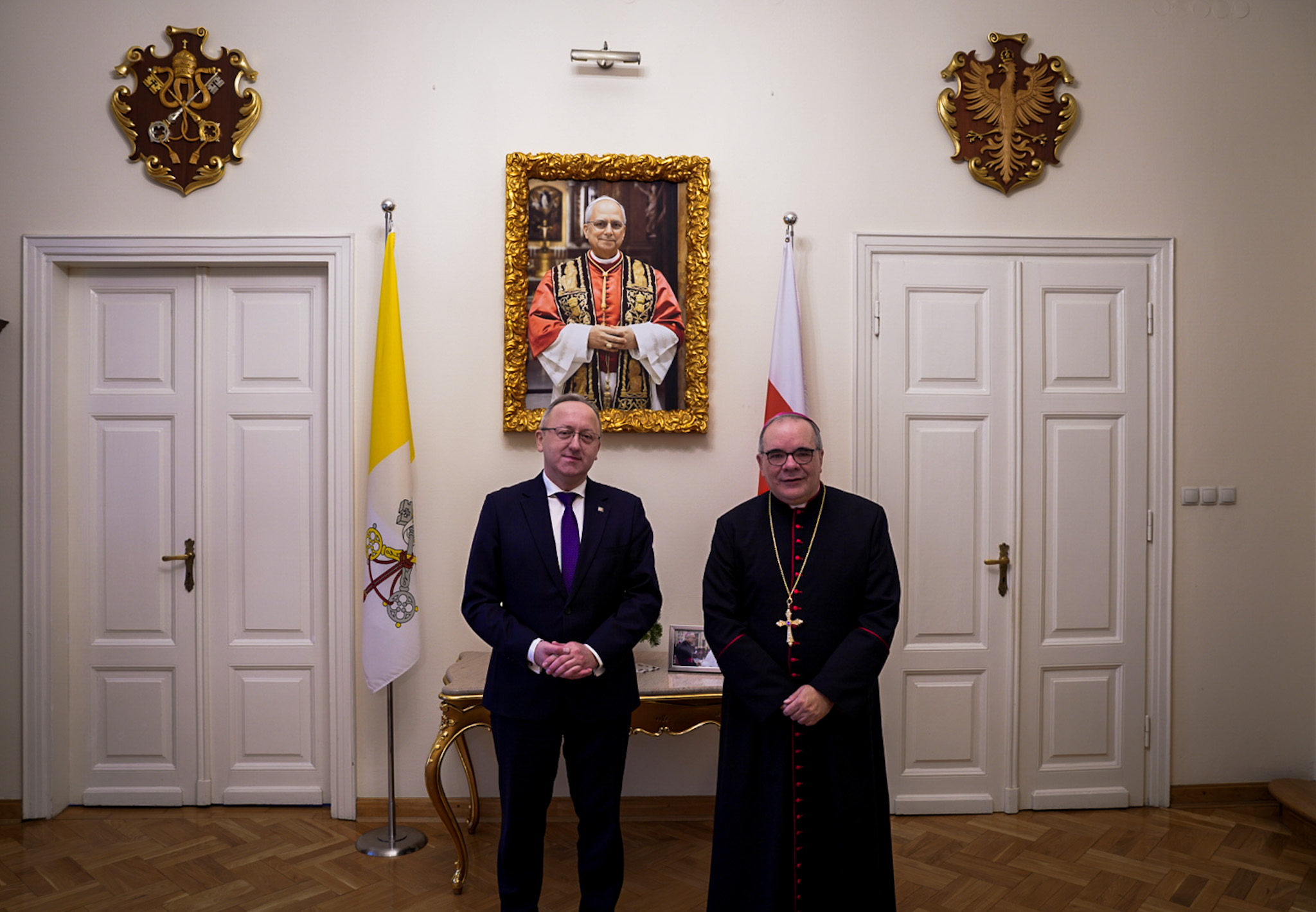
On 30 December 2025, a meeting was held at the headquarters of the Apostolic Nunciature in Poland between the Deputy President of the Institute of National Remembrance, Prof. Karol Polejowski, and the Apostolic Nuncio to Poland, Archbishop Antonio Guido Filipazzi. The discussions focused on the possibilities for joint initiatives planned for 2026.
During the visit, issues related to the upcoming 60th anniversary of the Millennium of the Baptism of Poland were discussed. In this context, reference was made to the historic 1965 Letter of the Polish Bishops to the German Bishops, in which they invited them to take part in the solemn celebrations of the millennium of Poland’s baptism in 1966.
Another topic concerned plans to organise an academic conference in Rome entitled The Holy See in Relation to Totalitarian Systems in the 20th Century – New Perspectives and Research Approaches. The event is to be prepared in cooperation with the Pontifical Gregorian University and the Pontifical Committee of Historical Sciences.
The talks also addressed cooperation with Vatican institutions. It was recalled that in September 2025 the IPN presented a copy of the Inventory of the Historical Archive of the Secretariat of State of the Holy See. The Pius XII Fonds, Volume I, prepared by Rev. Adam Szpotański, Ph.D., a staff member of the IPN Branch Office of Historical Research in Wrocław. The meeting also included information on the ongoing work on the second volume of the publication.
Prof. Karol Polejowski additionally outlined the scope of the IPN’s activities, with particular emphasis on historical research, publishing projects, and international initiatives.
In 2024–2025, Prof. Karol Polejowski, held a number of meetings, including with representatives of the Holy See, during which broadly understood cooperation in the fields of histoircal research, education, exhibitions, and publishing was established in line with the statutory tasks of the Institute of National Remembrance. Both the Vatican archives—which contain information, inter alia, on the fate of Poland and Poles during the period of two totalitarian systems, German National Socialism and communism—and the Roman milieus, which constituted spaces of freedom not only for the Polish clergy and consecrated persons but also for the émigré community, merit broader attention.
Read also: A delegation from the IPN visits the Vatican